Who Pays If a Nuclear Accident Happens? India’s New SHANTI Rules Explain the Stakes
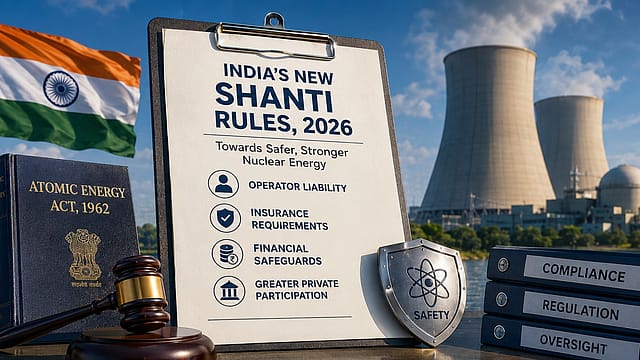
Imagine a company wants to build a nuclear power plant in India. It has the money. It has the technology. It has the site. But one question has to be settled before the reactor starts producing electricity: If something goes wrong, who pays?
That question sits at the heart of the Centre’s draft SHANTI Rules, 2026, released by the Department of Atomic Energy as India prepares for a major expansion of its nuclear sector. The rules lay down proposed provisions for operator liability, insurance, financial security, licensing, foreign reactor technology and the long-term costs of running and eventually shutting down a nuclear installation.
And behind all of it is a much bigger ambition: India wants to take its nuclear power capacity from 8.78 GW currently to 100 GW by 2047. The government has said the expansion will require a modernised legal framework and greater participation from private companies. The SHANTI Act, 2025, replaced the earlier legal framework and provides for limited private participation under regulatory oversight, according to the Press Information Bureau.

Losing Memory
16 Oct 2026 - Vol 05 | Issue 42
The making of a medical and social emergency
So, what exactly do these draft rules change?
First question: If there is an accident, who is responsible? The proposed framework puts the primary responsibility on the operator of the nuclear installation. The draft rules say the operator's liability for nuclear damage will be strict and based on the principle of no-fault liability. That means a person seeking compensation does not have to establish negligence by the operator before the liability framework can apply.
The approach builds on India's existing no-fault nuclear liability regime but comes under the new SHANTI framework, which introduces a graded liability structure depending on the type and characteristics of the nuclear installation. The government says the operator-liability limits are set out in the SHANTI Act's Second Schedule. But liability on paper is only one part of the equation. The next question is much more practical. Where will the money come from?
The operator will have to show it has the money
The draft rules require operators to maintain financial protection against nuclear damage. That protection can come through insurance, financial security, or a combination of both. India Today reported that the proposed financial security must remain in place until all spent fuel is removed from the relevant storage pool.
The draft also says financial security must be irrevocable. That is significant because the financial responsibility does not simply disappear when a reactor stops producing electricity. Nuclear facilities have long lives. Spent fuel has to be managed. Radioactive waste has to be dealt with. Eventually, the facility has to be decommissioned and the site may require remediation. The proposed rules therefore require financial arrangements to cover not just civil liability but also spent fuel, radioactive waste management, decommissioning and site remediation.
Why is this happening now?
Because India's nuclear sector is entering a very different phase. For decades, nuclear power remained largely within the government-controlled ecosystem. The SHANTI Act has now created a framework for greater private participation, while retaining government control over sensitive parts of the nuclear fuel cycle.
The government's long-term target is 100 GW of nuclear capacity by 2047. India currently has 8.78 GW, with capacity projected to rise to about 22.38 GW by 2031-32, according to the PIB. The Centre has also allocated Rs 20,000 crore under the Nuclear Energy Mission for the development and deployment of Small Modular Reactors, with a target of at least five indigenous SMRs by 2033. And private companies are already showing interest.
Major groups including Vedanta, Adani, Tata Power and Reliance Industries are reportedly positioning themselves for opportunities in India's emerging nuclear market. That makes the question of liability particularly important. Private investment may build the reactors. But the rules must establish who carries the financial risk if something goes wrong.
The rules look beyond electricity
The proposed framework is also broader than conventional nuclear power generation. The SHANTI framework covers applications including electricity, captive power, process heat, hydrogen production, medical isotopes, education, training and research.
The draft also envisages nuclear captive power for energy-intensive sectors and emerging industries such as data centres, semiconductor manufacturing, high-performance computing, quantum technologies and AI-related infrastructure. That reflects the government's larger argument for nuclear power: India needs reliable, round-the-clock electricity as its economy becomes increasingly energy-intensive.
Foreign reactor technology gets a framework too
India's nuclear expansion will not necessarily rely only on indigenous reactor designs. The draft rules propose conditions for nuclear installations based on foreign designs. Apparently a foreign reactor design would need to be certified or approved by the regulatory authority in its country of origin, with the draft defining eligible countries in terms of their nuclear design and supply-chain capabilities and the global acceptance of their regulatory approvals.
That could become important as India looks to bring in international technology while retaining regulatory oversight.
There is also a five-year review mechanism
Nuclear technology and the cost of managing nuclear risks can change over time. The draft therefore proposes that the Central Government constitute an expert group every five years to review the maximum limits of civil liability for nuclear damage. The group would include specialists in nuclear science and engineering, actuarial science, insurance and law, along with public-interest representatives. The group could recommend changes to the liability limits following its review.
The bigger picture
Put simply, the draft SHANTI Rules are trying to answer two questions at the same time. How does India build much more nuclear power? And: How does it make sure the financial responsibility for that expansion is clearly defined?
The government wants private investment, foreign technology and new applications of nuclear energy. At the same time, the framework retains government control over sensitive areas such as the nuclear fuel cycle and spent-fuel management. The SHANTI legislation also gives statutory recognition to the Atomic Energy Regulatory Board, strengthening the formal regulatory architecture. But there is one important caveat. These are draft rules. They set out the framework proposed for implementing the SHANTI Act; they are not the final version of every operational requirement.
Still, the direction is unmistakable.
India wants to build a much larger nuclear sector. And as private companies prepare to enter a field once dominated by the state, the government is putting something equally important alongside that ambition: a rulebook for who carries the risk, how that risk is financed and what happens long after a reactor stops running.
(With inputs from ANI)