Cheaper BMWs and Beer? Inside India’s Biggest Trade Deal with the EU
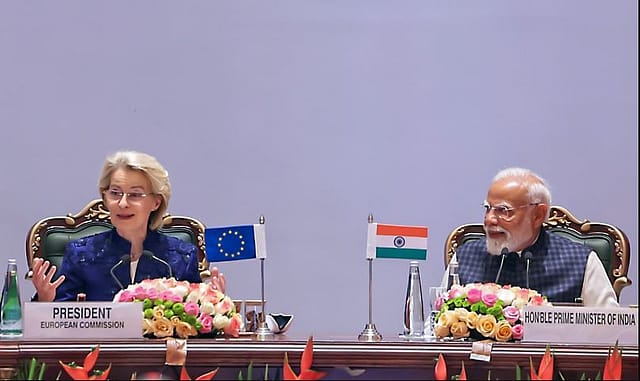
European luxury cars, beer and food items could soon cost less in India after New Delhi and Brussels sealed their largest-ever Free Trade Agreement, a landmark pact reshaping one of the world’s biggest economic relationships.
India-EU FTA promises cheaper European cars, beer and food
India and the European Union on Tuesday concluded their most ambitious Free Trade Agreement, a sweeping deal that will reduce tariffs on a wide range of European goods while opening unprecedented export opportunities for Indian companies.
Announced at the 16th India-EU Summit, the agreement is expected to directly benefit Indian consumers through lower prices on premium automobiles, wines, spirits and processed foods, while strengthening India’s manufacturing and export ecosystem.
Luxury European cars to get cheaper
Some of Europe’s most iconic car brands, including Mercedes-Benz, BMW, Audi, Ferrari, Lamborghini, Rolls-Royce and Bentley, are set to become more affordable in India.
Under the pact, India has agreed to a calibrated, quota-based liberalisation of the automobile sector. According to details shared by the European Union, import tariffs on cars will be slashed from as high as 110 per cent to just 10 per cent over a phased period, subject to quotas.
Currently, imported luxury cars attract steep duties, keeping prices out of reach for most buyers.
Wine, beer and food items see sharp duty cuts

India's Action Hero
27 Mar 2026 - Vol 04 | Issue 64
Riding the Dhurandhar Wave
Beyond cars, the agreement brings significant relief for food and beverage consumers.
Duties on wine will be reduced to 20 per cent, while tariffs on pasta, chocolate and several processed food items will be eliminated entirely. Duties on spirits will be lowered to 40 per cent.
The EU said tariffs on 96.6 per cent of its goods exports to India will be removed or reduced, delivering savings of up to €4 billion annually on European products.
Balancing consumer gains with ‘Make in India’
The Indian government said the carefully designed automobile liberalisation package balances consumer interests with domestic manufacturing priorities.
Officials stressed that the deal supports the ‘Make in India’ initiative by creating pathways for Indian-made vehicles to access the European market, opening new export avenues for domestic manufacturers.
Wider tariff cuts across sectors
The scope of the FTA extends well beyond automobiles and food.
Tariffs will be removed on 90 per cent of European optical, medical and surgical equipment exports to India. Duties on almost all EU aircraft and spacecraft exports will also be eliminated.
The agreement spans trade in goods and services, market access, mobility of professionals, digital trade and support for small and medium enterprises. More than 99 per cent of Indian exports are set to receive preferential access to the EU market.
Strategic and economic weight of the deal
India and the EU are the world’s fourth- and second-largest economies respectively, together accounting for nearly 25 per cent of global GDP and one-third of global trade.
Leaders on both sides said integrating two large, diverse and complementary economies would unlock unprecedented trade, investment and technology partnerships.
Alongside the FTA, India and the EU also signed a Security and Defence Partnership, making India the third Asian country, after Japan and South Korea, to enter such an arrangement with the bloc.
Modi calls for reform of global institutions
Addressing a joint press conference with European Commission President Ursula von der Leyen and European Council President António Costa, Prime Minister Narendra Modi said the India-EU partnership would help stabilise a turbulent global order.
“Today, there are major turmoils in the global order. In such a situation, the partnership between India and the European Union will strengthen stability in the international system,” Modi said.
He added that global institutions must be reformed to address contemporary challenges and said leaders discussed Ukraine, West Asia and the Indo-Pacific during the summit.
Shared democratic values
Costa said India and the EU, as the world’s largest democracies, share a responsibility to uphold international law and multilateralism.
Prime Minister Modi hailed the FTA as “not just a trade agreement, but a blueprint for shared prosperity,” noting that bilateral trade currently stands at €180 billion and has grown rapidly in recent years.
(With inputs from yMedia)