Burger King vs McDonald’s: Can India’s Cheap Meals Deliver Lasting Profits?
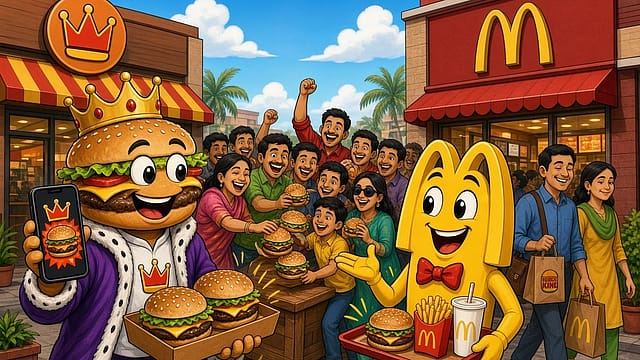
Burger King has put an instruction alongside its bargain: open the app.
Its October investor presentation says the “2 for 79/99” offer moved to the app to remain competitive. The same document describes app deals aimed at increasing purchase frequency.
That small change captures a bigger ambition. A cheap meal can bring someone through the door. An app gives the chain another opportunity to bring that person back.
Burger King now has an encouraging financial milestone to accompany that strategy. Restaurant Brands Asia, its India operator, reported its first positive standalone quarterly profit: ₹15.59 crore for July–September 2026. India revenue rose 24.1%, while sales at comparable restaurants grew 14%.
McDonald’s has a recovery story too. Westlife Foodworld, which operates the brand in West and South India, reported 10.1% same-store sales growth for the same quarter.

The Era of Forever Wars
30 Oct 2026 - Vol 05 | Issue 44
Coping with an explosive Middle East
The rivalry has acquired a more demanding question: can these chains make affordable eating profitable often enough to build lasting earnings?
The profit needs unpacking
Burger King’s milestone deserves attention. It also needs context.
Restaurant Brands Asia’s standalone accounts show ₹29.62 crore of other income, exceeding its ₹15.59-crore net profit. Mechanically subtracting other income would leave a ₹14.03-crore shortfall before tax. That calculation is not a measure of restaurant operating profit, but it shows why the reported surplus cannot be attributed entirely to selling meals.
The wider group, including Indonesia, still reported a ₹23.79-crore quarterly net loss.
There is nevertheless evidence of improvement inside the India business. Its restaurant EBITDA margin, measured before the effects of lease-accounting standard Ind AS 116, rose from 10.4% to 12.9% year on year. Company-level EBITDA margin on that basis increased from 5% to 7.8%.
EBITDA measures earnings before interest, tax, depreciation and amortisation. The gap between restaurant and company margins reflects the additional costs of running the organisation.
These operating gains strengthen the recovery argument. They do not establish the profitability of a particular discounted burger or meal. Aggregate accounts combine customers buying different products, through different channels, at different prices.
The cheap meal has several jobs
An affordable offer can perform several useful functions. It can persuade a hesitant customer to try the brand, fill a quiet restaurant or encourage an existing customer to visit more frequently.
Those outcomes have different economics.
An extra order can help spread rent and staffing costs across more sales. A discount given to someone who would have bought at full price can sacrifice revenue without creating another visit. A promotion that overwhelms a kitchen can damage the experience that was supposed to encourage loyalty.
Burger King’s presentation places value-led customer acquisition alongside premium menu innovation, family occasions and equipment efficiencies. It reports a 7% year-on-year increase in app frequency.
The commercial logic is understandable: offer an accessible starting point, then give customers enough reasons to return and enough choice to spend more when they wish.
The evidence remains incomplete. Higher app frequency does not reveal how often customers return without another incentive. Premium products do not automatically mean higher profit. Neither company discloses enough offer-level economics to establish whether its cheapest advertised meal earns an adequate return by itself.
It would be equally premature to assume that every bargain loses money. Scale, purchasing terms, preparation simplicity and restaurant utilisation can make inexpensive food commercially attractive.
McDonald’s is chasing the same habit
Westlife’s management credits its everyday value platform with helping increase customer visits and frequency. In its recent earnings call, it said guest numbers grew in double digits in every month of the quarter.
That is meaningful evidence of demand. It is management’s account of what drove the improvement, rather than a controlled test separating the effect of prices from marketing, new products or service.
Westlife’s revenue increased 16.3% to ₹746.72 crore. Its results still showed a ₹2.04-crore net loss.
The combination illustrates how busy restaurants and growing sales can coexist with a thin bottom line. Costs below the operating-profit line still have to be paid.
A margin comparison also requires care. Westlife’s highlighted operating EBITDA margin was 13.1%, including the effects of Ind AS 116. Its reconciliation puts the equivalent pre-Ind AS 116 margin at 7.8%, the same rounded level as Burger King India’s company EBITDA margin on that basis.
Lease accounting moves much of the rent charge into depreciation and interest. It can change the appearance of EBITDA without changing the rent a restaurant must fund.
Even the adjusted figures do not create a perfect league table. The businesses have different footprints and adjustments. Westlife’s territory covers part of India, while Burger King’s disclosed India business has a broader national footprint.
The available numbers also cannot establish that either chain is taking customers from the other.
The app cannot cook the burger
Digital ordering adds another complication to the rivalry.
Burger King’s delivery mix reached 46%. Westlife reported that digital channels contributed more than 75% of sales, a category encompassing apps, kiosks and delivery. Those percentages measure different things.
A kiosk order collected inside a restaurant has a different cost structure from a delivered meal. Digital adoption alone therefore says little about how much profit an order produces.
For customers, the relevant calculation is simpler: what does the complete meal cost, what conditions apply, and is it worth ordering again?
For the chain, the calculation includes food, packaging, labour, occupancy, discounts and any delivery-related costs. More digital sales become valuable when the resulting customer relationships and operating benefits justify those expenses.
Burger King’s US lesson costs $700 million
The global comparison adds a useful corrective to an argument built entirely around bargains.
Burger King’s US comparable sales increased 8.4% in the September quarter, according to global brand owner Restaurant Brands International’s October 29 results.
Its wider “Reclaim the Flame” programme includes up to $700 million of investment through the end of 2028. The programme combines advertising and digital spending with restaurant remodels, technology, kitchen equipment and building improvements.
That spending acknowledges an important part of value: customers judge the experience alongside the price.
The US performance does not prove that discounts caused the growth, or offer a directly comparable profit benchmark for India. It does show the scale of investment behind an effort to make the brand worth revisiting.
Who wins the next visit?
Both Indian operators have encouraging evidence of stronger demand. The unresolved issue is how much of that demand becomes durable, profitable behaviour.
Future results would be more revealing with clearer disclosure of repeat purchases after incentives, order contribution by channel and returns from mature restaurants.
Consumers can happily take the deal available today. Shareholders need to understand what happens after the customer finishes it.
The chain that wins this contest will have to serve an affordable meal, deliver a satisfying experience and retain enough of the bill to pay for the next one.