America’s Malls Are Dying. India’s Are Just Getting Started. Here’s why
The global retail map is being redrawn, and the lines are stark.
Across the United States, shopping malls are shutting down at a relentless pace. In India, malls are filling up, expanding, and attracting billions in global capital. While one market grapples with oversupply and fading footfalls, the other is riding a powerful mix of demographics, demand, and experience-led retail.
This is not a coincidence. It is a lesson in how retail breaks, and how it survives.
The great American mall collapse
The American mall story has entered its endgame.
According to Capital One Research, the US has roughly 1,200 operational malls as of April 2025. By 2028, that number is expected to fall to just 900. Some estimates suggest that nearly 87% of large malls could shut down within the next decade.

Rise of the Pivotal Power
18 Sep 2026 - Vol 05 | Issue 38
The BRICS declaration is a strategic victory for Modi
Store closures tell the same story. Business Insider reports that more than 3,700 retail locations closed in 2025 alone, sharply up from 2,055 closures the previous year. Party City shut all 700 of its stores. Joann Fabrics closed 850 locations. Macy’s continues to downsize aggressively.
The underlying problem is structural, not cyclical.
For decades, America overbuilt retail space. The US has nearly 23 square feet of retail space per capita, which is far more than any major economy. When e-commerce accelerated, physical retail had nowhere to hide. Footfalls fell, anchor tenants collapsed, and mall economics broke.
According to Coresight Research, almost 40% of empty malls are now being repurposed—into warehouses, residential housing, or community centres. Retail, quite literally, is being designed out of the space.
India’s retail boom tells a very different story
Now look east.
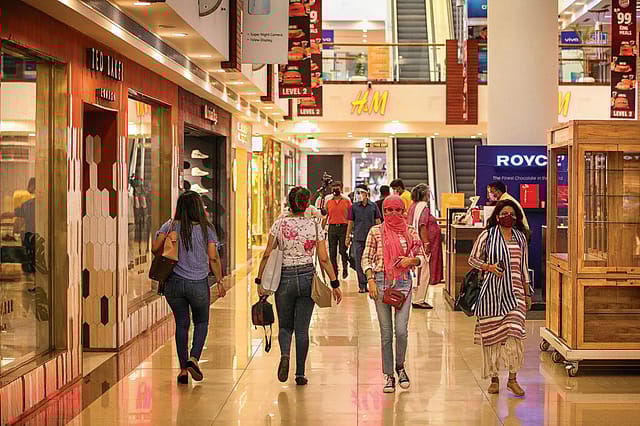
While American malls are being demolished or converted, India’s retail sector is emerging as one of the most attractive brick-and-mortar markets globally. According to Anuj Kejriwal, CEO of Retail Leasing and Industrial & Logistics at Anarock Group, over $3.5 billion is expected to flow into Indian retail assets over the next three years.
Since 2021, more than 88 foreign brands have entered India. Many more are waiting—often unable to find space in Grade-A malls that are already running at 95–100% occupancy, with long waitlists for prime locations.
In the first half of 2025 alone, retail leasing surged nearly 70% year-on-year, while new mall supply jumped more than 160%. In most markets, such a spike in supply would spell trouble. In India, it barely dents demand.
The supply–demand gap America never had, and India does
The biggest difference between the two markets is not e-commerce. It is supply discipline. India’s per capita retail stock is among the lowest in the world. Tier-1 cities offer just 4–6 square feet of retail space per person. Tier-2 and Tier-3 cities have only 2–3 square feet. Grade-A mall space? A mere 0.6 square feet per capita.
Compare that with the US (23 square feet) or China (over 6), and the contrast is staggering.
Add to this the fact that India’s per capita income has nearly doubled over the last decade, and the result is a demand–supply imbalance rarely seen in global retail. Where America drowned in excess space, India is starving for quality retail infrastructure.
Why e-commerce hasn’t killed Indian malls
Another myth collapses here: that online shopping inevitably destroys physical retail.
India’s e-commerce penetration stands at around 8%, far below the 20%+ levels seen in the US and China. More importantly, Indian malls have adapted differently. They are no longer just shopping centres—they are social and lifestyle hubs.
Food, beverages, and entertainment now drive 30–35% of footfalls in leading malls. These are experiences e-commerce cannot replicate. The mall is not competing with the internet; it is offering something the internet cannot.
A $6 trillion consumption story in the making
India’s retail momentum is being reinforced by policy and capital. The sector has attracted ₹41,645 crore ($4.86 billion) in FDI between April 2000 and June 2025. Institutional-grade retail assets deliver 14–18% internal rates of return—nearly double typical Western yields.
As India moves toward a $6 trillion consumption economy by 2030, malls are becoming central to how that consumption is organised, experienced, and scaled.
America’s mall crisis is a warning about oversupply, stagnating demand, and failure to evolve fast enough. India’s retail boom is proof that brick-and-mortar still works—when demographics are favourable, supply is disciplined, and experiences come first.
In a world quick to declare the death of physical retail, India is quietly writing its comeback story.
(yMedia is the content partner for this story)