50 Toppers, 0.75% Margin: Aakash Still Can’t Exorcise the Ghost of Byju’s
Aakash’s students know the penalty for answering the wrong question. Its owners apparently do not.
The easy question is whether Byju’s damaged Aakash Educational Services. It did.
But the harder question is why the damage continues after Ranjan Pai’s Manipal Group pumped in hundreds of millions of dollars, became the controlling shareholder and acquired the founder’s remaining stake.
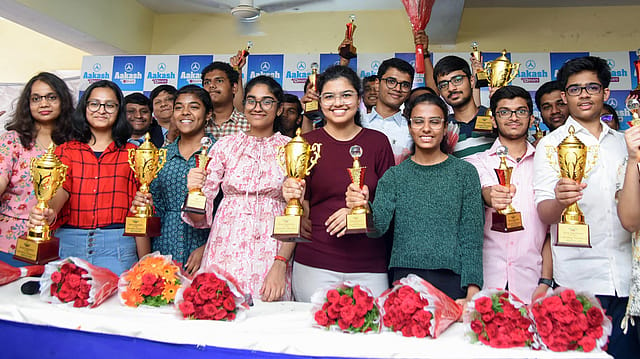
Aakash produced nine Top-100 ranks in JEE Advanced and 41 in NEET in 2026. Fifty of India’s highest-ranked engineering and medical aspirants emerged from its academic system.
The business managed an EBITDA margin of 0.75 per cent. That is the examination result Aakash cannot advertise on a billboard.
According to an Entrackr analysis of financial statements filed with the Registrar of Companies, operating revenue crawled from ₹2,032 crore in FY25 to ₹2,041 crore in FY26, an increase of less than half a per cent. EBITDA collapsed 65 per cent from ₹43.3 crore to ₹15.3 crore. The company reported a net loss of ₹186.5 crore. Return on capital employed stood at minus 46.1 per cent. “Aakash is producing elite academic outcomes, but its financial engine is barely producing an operating surplus,” reckons Jai Vardhan, founder and chief executive officer of Entrackr. But a 0.75 per cent EBITDA margin leaves almost no cushion for an admissions shock or a price war.

Zeroing In on ECI
09 Oct 2026 - Vol 05 | Issue 41
Constitutional legitimacy versus political opportunism
The company’s website claims more than 400 coaching centres and 5,500 faculty members. It has the brand. It has the classrooms. It has the teachers. It has the toppers. It does not have growth. It barely has operating profit.
Fifty Toppers Cannot Hide 0.75 Per Cent
The contradiction between Aakash’s academic and financial performance is brutal.
Aakash students reportedly secured five of the Top 10 ranks in NEET 2026. The institute continues to demonstrate that it can deliver the outcome for which parents spend lakhs: admission to India’s most fiercely contested medical and engineering institutions.
Yet the company’s classroom business is stuck. Coaching fees contributed ₹1,956 crore in FY26, almost unchanged from ₹1,951 crore a year earlier. Franchise revenue rose from ₹81 crore to ₹84 crore. Together, they produced only ₹9 crore of additional operating revenue.
Other income, meanwhile, more than doubled to ₹113 crore. Aakash earned over seven times as much from other income as it generated in EBITDA.
That is a warning masquerading as a footnote. The company’s total income increased 3.3 per cent to ₹2,154 crore largely because of the surge in non-operating income. Its operating business barely moved.
The cost sheet makes the result worse. Employee expenses declined 2.4 per cent to ₹1,300 crore. Advertising costs fell 7 per cent to ₹146 crore. Depreciation dropped 4.5 per cent to ₹235 crore. Aakash squeezed employees, promotion and depreciation. EBITDA still fell 65 per cent. Other expenses rose 6.5 per cent to ₹626 crore, while franchise service fees jumped 66 per cent to ₹91 crore. Total expenditure reached ₹2,398 crore, leaving a ₹244-crore hole between income and expenditure before tax and exceptional items.
These are not the numbers of a company spending aggressively to unlock its next phase of growth. Revenue is flat. Advertising is down. Employee costs are down. Operating profit is almost gone. Aakash is cutting without healing.
A ₹4,000-Crore Dream Became a ₹2,041-Crore Reality
In March 2023, Aakash reportedly expected to close FY23 with revenue of around ₹3,000 crore. It delivered ₹2,399 crore.
A few months later, while announcing plans for an IPO, Byju’s projected that Aakash would produce ₹4,000 crore in revenue and ₹900 crore in EBITDA in FY24. The company delivered ₹2,438 crore in operating revenue and ₹307 crore in EBITDA.
Those projections belonged to Byju’s most delusional period, when targets often appeared to be written for fundraising decks rather than achieved by operating businesses. Aakash should not be punished forever for failing to meet a number its desperate parent announced.
The actual trajectory condemns it without any help from Byju’s forecast. Operating revenue fell from ₹2,438 crore in FY24 to ₹2,032 crore in FY25. It reached ₹2,041 crore in FY26. That is a decline of approximately 16 per cent over two years. EBITDA fell from ₹307 crore to ₹43.3 crore and then to ₹15.3 crore. That is a collapse of approximately 95 per cent. “The real concern is not flat revenue alone,” says Vardhan. EBITDA has fallen from ₹307 crore in FY24 to ₹15.3 crore in FY26. "Aakash has lost roughly 95 per cent of its operating profit in two years,” he adds.
Revenue has weakened. Profitability has been almost erased. Calling this topline stagnation is an act of kindness the numbers do not deserve.
More Centres. Less Revenue
In March 2023, Aakash reportedly had approximately 320 centres and more than four lakh students.
Today, its website claims more than 400 centres. The network appears to have expanded by at least 25 per cent. Operating revenue, however, has fallen from ₹2,399 crore in FY23 to ₹2,041 crore in FY26.
A crude division is revealing. At 320 centres, FY23 operating revenue averaged approximately ₹7.5 crore per centre. At 400 centres, FY26 revenue averages roughly ₹5.1 crore.
The figures are indicative. Aakash operates a mixture of company-owned and franchised centres, and some revenue cannot be allocated evenly across locations. Centres may also have opened or closed at different points during the year.
The direction remains impossible to ignore. The network grew. Revenue shrank. If the centre network has expanded from around 320 to more than 400 while revenue has declined, Manipal must examine centre utilisation, revenue per classroom and whether expansion has diluted productivity, says Vardhan.
An offline coaching centre cannot survive on academic reputation alone. It needs occupied seats. Faculty, rent, electricity, security, administration and local marketing must be paid whether a classroom has 100 students or 40. Aakash appears to have added capacity without extracting corresponding growth. That is expansion on the signboard and contraction in the classroom.
Byju’s Did Not Merely Haunt Aakash. It Raided It
The ghost is real. When Byju’s acquired Aakash for approximately $1 billion in 2021, the transaction was sold as a marriage between digital reach and physical teaching.
Byju’s brought technology, an enormous online funnel and seemingly unlimited capital. Aakash brought a respected brand, examination expertise, profitable classrooms and parental trust accumulated over three decades.
The merger was supposed to create an education powerhouse. Instead, Aakash became Byju’s most valuable hostage.
In FY24, Aakash recorded ₹2,720 crore in exceptional items, largely linked to its relationship with Think & Learn, the parent of Byju’s. The charges reportedly included ₹1,363 crore associated with interest and loan obligations, a ₹780-crore write-off of loans extended to the related party, ₹100 crore following the termination of a service agreement, ₹102 crore in goodwill impairment and a ₹300-crore write-down of intangible assets.
Aakash reported a net loss of ₹2,443 crore that year.
Byju’s bought a profitable coaching company and allowed its own financial crisis to enter Aakash’s accounts through the front door. Aakash was pledged, borrowed against, positioned for an IPO and treated as the final monetisable asset of a collapsing empire.
The buyer needed its acquisition to save it. The acquisition eventually needed saving from the buyer.
How Long Can Manipal Blame the Ghost?
This is where sympathy must end.
Ranjan Pai entered the Aakash story in 2023. He reportedly paid around $170 million to settle debt that Byju’s owed to Davidson Kempner, freeing Aakash shares pledged as collateral. His total investment reportedly reached approximately $300 million, much of which was converted into equity.
Manipal emerged as the dominant shareholder.
In June 2025, the Competition Commission of India approved Manipal entities’ acquisition of shares from Aakash founder JC Chaudhry. By the end of FY26, Manipal reportedly held around 73 per cent of Aakash. Think & Learn retained 13.74 per cent, while Bisy Philip held 5.16 per cent. Chaudhry had exited completely.
Manipal had the capital. Manipal had control. Manipal had time to begin arresting the decline. During its period of growing influence, revenue fell approximately 16 per cent and EBITDA collapsed approximately 95 per cent. “Byju’s explains the exceptional charges and balance-sheet damage,” says Vardhan. "It cannot remain the explanation for every operating weakness after control has changed hands,” he adds.
Byju’s cannot indefinitely explain underutilised centres, flat coaching income, rising other expenses, surging franchise service fees and a 0.75 per cent operating margin under a new controlling shareholder. At some point, the haunting becomes management. At some point, the ghost becomes an alibi.
The Rescuer Inherited a Business, Not a Crime Scene
Repairing Aakash requires time.
But ₹2,041 crore of annual operating revenue is not a convalescent patient waiting quietly in a hospital bed. Aakash is a sprawling education company operating hundreds of centres in one of India’s most competitive consumer markets.
Every admission season matters. Every star faculty departure matters. Every discount matters. Every half-empty classroom matters. Physics Wallah, Allen, Unacademy and regional coaching chains have not suspended competition while Aakash completes its exorcism.
The pandemic initially appeared to have handed the future to online education. When students returned to classrooms, digital companies rushed offline. Physics Wallah used its low-cost online brand to build Vidyapeeth centres. Unacademy opened physical locations. Allen pursued a broader national and digital presence.
That return to classrooms should have been Aakash’s moment. It already possessed the physical network everyone else was spending heavily to construct. Instead, Aakash spent the offline revival disentangling itself from Byju’s ownership, debt and litigation.
That explains the lost opportunity. It does not guarantee another one.
Parents do not enrol children out of sympathy for a company’s cap table. They pay for faculty, results, discipline and confidence. Aakash still has those assets, as its 2026 ranks demonstrate. Competitors need only weaken its faculty bench, undercut its fees or outperform it locally to chip away at the network. A 0.75 per cent EBITDA margin provides almost no protection against that assault.
What is a $2-Billion Aakash Actually Worth?
In June 2026, Reuters reported that Byju’s global lenders were in advanced discussions to receive an approximately 30 per cent stake in Aakash as part of a wider settlement. The negotiations reportedly valued Aakash at around $2 billion.
The valuation is extraordinary.
Aakash was acquired for around $1 billion in 2021. It is reportedly being valued at twice that amount after revenue contracted, EBITDA fell to ₹15.3 crore, the founder exited and ownership became entangled in litigation across countries.
At current operating profit, the reported valuation represents a multiple of more than 1,000 times EBITDA.
Even that comparison flatters the business. Aakash is a coaching chain with heavy employee costs, physical infrastructure and volatile admissions. It does not possess the near-zero marginal-cost economics that might justify a technology-company multiple. “A reported $2-billion valuation appears to price in a successful turnaround,” says Vardhan. “The current earnings do not support that optimism.” The $2-billion number values what Aakash could become. The FY26 accounts show what it is today. Confusing aspiration with performance is how the Byju’s story began.
Who Owns the Failure Now?
JC Chaudhry built Aakash over decades and eventually exited. Byju’s bought it, damaged it and lost control. Manipal rescued it, recapitalised it and became the owner.
The ownership has changed faster than the operating story. That is now Manipal’s problem.
The new controller must answer why more than 400 centres are producing less revenue than approximately 320 did three years earlier. It must explain why elite examination results are not translating into admissions growth or pricing power. It must identify the costs swallowing EBITDA after employee and advertising expenses have already been reduced.
Most importantly, it must decide whether Aakash is a turnaround or merely a valuable stake in a settlement. If the objective is to preserve the brand until ownership disputes are resolved, the current numbers may be survivable. If the ambition is an IPO, a national education champion or a $2-billion company, 0.75 per cent is an embarrassment. Aakash cannot market its way out of this. Advertising expenditure is already falling. It cannot cut its way out without risking the teachers and classroom experience that produce its ranks. It cannot expand its way out if every additional centre dilutes productivity.
And it cannot invoke Byju’s forever.
The Ghost Has Company
Aakash remains one of the strongest brands in Indian test preparation. Its academic engine continues to produce exceptional results. A ₹2,000-crore revenue base is substantial. More than 400 centres form a national network that would take years and enormous capital to replicate.
That is precisely why the FY26 performance is damning. A weak brand producing weak numbers would surprise nobody. Aakash has strong results, national recognition, thousands of faculty members, an enlarged network and a powerful new owner.
It is still shrinking. Byju’s undoubtedly wrecked value. Its fingerprints remain across Aakash’s old accounts, ownership disputes and abandoned IPO dream.
But FY25 happened under Manipal’s growing influence.
FY26 happened under Manipal’s control. Revenue did not recover. EBITDA nearly disappeared. Byju’s left Aakash with damaged accounts, disputed ownership and years of lost momentum. Manipal can continue blaming the ghost. The FY26 numbers suggest the ghost is no longer the only one failing the test.