114 Rafale Jets, Scalp Cruise Missiles: What’s on the Agenda as Defence Acquisition Council Meets Today
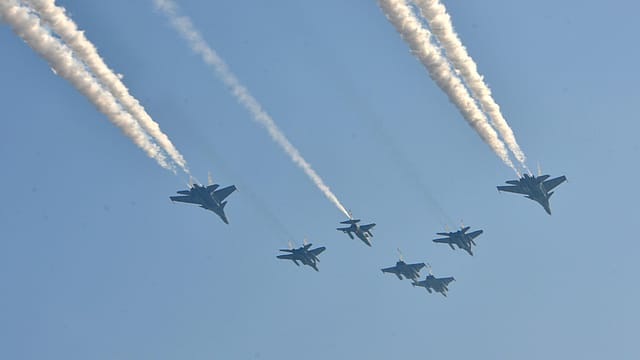
The Defence Acquisition Council, the defence ministry’s highest decision-making body on capital procurement, is set to meet today under the chairmanship of Defence Minister Rajnath Singh, with a packed agenda that could shape India’s combat capability and indigenous defence manufacturing push.
Foremost among the proposals is the acquisition of 114 Rafale multirole fighter jets from France in a deal estimated at Rs 3.25 lakh crore.
The proposal, described as the “Mother of all defence deals”, would be at least five times bigger than any military hardware contract signed by India so far.
The Defence Procurement Board, headed by Defence Secretary Rajesh Kumar Singh, endorsed the plan last month.
A final nod from the Cabinet Committee on Security led by Prime Minister Narendra Modi will be required after the DAC’s decision.
The Indian Air Force had formally sought the additional 114 jets in September last year to rebuild its shrinking squadron strength.
It currently operates 36 Rafale fighters, while the Indian Navy has ordered 26 naval variants. Infrastructure to support additional squadrons is already in place, with a training and maintenance, repair and overhaul facility functional at the Ambala air base.
How will the 114 Rafale jets be produced under the Make in India framework?

The Abandoned Kejriwal
01 May 2026 - Vol 04 | Issue 69
Brain drain from AAP leaves Arvind Kejriwal politically isolated
The IAF has space, trained personnel, tooling and spare parts to induct two more squadrons, roughly 36 to 38 aircraft, without delay.
If approved, the new jets are expected to be produced under a Make in India framework, with Dassault Aviation partnering with an Indian company.
The French manufacturer would integrate Indian-origin weapons and missile systems and enable secure data links to connect seamlessly with India’s radar and sensor network.
Transfer of technology for airframes is envisaged, with key suppliers such as Safran for engines and Thales for avionics participating.
Once fully implemented, indigenous content in the aircraft could rise to an estimated 55 to 60 per cent.
Will the Defence Acquisition Council Talks Gain Momentum During Macron’s India Visit?
India and France are expected to advance discussions during French President Emmanuel Macron’s visit from February 17 to 19, when he is scheduled to meet Prime Minister Modi.
The DAC is also likely to consider the purchase of a significant number of Scalp cruise missiles for the existing Rafale fleet.
In addition, it is expected to take up the case for acquiring six more P-8I maritime surveillance and anti-submarine warfare aircraft from the United States under a deal estimated at around $3 billion.
Another proposal on the table is the issuance of a tender to procure a large quantity of missiles for the Sudarshan air defence system, which scored multiple hits against the Pakistan Air Force in Operation Sindoor.
The tender would be issued to Russian government agencies in accordance with new intergovernmental agreements between the two countries.
The meeting is also likely to clear a major indigenous project to procure around one lakh Vibhav point attack anti-tank mines developed by the Defence Research and Development Organisation.
Multiple proposals for overhauling the armoured vehicle fleet of the Indian Army are expected to be discussed.
Beyond combat aircraft and missile acquisitions, the council is set to deliberate on next-generation surveillance platforms.
How Will High Altitude Pseudo Satellite Vehicles Enhance India’s Long-Endurance Surveillance Capabilities?
Approval may be considered for solar-powered High Altitude Pseudo Satellite Vehicles designed for persistent surveillance.
Operating at altitudes of around 20 kilometres, significantly higher than commercial aircraft, these platforms can remain airborne for extended durations.
They combine features of satellites and unmanned aerial vehicles and offer long-endurance reconnaissance at a fraction of the cost of space-based systems. They do not require rockets or launch vehicles for deployment.
India’s National Aerospace Laboratories has conducted tests of such a platform, while DRDO and Bengaluru-based NewSpace Research and Technologies are developing their own variants.
Only a handful of countries, including the United States, United Kingdom, Germany, Japan, South Korea and New Zealand, are investing in such systems.
What is the Indian Navy’s Marine Gas Turbine Project under Make-I?
The council is also expected to take up the Indian Navy’s marine gas turbine project under the Make-I category of the Defence Acquisition Procedure 2020.
The initiative aims to enable domestic design, development and testing of high-power gas turbines in the 24 to 28 megawatt class for frontline warships such as destroyers and frigates.
Under the Make-I framework, the government co-funds prototype development with industry partners, with contribution capped at Rs 250 crore per agency.
The total programme could involve Rs 4,000 to 5,000 crore in investment, with up to 70 percent of prototype costs potentially covered by public funding.
At present, the Indian Navy relies on imported turbines from Ukraine’s Zorya Mashproekt and the American company General Electric.
Indigenous development would reduce dependency on foreign suppliers and strengthen operational readiness.
In late 2025, the Navy sought inputs from domestic companies to assess capabilities in gas turbine design, precision manufacturing, testing infrastructure and lifecycle support.
Firms were evaluated on experience in design and integration, research and development infrastructure, forging and machining capabilities, testing facilities, proposed indigenous content and overall technical and financial viability.
Today’s deliberations are expected to span big-ticket fighter acquisitions, advanced surveillance systems and critical propulsion technology, reflecting a dual focus on enhancing combat readiness and accelerating self-reliance in defence production.
(With inputs from ANI)