The Last Hindu King of Delhi: How a Greengrocer Took Delhi From the Mughals
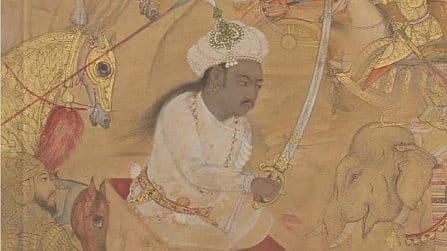
One stray arrow, on a November afternoon in 1556, may have decided who ruled India.
That is the argument of The Last Hindu King of Delhi, a new book by Nitish Sharma on Hemchandra Vikramaditya, known as Hemu. Sharma says the Mughal court's chroniclers reduced him to a footnote, and the book sets out to put him back among the country's great sovereigns.
Textbooks often present the transfer of power in 16th-century India as a smooth sequence: the Delhi Sultanate falters, Babur wins at Panipat, Humayun stumbles and the young Akbar secures an empire. Sharma says that sequence leaves out a period when the outcome was uncertain, and that Hemu stood at its centre.

Look Who's Talking Regime Change
23 Oct 2026 - Vol 05 | Issue 43
FROM MARKET WEIGHMAN TO EMPEROR
Hemu had no royal lineage, unlike rulers such as Maharana Pratap or Shivaji Maharaj. According to the book, he was born in 1501 into a modest Dhusar family in Machari, Alwar. His father, Puran Das, gave up worldly life and the family lived in poverty. Hemu began as a greengrocer and market weighman.
He rose from market surveyor to chief of intelligence and then Wazir, or prime minister, to Adil Shah of the Sur dynasty. Sharma says he did so on administrative skill, in a society bound by rigid caste barriers.
Mughal chroniclers such as Abul Fazl and Badayuni often called him a bakkaal (trader) or sabzi farosh (greengrocer). Sharma argues this hid what he actually traded: saltpetre, the key ingredient in gunpowder. By supplying munitions and logistics to the Sur empire, the book says, Hemu mastered artillery and supply chains before he commanded troops in the field.
THE RUN OF VICTORIES
As a commander, Sharma says, Hemu led an army of Hindu chieftains and Afghan soldiers across northern India for Adil Shah. The book credits him with 22 consecutive victories, taking in Kalpi, Sambhal, Agra and Tughlaqabad in Delhi, where he routed Mughal garrisons.
After defeating Tardi Beg Khan at Tughlaqabad, Hemu entered Delhi on October 7, 1556. He was crowned at Purana Qila and took the title Samrat Hemchandra Vikramaditya, restoring native rule to the city.
THE ARROW AT PANIPAT
The decisive clash came at the Second Battle of Panipat on November 5, 1556. According to the book, Hemu, riding his war elephant Hawai, had broken the flanks of Akbar and Bairam Khan's army and was close to pushing the Mughals out of India.
Then an arrow struck his eye and entered his brain. When he fell unconscious, his army panicked and fled. Hemu was captured and executed. Sharma says Mughal chroniclers were then free to rewrite the record and portray a master strategist as an intruder.
"Hemu's life stands as living proof that destiny is not merely inherited, it can be forged on the battlefield," Sharma says. "Without that single stray arrow at Panipat, the Mughal Empire would have ended before it truly began. It is high time we restore Samrat Hemchandra Vikramaditya to his rightful place in history."
With inputs from ANI