The God Whisperer
In the Valmiki Ramayana, Hanuman is very powerful and can literally move mountains. But he is still a side character in the larger scheme of things, serving Sugriva and Rama. The early Puranas rarely mention him. The later Puranas, 1,000 years old, repeat the tales of his strength but his status is not changed. Only as recently as 500 years ago does he become a major god himself. He is now an avatar of Shiva. Folk tales, local versions of the Ramayana, have him even rescuing Rama and Lakshmana from a sorcerer who is going to sacrifice the brothers to Kali in the netherworld. Hanuman beheads him instead. The name of the sorcerer: Mahi Ravana.

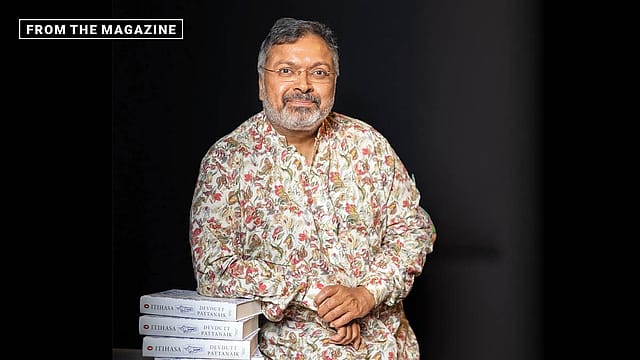
Just like human beings, gods too evolve and for the same reasons—because the circumstances around them have changed. As you read Devdutt Pattanaik’s latest book Itihasa: A History of Hindu Mythology (Penguin Books, 464 pages, Rs 899), this insight keeps leaping out. What happened 500 years ago to make Hanuman a god was a combination of social and political shifts. Hindu monasticism, as a religious ideal, had taken root because of Adi Shankaracharya. There was the expanding Vijayanagara empire, which had positioned itself as a Hindu bulwark against Islamic invasion. Pattanaik says, “The Vijayanagara kings were the first to call themselves guardians of Hindu dharma fighting against Turuku dharma. And they make Hanuman very powerful.” More than 500 temples of Hanuman are built by their guru. Being a bachelor contributed to Hanuman’s elevation because Tantric traditions attributed power to celibacy. Simultaneously, bhakti is becoming dominant and that contributes. “And then he (his popularity and presence) just explodes,” he says. “He sits outside the temple. So the common man can connect with him.”
Pattanaik has spent three decades in the world of Indian mythology and written over 50 books on it. They range from its applicability to the corporate world to children’s stories. Itihasa is not designed to be a page turner. It is academic and scholarly in tenor, trying to weave the long arc of Hindu mythology into a historical structure. This he does through six layers—Bangles, Horses, Money, Temples, Mosques, Passports. Each, representing a period of the past, is associated with two deities to represent the era. “Everybody talks about the ancient, modern, medieval and I keep saying why is history divided into three parts? There is no real logic for it. You just decided because the Europeans did it,” he says. “I realised there were six major innovations that took place, which helped me understand the history of India. It also helps me understand the folklore of India.”
Take, for instance, ‘Bangles’, the first of the six layers, which goes back 5,000 years. Pattanaik found they were uniquely predominant here. Elsewhere in the world people wore bracelets. A large number of bangles have been found among the Harappan civilisation’s artefacts. The famous dancing girl’s arm is covered in them. Bangles were a symbol of the circle of auspiciousness that women created in their homes to make them safe and secure. It was what the patriarchal Arya (the term Pattanaik uses for those commonly known as Aryans) encountered when they settled and married locally. Later, monastic orders and caste led to auspiciousness being overshadowed by the idea of purity making women subservient. An interesting nugget from the book says that among the 550 past lives of the Buddha, not even one is a woman.
‘Horses’ come after ‘Bangles’ and the two gods associated with that part of the book—Indra and Brahma—have something in common. Both are more or less minor figures now. Brahma was never really at the top, but Indra was. In the Rig Veda, no other god has as many hymns as Indra. His story is then one of progressive demotion as the Arya went from pastoralism to agriculture, moved from the Indus basin to the Ganga river valley. The Rig Veda is poetry in which Indra is mighty and all powerful. His fall begins as scriptures become prose. “When the Brahmanas are written, in order to kill the Asura, he needs bones of the Brahmin Dadhichi. Now he depends on the Brahmin to get a weapon. Then after he kills Vritra, he is accused of Brahma Hatya Paapa. And now he needs again a Brahmin to purify him. You are seeing this new group of people emerging who are telling people that we can even control the gods. Even the gods depend on us. And you see this rise of Brahminism emerging in the later Vedic literature,” he says.
A recurring theme in Itihasa is upheavals leading to adaptations. There is the advent of money. A mercantile class is born and they are starkly different. Money allows mobility. Merchants travel and so do monks of the new orders like Buddhism and Jainism. The Brahmins have to meet this challenge and out of that churn is propelled Vishnu into the centre of the pantheon. The mercantile lobbies have become powerful and a new god is needed to attract them, one who promises them success. Vishnu is who the Brahmins came up with to break the hold of the Buddhists and the Jains over the merchants. “Vishnu today is, remember, a god of the mercantile community. The Gujarati Vaishnavas, who are the richest people in India, worship Shrinathji. Vishnu is associated with Lakshmi, the goddess of wealth. The first images of the goddess of wealth come in Buddhist sites and Jain sites, not Hindu sites. The Brahmins created a god who attracts Lakshmi. So Lakshmi Vallabha, the one who Lakshmi adores is Vishnu,” he says.
Caste, says the book, is much younger than one thinks, ossifying 2,000 years ago. Pattanaik points to epigraphic evidence. Ashoka put up pillars across India, mentioning many things of the time but not caste. The most powerful man of the time therefore didn’t consider it important 2,300 years ago. Then there is genetic evidence, which shows endogamy, marriage within communities, firming up 1,900 years ago. It is around the time when the Bhagavad Gita talks about the chaturvarna. “Clearly something is going on in society. The Brahmins have come up with this new system of hierarchy. That is when the Dharma Shastras are enforcing it. For the first time, varna becomes important in the Ramayana text, in the Mahabharata text, in Bhagavad Gita. It is this time that you see genetic evidence appearing,” he says.
Itihasa gets into the intriguing roots of many elements of Hindu society that one takes for granted. Temple worship led by Brahmins, for instance. But, in fact, temples were from a strand of Hinduism that Brahmins looked down upon. There are hints of that in the present. Pattanaik says that he was surprised to learn that amongst Brahmins, there is even now a hierarchy in which the temple priest is seen as inferior to Vedic Brahmins. “And then I noticed all the early Dharma Shastras looked down on temple priests,” he says.
Temples used to be tantric, with female images, erotic carvings, rituals involving blood. That began to change into what we see now as Brahmins coopted them. It was a question of remaining relevant, and Islam had a part to play in it. The book notes, “The arrival of Islam had upset the social order. New opportunities opened up. Peasants could serve as soldiers. Soldiers could get lands. Shudras were becoming elites. Persian replaced Sanskrit as the court language. Brahmins lost their privileged position. The only way to survive was within temples. And so Brahmins actively merged Vedic philosophy with temple beliefs.”
The last element of the book is ‘Passports’, which pairs Krishna, one of the most beloved gods in Hinduism, with Bharat Mata, a goddess in the making. The reason for it is that both together are a function of the nation state, an idea introduced with the British as colonisers. Krishna, for instance, is a cowherd-and-wrestler god who with changing eras finds new facets added to him. He becomes the flute-playing lover, with the story of Radha added to his lore 800 years ago. “That is not the Krishna today. Today’s Krishna is the Bhagavad Gita Krishna, not the Raslila Krishna,” says Pattanaik.
European scholars couldn’t comprehend Hinduism when they encountered it. Pattanaik says they thought all religions needed a central figure, like Jesus with Christianity or Muhammad with Islam, and a holy text. The Bhagavad Gita and Krishna filled it for them. The book notes, “Unlike the polytheistic Vedas, the Gita appeared more monotheistic. It also contained verses that justified the Hindu caste hierarchy and food practices, and had no reference to any goddess. More philosophical than mythological, it helped the Hindu elite define a holy book that satisfied the colonial gaze.” In the 19th century, you suddenly see pictures of Krishna everywhere showing him as a king, whereas his devotional form used to be the cowherd, the flute-player.
The British also created an image of India as a woman and later Indians came up with Bharat Mata. Once the nation-state became the overarching political concept, associating it with the divine female as “an emotional and symbolic centre” was needed. Literary works and plays began such allusions. In the 20th century, images became popular of “a saffron-clad female figure holding grain, cloth, books, and rosary, without weapons or a lion—an icon of sustenance and instruction.” She had four hands making her a deity. Now there are two hands with a lion and a Tricolour symbolising dominion and military assertiveness of an independent nation.“Bharat Mata was invented, but gods are always invented in Hinduism,” says Pattanaik.
Itihasa is a story of continuity, of ideas and gods being repurposed, a process that is still ongoing. A religion based on rituals metamorphosed into one based on stories, which meant it could constantly reinvent itself. Pattanaik hopes the reader will take from his book an appreciation of Hinduism's history beyond the surface-level. “Hinduism was invented by women who made the house, the grihini, who created the Mangala rituals,” he says. “These women who invented the bangle and still wear the bangle, which was born 5,000 years ago, need credit.”