Still Unravelling: A contemporary appraisal of Gandhi

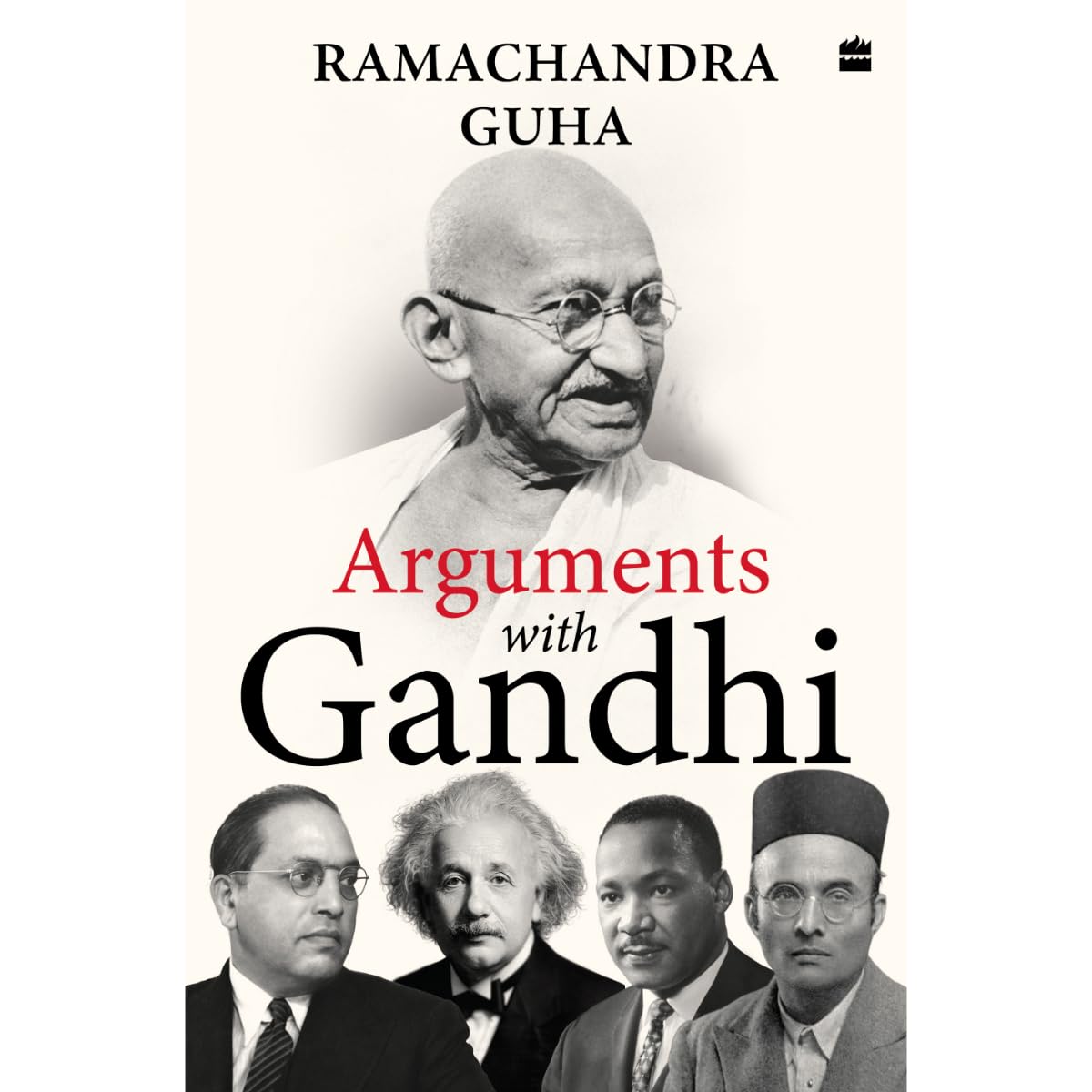
Arguing with the Mahatma is something most Indians have indulged in—some perfunctorily, others in depth. In Arguments with Gandhi, Ramachandra Guha enters this terrain by structuring his approach around four themes central to Gandhian thought and action: Violence, Justice, Faith and Progress. These centre on the well-known binaries of violence versus nonviolence, caste and untouchability, the Hindu-Muslim interface, and industrialisation versus the self-sufficient village or rural idyll.
It is a measure of Guha’s skill as a historian that even on these well-trodden fields he keeps the reader’s attention riveted.
Guha’s approach also amounts to a contemporary audit of Gandhi. The question becomes how relevant do some of his cherished notions remain now and how his ideas stood up to the passage of time. In part the book is a critique of Gandhi but also a defence and a validation. The conclusion is that Gandhi remains as relevant as ever to India in the context of massive erosion in religious tolerance, rising majoritarianism, a decline in civic values and a degraded environment.

Zeroing In on ECI
09 Oct 2026 - Vol 05 | Issue 41
Constitutional legitimacy versus political opportunism
The nonviolence versus violence debate began early in Gandhi’s political life in India with the Non-Cooperation Movement after the Chauri Chaura incident in 1922. The debate never really subsided and Gandhi’s insistence on non-violence as a creed would be denounced both by the left and the right. There were also questions on whether such a strategy could be effective in contexts other than British India. If there are powerful dissenting notes, Guha argues that validation for Gandhian politics has come from the Civil Rights movement in the US, the Solidarity trade union in Poland, the Velvet Revolution in former Czechoslovakia and elsewhere. In South Africa while the African National Congress turned away from nonviolence to armed resistance in the early 1960s, Nelson Mandela’s final role was as a reconciling figure—Gandhian in fact—and thus validated the approach.
On Justice—particularly relating to caste, untouchability and gender issues—Gandhi’s legacy is more ambiguous and strongly contested. Validation here is more difficult to detect notwithstanding the Mahatma’s many efforts with regard to eradication of untouchability and to advance women. Guha agrees that from the 1980s Dalits have turned more to Ambedkar’s legacy than to Gandhi’s. Similarly on women’s issues, “his adherence to traditional stereotypes” falls far short of expectations of contemporary Indian women.
The most intense confrontation between Gandhi and his critics took place over religion and Hindu-Muslim issues. His assassination was not an act of a madman but the outcome of a diametrically opposite ideological and intellectual position. Guha concludes that Gandhi’s credo for interfaith harmony remains vital since “defining our politics and statecraft principally in terms of our majority religion does not appear to be in the best interest of India or Indians”.
Gandhi’s ideas on industrialisation and modern technology drew much comment and criticism during his lifetime. It was the one aspect which virtually the entire political spectrum agreed to relegate to the area of lip service. To Guha the predicaments of the 21st century, globally but specifically in India too, the condition of our cities, the state of the environment, the inability of growth to provide employment, the explosion of inequality etc—urgently force the need for an honest reappraisal of Gandhian economic thought.
I was disappointed not to find in the book what was one of the most significant arguments of the early 20th century—between Tagore and Gandhi after the latter said that the 1934 Bihar earthquake was divine retribution for untouchability. It certainly got all those who believe in rationality and scientific reason fired up but perhaps the Mahatma’s attention was to do just that in the face of an abomination which still plagues our country and society.
Such quibbles apart, Guha’s sympathetic but probing reappraisal of Gandhi is a most timely, thoughtful and stimulating read.