Burn after Reading
In a recent viral video, a man distributes special gloves to street painters whom he pledges to pay $500 a day for two weeks if they agree to use those gloves while painting. Maybe it is an AI-generated video, or maybe it isn’t, but it has simply gone viral because what those gloves reportedly do is collect data from thousands of street painters across continents and use the millions of strokes they make to train large language models of Artificial Intelligence (AI) companies. The man says in the video that their next targets are street musicians. This could be pure imagination for the time being, but what is true is that a section of generative AI giants is busy purchasing antique and rare books in bulk and scanning them to train their LLMs to write better and in humanised fashion. They want to acquire as much high-quality human writing as soon as possible in place of low-quality content being churned out on the Internet.
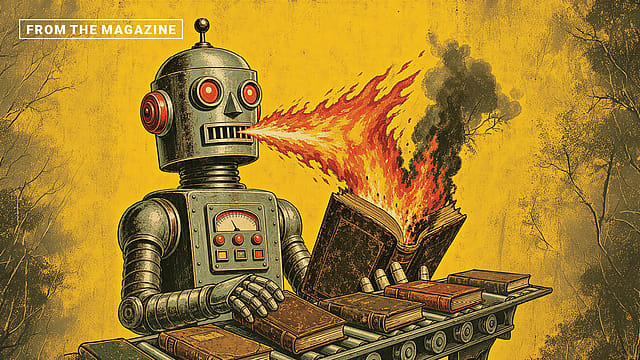
But then there is a problem. These AI giants are scanning these books in such a way that they are finally shredded and destroyed.
First, the spine and the binding of a book are sliced off with hydraulic cutters to make the scanning fast and massive. Feeding loose papers into industrial scanners makes the process efficient. After that, the books are shredded with no mercy. An investigation by US news outlet 404 Media has tracked such bulk orders of books, in one instance, to an Amazon facility, where the books are industrially scanned and permanently destroyed.

Losing Memory
16 Oct 2026 - Vol 05 | Issue 42
The making of a medical and social emergency
Similar accusations have emerged against Anthropic for destroying physical books to train their models, in order to gain a competitive advantage. Legal loopholes across countries allow AI companies to get away with shredding such books because what you do after you make a purchase is your choice. The whole exercise is done in secrecy, bringing to the fore the extent to which generative AI giants go to train their LLMs and launch frequent upgrades of their older models to stay ahead of the race as competition heats up. One such operation is called Project Panama by Anthropic. Older books, especially those written before 2022, are seen as more original and cleaner because they were written before the advent of ChatGPT by OpenAI, which helps people write stories and books.
In August, a group of civil society groups in the US, called the Demand Progress Education Fund, requested the Federal Trade Commission to start a book probe into this practice of bulk buying, scanning, digitising and destruction of culturally and historically valuable physical books by AI companies to gain market advantage and train their LLMs. They have called it the “destructive new data acquisition practice” by dominant artificial intelligence companies that leaves their “internal digital copy” as potentially the only surviving version of the source work. “We urge the FTC to view this practice not in isolation but rather as the latest escalation in a documented pattern of anticompetitive conduct designed to create an insurmountable systemic moat around AI incumbents— conduct which the FTC is already watching under your leadership,” the coalition said in a letter to the FTC.
The global response to such destruction of rare books has been strong, especially from historians, writers, artists and even a section of technologists who aver that once destroyed, these rare books—which often number only a handful of copies—are lost forever in their physical form, obliterating historical value of such works. All this is to fuel generative AI development.
The question that arises is this: is this digitisation which erases unique historical records ethical?
In fact, these old and rare texts are essentially irreplaceable and therefore any action to eliminate such historical evidence in physical form is a direct attack on the culture and history of the world.
Although this kind of destructive form of scanning is easy, experts point out that AI training doesn’t actually require it to be done this crudely. Books can often be scanned, photographed or digitised non-destructively. What must also be considered is that physical books contain information which scans can easily miss. Experts argue that paper quality, binding, annotations, marginalia, stamps, handwriting, illustrations, and even evidence of how a book was used can be historically significant and therefore their destruction is an immoral act.
This practice by AI companies that are moving heaven and earth to upgrade their LLMs at a fast clip appears to reach ridiculous proportions because this also harms the cultural heritage of mankind. After all, rare books aren’t merely containers of text. Instead, they are artefacts that document literature, science, politics, printing and everyday life. What the AI giants forget is that technology changes—meaning models may become obsolete—and destroyed books cannot be recovered, making the loss of cultural and historical value permanent.
What, again, must worry rulers across the world and the human race is the extremes to which these AI behemoths go to achieve their short-term goals and undermine the whole human tendency to preserve its past, as is obvious from the endless museums built across the world.
By allowing for books to be destroyed on a whim, the world ends up incentivising greed and ruthless commercial efficiency over respect for history and preservation. In the end, AI training of LLMs is a temporary exercise while the preservation of rare cultural artefacts is not.
The American civil society groups, in their letter to FTC, outlined that “this practice is the latest prong in a broader strategy to systematically convert crucial inputs of competition into private moats—through predatory talent acqui-hires, cloud computing lock-ins, exclusive data and distribution deals that wall off resources to competitors and entrants, and now the demolition of the physical secondary book market”.
Arguments have emerged in favour of AI companies, too, with a few columnists stating that the scenario is not as scary as it sounds, and that destructive scanning is making information more accessible to the masses. One of them contends that this effort by AI companies will only democratise access to books, both rare and out of print ones. Well, what then explains the secrecy around all this? After all, it is mostly the proxies and intermediaries of AI behemoths that are on a buying spree of books from bookstores, especially second hand bookstores, only to destroy them. This cannot be seen as anything short of avoiding regulatory scrutiny from the consolidation tactics zealously employed by AI giants. If the process were transparent, things would have been seen differently than they are now. Similar efforts can be seen in the way the disadvantages of data centres are concealed by generative AI companies, which in several parts of the globe are competing directly with municipal drinking water and power suppliers for resources. Urban-centric data centre expansion is often justified by obscure columnists in the name of unemployment – ignoring that it is happening in a largely automated environment and in many cases in the name of digital sovereignty, while still using foreign software and hardware.
Books were burnt or decimated for various other reasons in the past—religious bigotry, political authoritarianism, communal hatred. Destruction of books indeed has a long history. This time around, it is purely commercial!