World Nomad Games 2026 Explained: The Sports, the Stakes and What Survives Closing Night
In one contest, the task is to wrestle another rider off his horse. In another, it is to scoop coins from the ground without dismounting. Elsewhere, the struggle unfolds across a board, with calculation taking the place of muscle.
The World Nomad Games bring these very different tests into the same arena. As the sixth edition reaches its scheduled conclusion in Kyrgyzstan on Sunday, September 6, the spectacle comes with a harder question: how do you keep a tradition alive when the way of life that sustained it has changed?
At Ornok, in the Issyk-Kul region, one answer is taking shape in stone. Sixteen new sculptures will remain after the athletes leave. But the Games’ larger ambition depends on something less permanent than a monument: people continuing to ride, wrestle, play and pass on what they know.
Are the World Nomad Games ending today?
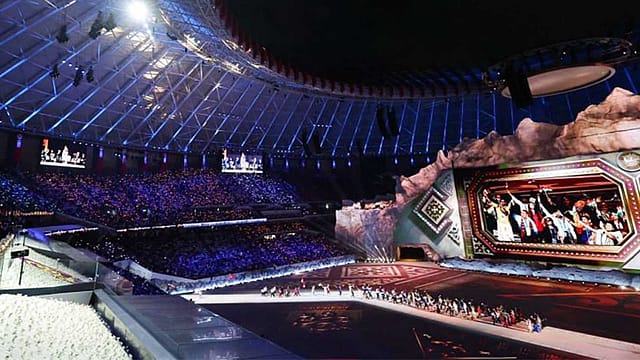
Yes. The official programme schedules the closing ceremony for Sunday, September 6, at the Cholpon-Ata Hippodrome, with concerts, fireworks and the ceremonial handover of the right to host the next edition. The Games opened at Bishkek Arena in the capital on August 31. The main competitions have been staged in the Issyk-Kul region from September 1 to 6. Kyrgyzstan’s state news agency Kabar reports participation by more than 3,000 athletes from 109 countries. The organisers’ sports catalogue lists 43 disciplines.

Zeroing In on ECI
09 Oct 2026 - Vol 05 | Issue 41
Constitutional legitimacy versus political opportunism
What exactly are the World Nomad Games?
They are an international competition and cultural festival built around traditional sports, particularly those associated with nomadic peoples. The organisers describe a project to preserve traditional games and cultural heritage while bringing countries together through competition. That produces a programme much broader than horse racing: wrestling, strength contests, archery and strategy games sit alongside music, crafts and other cultural events. The important word is “traditional”, not “ancient”. These are practices people still perform, teach and adapt. Putting them into international competition gives them rules, rivals, audiences and a reason for another generation to learn.
How did the Games begin—and why is their return to Kyrgyzstan significant?
Kyrgyzstan launched the first edition in 2014 at Cholpon-Ata. According to the Games’ official history, it brought together 583 athletes from 19 countries competing in 10 disciplines. Kyrgyzstan also hosted in 2016 and 2018. The fourth edition took place in Iznik, Türkiye, in 2022; the fifth was held in Astana, Kazakhstan, in 2024. This year’s tournament is therefore both the sixth edition and a homecoming. The expansion matters. An event rooted in Kyrgyzstan’s heritage has acquired an international circuit. Its challenge now is to make traditions accessible to a worldwide audience without stripping away the knowledge and meaning that made them worth preserving.
Why does kok-boru attract so much attention?
Because it demands control of a horse, possession of a contested object and the ability to withstand opponents trying to take it away. In kok-boru, two mounted teams compete to carry an ulak into the opposition’s goal. Traditionally, the ulak is a goat carcass; UNESCO’s account of the game also notes the use of a moulded substitute in modern play. The result combines riding skill, strength and collective tactics. A player must compete for possession while managing an animal with its own speed, balance and reactions.
UNESCO inscribed kok-boru on its Representative List of the Intangible Cultural Heritage of Humanity in 2017. Its description places the game within a wider community of players, trainers and knowledge bearers. What spectators see on the field rests on skills acquired well before a match begins.
What other horse sports explain the Games’ appeal?
Er enish makes the contest startlingly direct: two riders wrestle from the saddle. Under the official description, a rider wins by bringing an opponent off the horse so that part of the opponent’s body touches the ground. The organisers trace the discipline to military training. The horse’s stability and responsiveness are part of the contest, not incidental to it.
Tyiyn enmei, also described by the organisers as tenge ilu, tests a different kind of control. Riders collect coins from the ground without dismounting, combining speed with the flexibility and balance needed to reach down from a moving horse. Both make an everyday relationship central to the sporting challenge: how well can rider and horse work together?
Is everything about horses and physical strength?
No. Some of the sharpest contests require a board and careful counting. The official sports list includes toguz korgool, mangala and oware among its traditional intellectual games, alongside wrestling styles, archery, strength sports and hunting-related disciplines. In UNESCO’s description of the related togyzqumalaq, toguz korgool and mangala traditions, players distribute counters through pits or holes, seeking to collect the most. Boards can be purpose-made; the playing spaces can also be dug into the ground.
There is also the deceptively simple-looking mas-wrestling, or tayak tartysh. The organisers explain that opponents sit facing each other, feet braced against a board, and pull on a shared wooden stick. Victory comes by taking the stick or pulling the opponent across. Different equipment, same unforgiving proposition: someone else is trying to undo your plan.
Why do these traditions need safeguarding?
Because a game can disappear when the circumstances in which people learned it disappear. UNESCO’s account of Kyrgyzstan’s safeguarding programme links the country’s cultural heritage to nomadic life and says forced settlement during the Soviet period endangered elements of that heritage, including traditional games.
The revival involved more than staging a festival. Practitioners and knowledge bearers came together at a major meeting in 2007, helping efforts to identify and document games across different regions. UNESCO placed “Nomad games, rediscovering heritage, celebrating diversity” on its Register of Good Safeguarding Practices in 2021. That recognition concerns the work of recovering and transmitting heritage. An international tournament provides visibility. Safeguarding asks the longer-term question: who will know how to play when today’s experts are gone?
What do the 16 new sculptures add?
They give the Games a permanent physical legacy—and broaden the picture of nomadic life beyond competitive prowess. Kabar reports that the works have been installed at the Centre for Nomadic Civilisation in Ornok. Sixteen projects were selected from more than 75 proposals, and sculptors spent a month working primarily with Uzgen travertine.
Among them is Bakyt Imanbaev’s “Zhargylchak”, inspired by a traditional grain-grinding tool used by Kyrgyz women to prepare flour and talkan. Its subject brings domestic work into a festival whose sporting images can be dominated by riders and wrestlers. Another work, “Ozök”, explores the foundations of nomadic culture through traditional ornament and contemporary form. Citing the Games’ media headquarters, Kabar says the sculptures will remain as a permanent open-air collection. Imanbaev’s hope is that future generations will read them as evidence of both the 2026 Games and the ideas their artists wanted to preserve.
Is there a diplomatic purpose too?
Yes. Hosting gives Kyrgyzstan a platform to present its culture and convene international visitors. The Shanghai Cooperation Organisation says heads of delegations attending its summit were present at the opening ceremony. Its account explicitly connects the Games with cultural contacts, mutual understanding and relations between peoples. That is cultural diplomacy through a sporting event: the host country decides what the world sees of it, while visiting delegations meet in a setting built around shared participation. The test after closing night is more local. Sculptures can preserve a record of the Games. Keeping the games themselves alive requires players, teachers, horse handlers and communities willing to carry them into the next year—not just the next tournament.
With inputs from ANI & agencies