Who Are the Iranian Kurdish Fighters Opening a Potential Second Front Against Tehran?
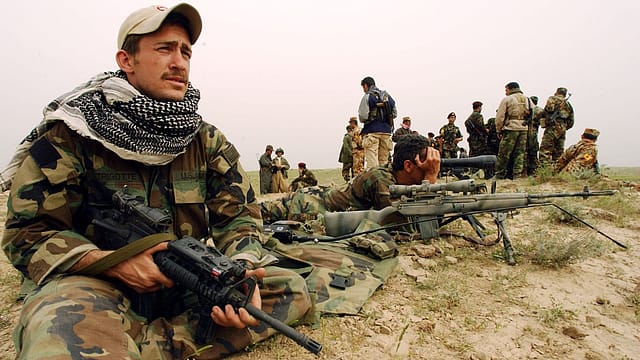
Tensions across West Asia continue to rise across multiple fronts, and attention is now turning to a lesser-known but potentially influential force gathering in the rugged mountains along the Iran-Iraq border.
Iranian Kurdish fighters, many of them long in exile and shaped by years of insurgency, are increasingly emerging as a key element in a rapidly evolving geopolitical calculation.
Here is a closer look at who they are and the role they may play in the unfolding conflict.
Who are the Kurdish fighters opposing Iran?
Iranian Kurdish fighters consist of exiled political-military groups operating from northern Iraq’s Kandil Mountains.
The three principal organisations involved are the Kurdistan Democratic Party of Iran (KDPI), Komala, and the PJAK (Free Life Party of Kurdistan).
Flood and Fury
04 Sep 2026 - Vol 05 | Issue 36
Devighat, Nepal, August 29, 2026
Predominantly Sunni Muslim, these groups have opposed Tehran’s centralised authority for decades and have sought either greater autonomy within Iran or, in some cases, full independence.
Among them, the Kurdistan Freedom Party (PAK), led by Hussein Yazdanpanah, is widely regarded as the most militarily active formation at present.
Reports indicate that several of these groups have recently formalised cooperation through the creation of the “Coalition of Political Forces of Iranian Kurdistan”, a joint platform designed to coordinate political and military efforts aimed at challenging the Islamic Republic.
Are they actually battle-hardened?
Yes, and their experience is rooted in decades of guerrilla warfare. These fighters are not newly formed militias but insurgents who have spent years conducting low-intensity operations against the Islamic Revolutionary Guard Corps (IRGC) from bases in the mountainous terrain near the Iran-Iraq border.
Their tactics have typically included ambushes, raids on border outposts, and swift hit-and-run attacks carried out in terrain that has repeatedly complicated Iranian military operations.
Defence analysts note that their mountain bases serve not only as hideouts but also as training grounds and operational centres, giving them a structural advantage in a landscape where conventional military units often struggle to operate effectively.
What role are they playing in the West Asia conflict?
Kurdish fighters are believed to be preparing to move into western Iran, potentially opening a new ground-level insurgency that could compel Tehran to contend with multiple pressure points at once.
According to The Wall Street Journal, their targets include IRGC facilities, border posts, and security installations, with the aim of weakening Iran’s internal security infrastructure.
At the same time, the newly formed coalition is reportedly attempting to mobilise protesters within Iran’s Kurdistan Province.
The effort seeks to tap into lingering anger following the nationwide protests that erupted after the death of Mahsa Amini in 2022, with the intention of encouraging broader unrest against the Iranian state.
Are the US and Israel involved?
Reports have suggested possible external involvement, although details remain unclear.
According to Axios, American and Israeli intelligence officials have been in discussions with Kurdish groups, and there have been indications of potential arms transfers as part of efforts to create what officials describe as a “second front” against Iran.
In addition to possible military support, Kurdish groups could also provide on-the-ground intelligence that might assist US and Israeli air operations.
Such cooperation could allow external forces to strike IRGC positions more effectively while Kurdish fighters potentially secure or monitor targeted areas.
How does this stretch Iran’s military?
Operations inside Iran’s western regions would compel the IRGC to divert troops and resources away from other theatres of conflict.
At a time when the country’s military is already dealing with pressures linked to the broader West Asia crisis, the need to reinforce security within its own borders could significantly complicate Tehran’s strategic calculations.
Analysts say this dynamic works to the advantage of Iran’s adversaries, since it forces the Iranian military to disperse its strength across multiple fronts without necessarily requiring additional large-scale deployments from opposing forces.
What is the risk of regional spillover?
The situation carries the potential to widen the conflict beyond Iran’s borders.
The Economic Times has reported that Iran has already launched strikes against Kurdish bases located within Iraqi territory, a move that risks drawing Iraq into a confrontation it has been keen to avoid.
The Kurdistan Regional Government in northern Iraq finds itself in a particularly difficult position.
While the exiled Kurdish fighters operate from areas within its jurisdiction, the regional authorities cannot afford to appear as though they are allowing their territory to be used as a launchpad for attacks against Iran.
Could this trigger a wider uprising inside Iran?
The possibility exists, though the outcome remains uncertain. Kurdish groups are actively seeking to mobilise communities within Iran’s Kurdistan Province, where resentment against the authorities has remained strong since the heavy-handed crackdown on the protests of 2022.
Whether an armed insurgency can translate into a broader and sustained uprising across the country will largely depend on how many ordinary Iranians are prepared to confront the state at a time when the government’s security apparatus continues to exert tight control.
What does this mean for the broader West Asia conflict?
The emergence of a Kurdish insurgent front would significantly alter the character of the wider conflict.
What has largely been a confrontation defined by air strikes, missile exchanges, and naval manoeuvres could evolve into a multi-theatre struggle that includes active ground operations inside Iran.
For Tehran, already engaged in multiple external confrontations, the prospect of defending territory within its own borders introduces a new and potentially decisive dimension to the crisis, one that could shape the trajectory of the conflict in the months ahead.
(With inputs from yMedia)