War on Iran: The Price of Syrianisation
ON FEBRUARY 28, when US President Donald Trump authorised Operation Epic Fury and launched joint, coordinated strikes on key military sites and leadership positions in Iran, the US and Iran entered their first direct military confrontation. Since 2024, when Israel began escalating against Iran and its network of regional allies through deliberate phases, a key Israeli goal has been to expand American operational involvement, first in defensive and gradually in offensive operations, against Iran. Iran’s telegraphed retaliatory strikes on Israeli bases after Israel struck its consulate in Damascus in April that year brought the long-running Israel-Iran shadow war through proxies to the first direct state-to-state missile and drone strikes. The US, alongside the UK and France, joined Israel in mounting a coordinated, multi-layered defence against Iranian projectiles in April and again in October. In June 2025, Israel launched a sustained air campaign, starting with the decapitation of the Islamic Revolutionary Guard Corps (IRGC) leadership, targeting nuclear facilities and missile sites, and ending with US B2 bombers dropping bunker-buster bombs on Iran’s underground nuclear enrichment sites.
Since October 7, 2023, Israel has been committed to realising its vision of “the New Middle East”, taking the war to Iran, and seeking to force a regime collapse through destabilisation. By degrading the Iranian-led axis of resistance and exposing Iran’s military vulnerabilities, Israel has successfully convinced the US to act on the window of opportunity to make the final push against Iran. Trump, by embracing “peace through strength” as a foreign policy doctrine, has been keen to leverage threats and the use of military power to seek rapid political-economic wins and shape a new regional architecture not just in the Western hemisphere but also in the Middle East. In the run-up to the Israeli attack on Iran in June last year and the coordinated US-Israeli strikes this time, Trump engaged in unsuccessful coercive diplomacy against Iran. Each time, Tehran has chosen confrontation over what it views as strategic surrender. The US-Israeli attacks have failed to soften Iran into accepting the US’ maximalist demands on Iran’s nuclear and missile programme. Not only has the US fundamentally misread Iranian strategic culture, but by signalling regime-change ambitions, it has pushed the Islamic Republic towards an existential framing of the war and greater risk acceptance.
The Islamic Republic of Iran was established as a revolutionary ideological system. Ayatollah Khomeini’s interpretation of Shi’ism as a justice-seeking religion, the creed of the oppressed masses against unjust and oppressive power, lies at the core of Iran’s Shia Islamic ideology.
The Islamic Republic views the existing international order as intrinsically unjust and places national independence and resistance to US hegemony—described as “global arrogance” by Khomeini—at the core of its legitimacy and self-image. Beyond pure ideological flourish, the Iranian leadership has periodically recalibrated revolutionary ideology with pragmatic geopolitics of survival, such as cooperating with the Bush administration to remove the Taliban from power and negotiating a nuclear deal with the Obama administration that allowed Iran to retain a minimal enrichment capacity—framed by Iran as a sovereign right under the Non-Proliferation Treaty (NPT)—in exchange for intrusive monitoring and transparency measures. However, Trump’s unilateral withdrawal from the nuclear agreement with Iran in 2018 and the launch of sanctions-based “maximum pressure” against Iran hardened perceptions that the US was waging an “economic war” aimed at regime collapse. Supreme Leader Ayatollah Khamenei declared that the US-Iran confrontation was “a struggle of wills” and there would be “no talks and no war” with the US.
Emboldened by the US pressure campaign against Iran, Israel escalated its “campaign between the wars” through a sustained strike campaign against Iranian assets in Syria, a series of grey-zone attacks targeting Iran’s nuclear and military sites, and attacks on Iranian shipping carrying oil and military equipment to Syria and Lebanon. Iran’s IRGC responded by incorporating an offensive element to its deterrence posture. In January 2020, when Iran’s Quds Force Commander Qasem Soleimani was killed in a drone strike ordered by Trump, the IRGC responded by launching telegraphed missile strikes on US bases in Iraq. Since then, Iran’s celebrated response to Israel’s deliberate escalation has been designed to avoid a full-fledged war with the US on Israel’s side. But Israel and the US viewed Iran’s restraint as weakness and were emboldened to cross dangerous thresholds with each escalation.
Khamenei’s doctrine of “strategic patience”, which entailed absorbing losses to avoid an all-out war, became unsustainable as Trump entered the Israeli campaign to destroy Iran’s nuclear and missile programme and Israeli Prime Minister Benjamin Netanyahu openly called on the Iranian people to rise against the Islamic Republic. Last June, when the US bombed Iran’s nuclear facilities, Tehran signalled its willingness to expand the scope of the conflict to the Gulf States by retaliating with a missile strike on the US Central Command forward base at Al Udeid in Qatar.
The US launching the war alongside Israel has created a direct US-Iran escalation dynamic, and Iran has responded by regionalising the war from the outset. Iran has a wider set of escalation options against US bases in the Gulf, using its more accurate and larger arsenal of short-range ballistic missiles (SRBMs) and cheaper kamikaze Shahed drones, which can be used more effectively in the Gulf than against Israel. Furthermore, Iran is now fighting a “war of balance”, using escalation as a tool to not only impose enough costs on the US and its regional allies but also to ensure that war risks are felt globally. Tehran hopes to establish a new deterrence equation in which the security of the Gulf States—deeply embedded in global energy, capital and trade networks—cannot be insulated from the trajectory of escalation and pressure against Iran.
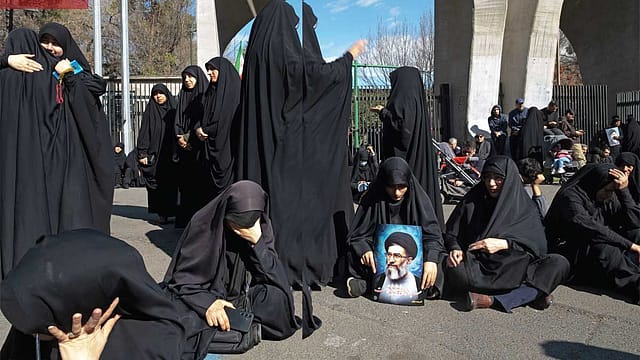
If the US believed that assassinating Khamenei would create conditions for elite fracture or societal mobilisation against the regime, the strategy seems to have backfired. Iranian political elites, who collectively see their survival at stake, have closed ranks. For many Iranians, the martyrdom of Khamenei, along with most of his family members, evokes the ultimate tragedy of the Battle of Karbala and the sacrifice of Imam Hossein.
Among the Iranian population, Shia imaginaries and deeply rooted nationalist exceptionalism create a strong sense of endurance and nationalist defence in times of crisis. Amid reports that Israel is bombing Iranian Border Guard positions in Western Iran and arming Iranian Kurdish separatist groups to enter from Iraq, the spectre of territorial disintegration only reinforces the regime’s narrative that the Israeli-US plan is not to liberate the country but its “Syrianisation”, a powerful shorthand for a country marred by civil strife. The threat of territorial dismemberment of Iran by foreign powers has the effect of uniting the opposition and the Islamic Republic. Even Reza Pahlavi, the son of the deposed Shah, who has supported the war against Iran, had to take a stand against the separatist ambitions of Kurdish dissidents. The legitimacy of the Islamic Republic as the provider of security lies in tatters, but to prove that “Tehran is not Damascus”, it will not go down without fighting.