What Went Wrong at LaGuardia Airport? Inside the Air Canada Runway Collision
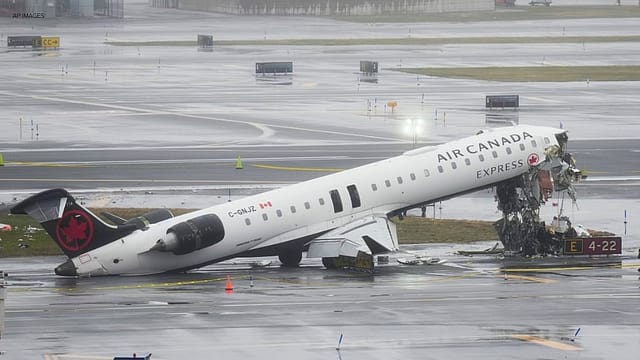
A fatal runway collision at New York’s LaGuardia Airport has exposed the thin margins of modern air traffic control.
Late on March 22, an Air Canada Express CRJ-900LR struck a fire truck during landing, killing both pilots and injuring 41 people, with nine still critical.
Early evidence points to a clearance error during a simultaneous emergency, now under scrutiny by the NTSB.
Here’s a more detailed look.
What happened at LaGuardia Airport on March 22?
At around 23:40 local time (03:40 GMT) on March 22, Air Canada Express Flight 8646 collided with a Port Authority fire truck while landing on Runway 4 at LaGuardia.
The aircraft’s nose was heavily damaged after impact, marking one of the most serious ground collisions in recent US aviation history.
Which aircraft and agencies were involved in the crash?
The aircraft was a Mitsubishi CRJ-900LR operated by Jazz Aviation under the Air Canada Express banner.
The fire truck belonged to the Port Authority’s Aircraft Rescue and Firefighting unit. The NTSB has taken charge of the investigation, with Canadian authorities assisting due to the aircraft’s origin.

Open Minds 2026
26 Jun 2026 - Vol 05 | Issue 26
The power of ideas and arguments in 50 portraits
What caused the runway collision during landing?
Preliminary findings suggest the fire truck had been cleared to cross Runway 4 at Taxiway D just as the Air Canada CRJ-900LR was touching down.
Hampered by heavy rain and limited visibility, the driver failed to spot the approaching jet.
ATC audio captures a controller shouting, “Stop, Truck 1. Stop!” moments before impact, as the aircraft, travelling at high speed, struck the vehicle.
How severe were the casualties and injuries?
Both pilots were killed on impact, while 41 passengers and crew were taken to hospitals. Nine individuals remain in serious condition.
Survivors include a flight attendant who was ejected but found alive, highlighting both the force of impact and moments of chance survival.
Was there another emergency unfolding at the same time?
The fire truck was responding to a separate United Airlines incident involving a reported cabin odor.
This “dual emergency” forced controllers to manage two high-priority situations simultaneously, increasing the risk of miscommunication during a critical landing window.
What do early ATC recordings and data reveal?
Air traffic control audio reviewed by investigators suggests confusion in sequencing runway movements.
According to CBC, one controller later admitted the error, reportedly saying, “I messed up,” reflecting the pressure of handling overlapping emergencies in a constrained operational environment.
What role could staffing shortages and fatigue have played?
Early reports indicate that La Guardia was operating below optimal staffing levels. While Transportation Secretary Sean Duffy said the airport had 33 controllers on duty, he acknowledged it remained 4 short of its target.
Investigators are also examining the use of a single controller handling both ground and air traffic during the crash, a combined role now under scrutiny.
The US faces a shortage of nearly 3,000 controllers.
What is the current status of the NTSB investigation?
The NTSB has recovered both the cockpit voice recorder and flight data recorder. According to CNN, investigators are focusing on timing, communication logs, and runway protocols.
Runway 4 remains closed as debris analysis and reconstruction efforts continue at the crash site.
What are the broader implications for aviation safety?
The LaGuardia crash raises deeper concerns about how modern aviation systems handle simultaneous emergencies.
It underscores the fragility of coordination in high-density airspace and may prompt renewed scrutiny of staffing norms, training standards, and real-time decision-making under pressure.
(With inputs from yMedia)