What Is a ‘Jellyfish Drone’? The Mysterious Formation That Shocked US Intelligence Officials
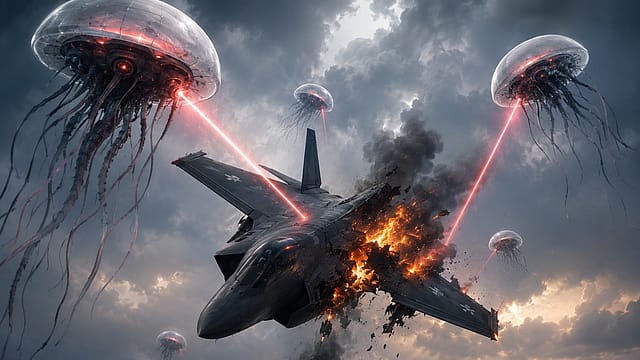
When a US pilot ejected from his downed F-15 fighter jet over Iran in April, he reported something that left intelligence officials deeply unsettled. According to CNN, he described multiple Iranian drones moving in perfect unison, forming a shape that resembled a jellyfish. The account triggered fierce debate inside the US intelligence community about whether Iran has quietly developed a drone capability that no Western agency knew existed.
Who Is the US Pilot and What Did He See Over Iran?
The F-15 pilot shared his account during a debriefing with intelligence officials after being rescued by special forces. He described interconnected Iranian drones moving as one, with smaller drones hanging below larger ones like legs. A source also told CNN the US pilot described encountering a "minefield of drones" before ejecting from his fighter jet.

Greening the Future
23 Jul 2026 - Vol 05 | Issue 30
Securing a sustainable India
What Is a Jellyfish Drone Formation?
The technical term for what was described is "one-to-many meshed networking." This allows a single operator to command several Iranian drones simultaneously, enabling them to move as a coordinated unit. Russia and China are believed to possess this capability, but it was not something US intelligence had previously assessed Iran possessed.
Could the Iranian Drone Swarm Have Brought the Fighter Jet Down?
While the exact cause of the F-15 downing remains under investigation, initial assessments suggested the Iranian drone formation may have in some way enabled the aircraft to be shot down. It marked the first time a US fighter jet has been downed over Iran during the conflict.
Was the US Pilot's Account Considered Reliable?
Intelligence officials were not immediately convinced. The US pilot was concussed during the crash and had previously been shot down in a friendly fire incident involving Kuwaiti forces. Officials questioned whether he saw a real capability or a stress-induced misperception.
Did China or Russia Help Iran Build This Technology?
Iran had reportedly been receiving assistance in developing its drone technology from both China and Russia, raising significant concern among US allies in the region.
How Dangerous Could Coordinated Iranian Drone Swarms Be?
According to CNN, drone warfare expert Emma Bates warned that an Iranian drone swarm capable of maintaining formation, carrying explosives, and striking secondary targets would represent a formidable threat requiring enormous resources to counter.
What the US pilot saw over Iran may never be fully confirmed. But the possibility that Iranian drones can coordinate and down a fighter jet has already forced a reckoning inside the American defence establishment that shows no signs of resolution.
(With inputs from yMedia)