US-VENEZUELA OIL DEAL | 65 Billion Barrels, 100 Years & India’s New Crude Calculus
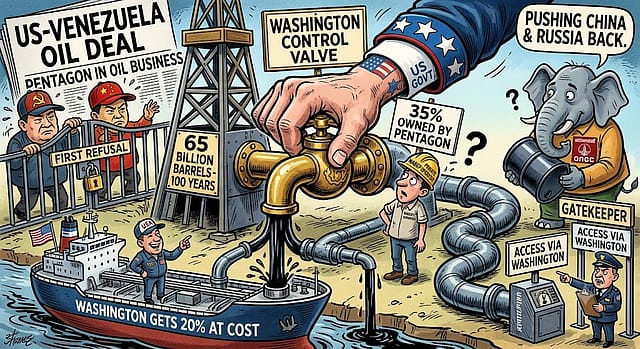
Donald Trump did not buy Venezuela’s oil. He found a more inventive route into it.
A private company will receive 100-year concessions over 17 Venezuelan oilfields containing an estimated 65 billion barrels. The United States government will acquire a 35 per cent stake in its corporate parent. Washington will be entitled to buy 20 per cent of the company’s current and future production at cost and will receive the first opportunity to purchase the remaining 80 per cent.
The company’s board must have an American majority. The US government can veto appointments. The agreement will be governed by American law and disputes placed within the jurisdiction of US courts.
The Pentagon has entered the oil business without purchasing an oilfield. The arrangement brings the US into an extraordinary partnership with North American Blue Energy Partners, or NABEP, a private operator controlled by Venezuelan businessman Alejandro Betancourt. Venezuela’s ruling party-dominated National Assembly approved the deal on September 1, ahead of a visit by US Energy Secretary Chris Wright.

Zeroing In on ECI
09 Oct 2026 - Vol 05 | Issue 41
Constitutional legitimacy versus political opportunism
Trump has called it the biggest oil deal in history. It is certainly among the strangest. A defence department investment office will become a shareholder in a private Venezuelan operator. The State Department will receive preferential access to its crude. Venezuela promises concessions extending into the next century. Private investors are expected to supply as much as $100 billion to rebuild fields and infrastructure.
China and Russia lose influence over strategic assets. India gains a possible route back into a country where its state oil company already owns fields and more than $500 million in unpaid dividends. It may also discover that Venezuelan oil has acquired a new gatekeeper.
What Exactly Has America Acquired?
The White House describes the agreement as giving the US “majority control” over more than 65 billion barrels of proven Venezuelan reserves. That requires unpacking. The United States has not annexed Venezuelan territory or transferred the underground resources to American sovereign ownership. Venezuela’s hydrocarbons remain constitutionally owned by the state. NABEP will instead receive concessions over 17 fields, principally in the Orinoco Belt and Lake Maracaibo region.
The concessions are expected to run for 100 years. The Pentagon’s Office of Strategic Capital will obtain a 35 per cent equity interest in NABEP’s corporate parent. The stake is being granted without payment by the US taxpayer, according to the White House fact sheet.
That explains the administration’s “zero cost” claim. It does not mean developing the oil will cost nothing. Venezuela’s fields need drilling equipment, pipelines, electricity, storage, diluent, upgrading facilities, ports and years of maintenance. NABEP says it could invest up to $100 billion and raise its production from approximately 170,000 barrels a day to more than one million.
That money must come from the company and private investors. The American government receives equity, governance rights and preferential crude access without directly financing the promised reconstruction. It is a remarkable exchange. Venezuela supplies the century-long concession. NABEP supplies the operating structure. Private capital assumes the development risk. Washington receives influence over the company and an oil-purchase option extending across its present and future fields.
What Does “Oil at Cost” Mean?
The State Department will have the right to acquire 20 per cent of NABEP’s production at its production cost rather than the prevailing market price. If applied exactly as described, this could deliver crude to the US at a substantial discount during periods of elevated global prices.
Washington could direct some of that oil towards its Strategic Petroleum Reserve, military requirements or other sensitive uses. The administration has also linked the agreement to lower fuel prices and a more secure Western Hemisphere supply chain.
The difference between production cost and market price becomes part of America’s economic benefit from the arrangement. The remaining 80 per cent is not automatically American property. However, the State Department will possess a right of first refusal. If NABEP offers that oil for sale, the US gets the opportunity to match the terms before another buyer takes it.
This does not guarantee that every barrel will travel to an American refinery. It gives Washington enormous influence over where those barrels can go. A Chinese, Russian or Indian buyer may theoretically remain eligible. The United States would receive the first look.
Why Is the Pentagon Buying Oil Equity?
The Office of Strategic Capital was created to mobilise investment into industries considered important to US national security. Its usual vocabulary belongs to critical minerals, advanced manufacturing, semiconductors, batteries and defence technology. A passive stake in a Venezuelan oil operator marks a striking expansion of that logic.
Oil has always been strategic. What is unusual is the mechanism. The Pentagon is not deploying troops to guard a field or awarding a conventional fuel-supply contract. It is using an equity position to embed the US government within the ownership and governance of a private energy company.
The instrument resembles industrial policy conducted through a balance sheet. Washington gains dividends if the business succeeds. It can influence the board. The State Department acquires preferential crude rights. Private investment performs much of the expensive rehabilitation.
Capital becomes an extension of foreign policy. The approach also places the US government in potential competition with American companies. ExxonMobil and ConocoPhillips left Venezuela after the government of Hugo Chávez nationalised their assets in 2007. Both have continued demanding legal certainty and respect for contracts before committing new capital.
Some major producers were reportedly uneasy about operating beside Betancourt and competing with a company in which their own government holds an equity position. Trump needs the oil majors’ capital, engineering and technical ability to revive Venezuela. The government-backed operator could make them more cautious.
Why Is Washington Targeting China and Russia?
Venezuela became increasingly dependent upon China and Russia as its relations with the US collapsed.
Chinese lenders supplied tens of billions of dollars, often secured against future oil deliveries. Russian companies entered energy projects and helped Caracas market crude during periods of sanctions. Moscow also provided political and military support to the Nicolás Maduro government.
For Washington, that influence created an adversarial foothold in the Western Hemisphere. The new deal attempts to reverse it. The 17 fields include assets previously influenced or operated through Russian and Chinese corporate structures. By placing them under a private operator with American government ownership, US-majority governance and preferential American purchasing rights, Washington is trying to redirect the oil economy westwards.
This is the Monroe Doctrine rewritten for private equity. The United States is not merely asking Venezuela to distance itself from China and Russia. It is building corporate structures designed to make the separation durable. A government may change. A 100-year concession is intended to outlive several of them.
Who Is Alejandro Betancourt?
Betancourt’s central role supplies the deal with its most controversial human element. He is a Venezuelan businessman associated with energy, infrastructure and investment ventures. His companies reportedly maintained oil operations during years when Venezuela’s production system was deteriorating.
NABEP reportedly produces approximately 170,000 barrels a day. Betancourt has also faced scrutiny over past dealings connected to the Maduro-era economy. Authorities in the United States and Europe have reportedly examined matters involving him, although he has not been charged. He has previously denied allegations of wrongdoing. US officials have defended the partnership by pointing to his operational record, previous assistance to Washington and reported support for opposition leader Juan Guaidó.
One official supplied an unusually candid character reference. “I’m not nominating anyone for sainthood here,” the official underlined. “What I am telling you is that this is a person that, in the past, has been helpful to the United States government.”
That may be honest realpolitik. It is not a substitute for transparency. NABEP could receive rights over fields containing roughly one-fifth of Venezuela’s proven oil reserves. The US government could become a significant shareholder. The proposed concessions may endure for a century. The identities of investors, financing obligations, revenue-sharing terms, independent audits and rules governing conflicts of interest will, therefore, require scrutiny well beyond a White House announcement.
Can Venezuela Legally Lease the Fields for 100 Years?
The National Assembly’s approval strengthens the deal politically. It does not remove every constitutional question. Venezuela nationalised its petroleum industry in the 1970s. The constitution and hydrocarbons framework reserve ownership of underground resources for the state and historically required PDVSA-controlled structures for core operations. The country has since enacted energy reforms allowing substantially greater private participation. The White House says the NABEP concessions were granted under the new hydrocarbons law.
Critics are likely to ask whether private concessions of this duration preserve meaningful state control and whether an American government stake conflicts with Venezuelan sovereignty. There is also the durability problem. A contract governed by US law can regulate relations within NABEP’s corporate structure. It cannot eliminate the political risk that a future Venezuelan government rejects concessions issued during an interim administration. Exxon and ConocoPhillips remember what happened when Venezuela rewrote the rules in 2007. A 100-year document is valuable only if successive governments continue respecting it.
Will 65 Billion Barrels Flood the Market?
No. Reserves are not production. Venezuela possesses approximately 303 billion barrels of proven crude reserves, the largest reported total in the world. It currently produces only around 1.25 million barrels a day. The country once produced more than twice that quantity. Years of underinvestment, sanctions, corruption, electricity failures, equipment shortages, loss of skilled personnel and deteriorating infrastructure destroyed capacity. Some fields need extensive rehabilitation before production can rise meaningfully.
Venezuelan crude creates an additional technical challenge. Much of it is heavy or extra-heavy, particularly in the Orinoco Belt. It is dense, viscous and rich in sulphur. Moving it through pipelines may require lighter petroleum products as diluent. Refining it requires sophisticated equipment. The barrel exists underground. Extracting, transporting and converting it into useful fuel is the expensive part.
NABEP’s ambition to exceed one million barrels a day would transform the company and materially increase Venezuelan supply. It will not happen merely because the concession has been signed. Energy markets should distinguish the scale of the reserve announcement from the speed of arriving barrels. The first is enormous. The second could be slow.
Why Does Venezuela Accept This Deal?
Venezuela needs capital. Its oil industry supplies the economic foundation for government revenue, foreign exchange and imports. When production collapsed, the wider economy collapsed with it. The interim administration led by Delcy Rodríguez estimates that the arrangement could generate approximately $200 billion in royalties and taxes over its first 25 years. It promises employment, restored infrastructure and the recovery of petroleum output.
Washington presents that economic revival as part of a three-stage programme: stabilisation, reconstruction and democratic transition. The sequence is politically convenient. It allows the US to rebuild the oil economy before Venezuela conducts a fully credible national election. Officials argue that elections held without institutions, functioning political parties, independent media and economic stability could collapse into another authoritarian cycle.
Critics see a different sequence. Secure the oil first. Promise democracy later. Talks involving Venezuela’s 2015 National Assembly and recognised opposition leadership are expected to resume in September. No binding election timetable has been announced. A century-long oil concession may therefore acquire legal and commercial momentum before Venezuelans have voted on the country’s permanent political direction.
Why Does This Matter to India?
India is not a distant observer. ONGC Videsh holds 40 per cent of Venezuela’s San Cristobal field. Along with other Indian companies, it holds an 18 per cent interest in the Carabobo-1 project. ONGC said in August that it hoped to assume operatorship of two Venezuelan projects under the country’s reformed petroleum law. US sanctions relief has given the company greater freedom to invest and pursue recovery of more than $500 million in unpaid dividends.
Venezuela also produces the kind of crude several Indian refineries were built to exploit. Reliance Industries’ Jamnagar complex can process difficult, high-sulphur heavy grades. Indian Oil and Hindustan Petroleum have bought Venezuelan Merey crude. HPCL’s expanded Visakhapatnam refinery has greater ability to handle heavier feedstock. These refineries make money by buying discounted, complicated crude and turning it into higher-value fuels.
Venezuela can fit that model beautifully. In January, Reliance said it would consider purchasing Venezuelan oil if sales to non-US buyers were permitted. That final condition now matters more. The US agreement does not expressly ban sales to India. But Washington’s guaranteed share and first-refusal rights mean American requirements may receive priority. If Venezuelan production remains limited while US refineries, military users and the Strategic Petroleum Reserve demand supplies, fewer discounted barrels may reach other markets.
India’s opportunity and vulnerability sit together. American-backed rehabilitation could increase production, stabilise operations and help ONGC recover stranded value. A growing Venezuelan industry would diversify India’s crude basket during Gulf disruption and uncertainty surrounding Russian supplies. Yet the architecture places more influence over Venezuelan exports in American hands. India may gain access to more oil. The permission structure could become more American.
Does This Weaken Russia’s Position With India?
Potentially. Russia became India’s largest crude supplier after Western sanctions pushed Moscow to offer discounted barrels. That relationship gave Indian refiners an alternative to more expensive Gulf oil and allowed New Delhi to resist Western pressure over its purchasing decisions. A revived Venezuela offers another source of heavy, discounted crude. That could strengthen India’s bargaining power with Russia and Middle Eastern exporters. Refiners are most powerful when several suppliers compete for their capacity. But Venezuela cannot replace Russian volumes quickly. Freight from the Caribbean is substantial, production growth will take time and American purchasing rights may limit availability.
The greater strategic shift lies in Washington offering an alternative rather than merely demanding that India buy less Russian oil. The US can tell Indian refiners: diversify away from Moscow, and we can help reopen Venezuela. That is a more persuasive energy policy than sanctions alone.
Is This an Oil Deal or a New Foreign-Policy Model?
It is both. The Trump administration has fused energy security, defence investment, regime transition and commercial ownership into one agreement. A Pentagon office receives equity. The State Department acquires crude rights. A private operator receives century-long concessions. Venezuela gains a promise of investment. American refiners gain a potential source of heavy oil. China and Russia lose ground.
The arrangement may produce millions of barrels, billions in revenue and a more stable Venezuelan economy. It may also deter established oil companies, provoke sovereignty disputes, enrich politically connected actors and bind future Venezuelan governments to terms they did not negotiate.
The reserves are real. The legal durability, financing and production targets remain promises. India must, therefore, watch two flows. The first is physical: how many additional Venezuelan barrels actually reach the market. The second is political: who decides where those barrels travel. The United States has not taken Venezuela’s oil home. It has placed itself beside the tap.
With inputs from ANI