US Rejects Iran's Claim of Hormuz Closure As Pentagon Preps For Possible New Strikes
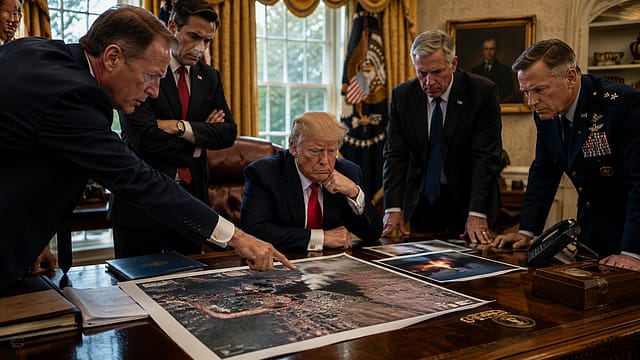
The US military on Wednesday rejected Iran's claim that the Strait of Hormuz is closed, even as Washington reportedly told the Pentagon to be ready to resume major combat operations against Iran. President Donald Trump, meanwhile, said the war would end "very quickly."
US Central Command (CENTCOM) responded to comments by Mohammadreza Naqdi, an adviser to the commander of Iran's Islamic Revolutionary Guard Corps (IRGC). He told the semi-official Fars news agency that the strait was closed, that Iran had "full control over it" and that transit routes Iran considers illegal would soon be shut.
"This is FALSE," CENTCOM said on X. "Traffic is flowing through the Strait of Hormuz right now carrying commercial goods and energy supplies, including 20 million barrels of crude oil. The United States and regional partners clearly control the strait."
Iranian Foreign Ministry spokesperson Esmaeil Baghaei said Tehran has "clearly and firmly" set out its conditions for ending the war on all fronts and restoring security to the Gulf and the strait. Iran would deliver its response to US proposals through mediators, he said, according to state broadcaster IRIB.

The Modi Years
02 Oct 2026 - Vol 05 | Issue 40
A Nation Rebuilt
Baghaei also said Iran and Oman had reached an understanding on safe passage through the strait, including the geographical coordinates of safe routes, and would soon present it to the relevant international body.
PEACE PLAN AND A COUNTERPROPOSAL
Foreign Minister Abbas Araghchi said that while Iran remains determined to defend itself, it is serious about diplomacy. He said Iran's delegation to the UN General Assembly in New York presented the US with a seven-day plan to reopen the strait. Trump rejected it a day after it was presented late last month, and US officials responded with a counterproposal to revive talks.
Negotiations have made no progress, Axios reported, and Qatari mediators are still waiting for Iran's response to a US counterproposal that included demands for nuclear concessions.
Vice President JD Vance told Reuters that Tehran must make a "meaningful" cut in its enrichment capacity before Washington will agree to end the seven-month war. "If you don't want a nuclear weapon, then why do you need 60% enriched fuel?" he said. "We're not going to trade words for actions."
He said it is not clear to the US how decisions are made in Tehran, and doubted how much authority President Masoud Pezeshkian and Araghchi hold. Baghaei hit back, saying the problem is "the contradictory positions and mixed messaging from US officials."
Vance also said Iranian forces keep the ability to hit commercial ships in the strait but are largely unable to block energy shipments. He rejected suggestions that the US is short of critical munitions.
TRUMP: "WIPED OUT"
Speaking to reporters as he left Washington for a Republican rally in San Antonio, Trump said, "It is a war from the standpoint of what we have to do. We have to get rid of the nuclear weapons for Iran. We have taken away their nuclear power. If they had nuclear power, you would have had problems like you have never had before. Their whole country right now is wiped out. It will be over very quickly, and when it does, oil prices will come tumbling down."
A day earlier, at Sparrows Point in Maryland, he described the US naval measures as a "wall of steel" and said "nobody's ever seen a blockade like that, with no ships, zero, getting in."
He said oil shipments from outside Iran had recovered to levels "almost higher than they've ever been," and described how ships that try to run it are handled.
"They'll either hit the cabin, if it's got oil, or they'll hit the rudder. If it doesn't have oil, we just sink the ship," he said. He added that "the Hormuz Strait belongs to the United States Navy and the United States of America."
Trump also claimed Iran's oil minister "just quit," telling him, "We have no economy, we have no oil, we have nothing." Government spokesperson Fatemeh Mohajerani called that "a futile effort to hide his own failures" and said the resignation was "not a sign of weakness" but flexibility within a stable political system.
PENTAGON TOLD TO PREPARE
Trump has not made a final decision on resuming major combat operations, but the Pentagon has been told to be ready, Axios reported, citing US officials.
CENTCOM was instructed several days ago to finish preparations, though no date was set. Any renewed campaign is expected to include extensive strikes on Iranian energy, infrastructure and nuclear targets.
"The Department's job is to develop and present military options to the President," a Pentagon official said. A White House official said, "Iran has been decimated, and things will go one of two ways: the easy way or the hard way."
US and Israeli officials said renewed fighting could come before the US midterms on November 3, and possibly before Israel's elections, expected a week earlier.
Trump's national security team met at Camp David on Friday, and an Israeli official said part of the discussion was on resuming combat. Secretary of State Marco Rubio said the meeting focused on "long-term" foreign policy planning.
Trump spoke with Israeli Prime Minister Benjamin Netanyahu on Wednesday, their second call in days after weeks of barely speaking. A US official said they discussed remembering the victims of the October 7 massacre.
The war began on February 28 with US and Israeli strikes on Iran, and the Strait of Hormuz, a vital artery for global energy supplies, has been at the centre of it since. The prolonged fighting has unsettled energy markets, and rising fuel prices have become a political problem for the administration ahead of the midterms.
With inputs from ANI