US-Israel Security Pact May Halve Direct Military Aid After 2028 Under New 5-Year Framework
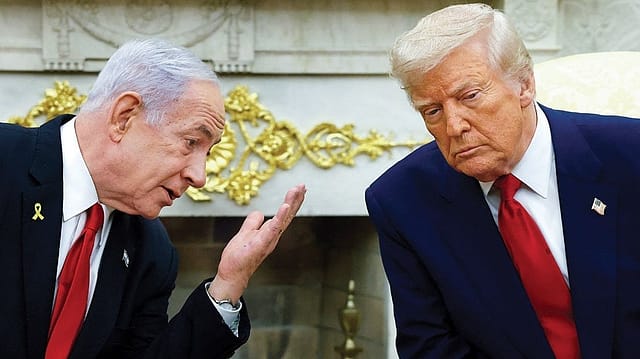
The United States is considering a revised security assistance agreement with Israel that would retain current levels of direct military aid through 2028 before reducing the duration of the next funding arrangement from 10 years to five.
Under the proposed framework, direct assistance would continue at roughly the same annual level for the shorter period before being phased out, according to a report by Israeli news outlet Ynetnews.
The details emerge a week after US President Donald Trump said he and Israeli Prime Minister Benjamin Netanyahu had agreed to end American military aid to Israel by the end of this year.
The statement reportedly caught Israeli negotiating teams by surprise, as discussions over a new memorandum of understanding are still under way.

The Era of Forever Wars
30 Oct 2026 - Vol 05 | Issue 44
Coping with an explosive Middle East
A senior Israeli official told Ynetnews that Trump's announcement was driven partly by domestic political considerations, including an effort to help Republican Senate candidate Mike Rogers in Michigan against Democratic challenger Abdul El-Sayed. El-Sayed won the election, becoming the first Muslim elected to the US Senate, according to the report.
A FIVE-YEAR FUNDING FRAMEWORK
Speaking to Fox News on Election Day, Trump said, “We were giving them $4 billion. We are, but it gets cut off at the end of the year.” He also said Netanyahu had previously raised the possibility of phasing out assistance, arguing that Israel had become a prosperous country capable of supporting itself.
However, the framework currently under discussion does not provide for an immediate halt. Under the existing 10-year memorandum of understanding, the US provides Israel with $3.3 billion annually in Foreign Military Financing and another $500 million for joint missile defence programmes. These arrangements remain in place through 2028.
Under the proposed agreement, negotiated by teams representing US Secretary of State Marco Rubio and Israel's Defence Ministry, annual direct military funding would remain broadly comparable but cover only five years. This would amount to approximately $16.5 billion before direct military assistance is phased out.
Funding for joint air and missile defence research and development, meanwhile, is expected to increase from the current $500 million annually, although the revised amount has not yet been finalised.
US INDUSTRIES ALSO HAVE A STAKE
The proposed shift is not without opposition in Washington. A senior Israeli official familiar with the negotiations told Ynetnews that several members of Congress are reluctant to reduce assistance because much of the money is spent in the United States, supporting defence manufacturers and local economies.
“We are moving here from a model of aid to a model of partnership,” the official said. The official added that reducing assistance would also affect American industries and require adjustments to existing arrangements.
CONGRESS REMAINS A KEY FACTOR
Negotiators are seeking to finalise the agreement before the new US Congress convenes in January. However, Israeli officials remain concerned that annual congressional appropriations could complicate the arrangement, particularly if political priorities in Washington change.
The level of support for the agreement will depend on the composition of future governments and the positions of political leaders in both countries, Ynetnews reported.
The proposed framework would mark a change in the structure of US security assistance to Israel, moving away from the traditional decade-long commitment towards a shorter arrangement that places greater emphasis on joint defence programmes.
With inputs from ANI