China’s QUAD unease tied to South China Sea insecurities
The meeting of QUAD (Quadrilateral Security Dialogue) leaders on the sidelines of the ASEAN (Association of South-East Asian Nations) summit, taking place after former US President Joe Biden hosted the group in September, 2024, has evoked interest as it comes after President Donald Trump received a hiding in the mid-terms. America’s engagement with the Indo-Pacific will be closely watched. The question is will Trump revive America’s faltering commitment towards the QUAD, which though not a security grouping, reflects shared concerns over China’s rise and its hegemonistic view of its vast neighbourhood.
China’s thin skin on SCS
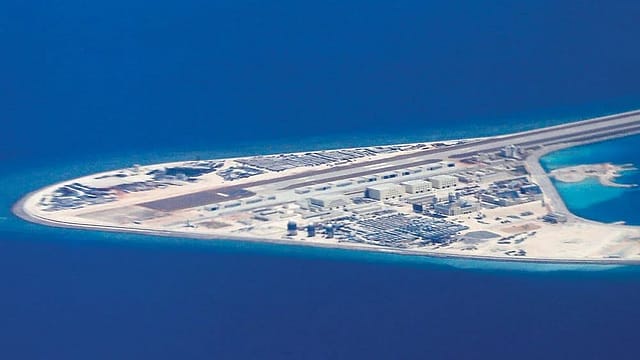
A commentary in Global Times fired a warning shot making it evident that China does not have a benign view of the QUAD and despite dismissing the group as a “small circle” bristles at the prospect of any “meddling” in the South China Sea “matters” where Beijing has consistently ridden rough shod over smaller neighbours. The commentary, authored by the director of the research department of Tsinghua University’s National Strategy Institute, notes the venue serves as an “invisible crutch” for Philippines which it darkly observes has “long resorted” to provocative actions in the South China Sea issue.

The Era of Forever Wars
30 Oct 2026 - Vol 05 | Issue 44
Coping with an explosive Middle East
The criticism of Philippines is not unexpected given China’s view that it is incumbent on neighbours to accord primacy to its concerns and not doing is unreasonable and an act of defiance. More importantly, however, China appears to anticipate that Trump may use the occasion to signal US commitment to the Indo=Pacific and the need to prevent it from being dominated by a hegemon. “Now, by choosing to hold the Quad summit in Manila on the sidelines of the ASEAN meetings, US avoids having to invest significant additional diplomatic resources or arrange a lengthy itinerary specifically for a multilateral summit. It just sends a clear, low-cost signal to the entire Asia-Pacific region that "the US is still present," author Qian Feng writes.
Trump’s post mid-term Agenda
The commentary is not likely to be off the mark as Trump would like to make a strong statement to shake off any impression that he has become hamstrung after Republicans lost both the House of Representatives and the Senate to a resurgent Democratic party. The commitment to QUAD, if accompanied by a more consistent approach, will be timely as China has certainly been the beneficiary of the poorly considered US-Israeli war on Iran and Trump’s ill-advised tariff policies. Despite disparities within the grouping, QUAD has strong reasons to hang together and demonstrate the viability of alternate supply chains.
The GT commentary, interestingly, takes an “accommodative” view of India’s engagement with the QUAD, noting: “India's approach bears clear hallmarks of "balance-of-power maneuvering." Its earlier plan to host the summit fell through, essentially because Washington and New Delhi failed to strike a (trade) deal that both sides would accept. New Delhi is unwilling to jeopardize the improving China-India relationship by aligning with other nations' efforts to contain China, nor is it willing to make unilateral concessions on issues such as trade tariffs and market access.” This is a reminder to New Delhi that it has much at stake in improving ties with Beijing while there are substantial, unresolved differences with the US.
Harsh on Japan and Australia
The commentary is harsh on Japan and Australia, two nations who have angered the Communist giant by their increasingly close military cooperation and refusal to accept China’s claims to being the pre-eminent Asian power. Japan and Australia are derided as “free loaders” in an “ad-hoc gathering.” The commentary points out that “Tokyo hopes to leverage the Quad's relaunch to advance the outward expansion of its military presence. Canberra, meanwhile, seeks to secure greater access to the US market for exports of critical minerals.” All in all, the four nations are seen as pursuing their own respective agendas and the gathering in Manila is “fraught with irreconcilable rifts” the GT commentary concludes.
Yet, for the disdain expressed for the QUAD and a “photo op” event, China is concerned about the likelihood of “South China Sea, Indo-Pacific maritime cooperation, critical mineral supply chains and energy security being on the agenda for this Manila summit. Many countries in the region are already on guard, wondering whether this "small circle" will use the summit as a pretext to slip provisions interfering in South China Sea affairs into the joint statement, in an attempt to impose a public opinion straitjacket on China.” It is quite clear that references to SCS worry China as Japanese Prime Minister Sanae Takaichi’s forthright comments on Taiwan indicate that other nations are no longer ready to avoid the taboo topic.
The GT commentary asserts China’s claim to “indisputable” sovereignty over SCS islands and its determination to resolutely oppose any attempt to interfere in the waters Beijing considers its backyard. China’s sensitivity on the SCS is often read as its “red lines” which others can transgress at their peril. But it is also a pressure point and vulnerability that China’s Communist leaders hate to admit as a weakness. Having convinced its population that Taiwan and the disputed SCS islands are China’s “rightful” possessions, any loss of face is unacceptable.