US-Iran Deal Near? Spotlight on Trump's Tough Terms Vs Tehran's Firm Pushback
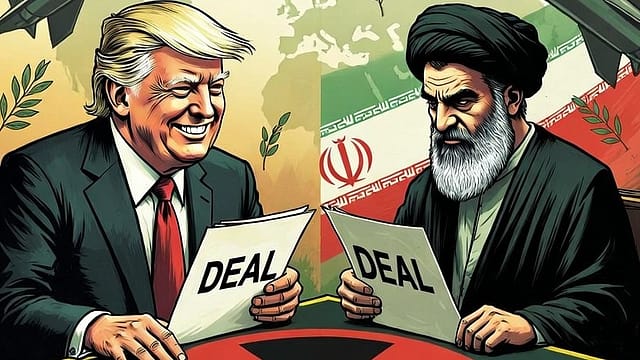
The White House says it is on the verge of a major diplomatic breakthrough with Iran, projecting confidence that a new nuclear agreement could soon be finalised. Officials argue that the current negotiations are closer to success than at any point in recent years.
Press Secretary Karoline Leavitt framed the progress as unprecedented, saying, “The United States has never been closer to a good deal with Iran… thanks to President Donald Trump's negotiating ability.”
The administration believes its approach — combining pressure with negotiation — will produce a stronger outcome than earlier diplomatic efforts.
At the centre of the messaging is a sharp rejection of the 2015 Joint Comprehensive Plan of Action (JCPOA), negotiated under Barack Obama.
Trump has repeatedly described that agreement as deeply flawed, calling it “one of the worst deals ever.” He argues it created a “guaranteed road to a nuclear weapon” — something he insists will not happen under his watch.
“The DEAL that we are making with Iran will be FAR BETTER than the JCPOA,” Trump said, also criticising Joe Biden for his association with the earlier framework.
He also revived claims about financial concessions made to Iran, including the controversial transfer of $1.7 billion in cash.
Is Trump open to direct talks with Iran?
In a notable shift, Trump has indicated he is willing to personally meet Iranian leaders if necessary.

Open Minds 2026
26 Jun 2026 - Vol 05 | Issue 26
The power of ideas and arguments in 50 portraits
“If they want to meet… I have no problem meeting them,” he said, signalling openness to a high-level summit.
Meanwhile, a senior US delegation — including Vice President JD Vance, Jared Kushner, and envoy Steve Witkoff — has already been dispatched for talks in Islamabad. Their mission is clear: push for the complete dismantling of Iran’s nuclear programme.
“Get rid of their nuclear weapons… There will be no nuclear weapon,” Trump said, outlining what appears to be a non-negotiable demand.
Why is Iran refusing to engage?
Tehran has pushed back strongly, accusing Washington of negotiating in bad faith and applying coercive pressure.
Iranian leaders have rejected talks “under duress,” with parliamentary speaker Mohammad Baqer Ghalibaf warning that negotiations are being turned into a “table of surrender.”
Iran has also cited ongoing tensions — including maritime disputes in the Strait of Hormuz — as reasons for its reluctance to proceed.
President Masoud Pezeshkian echoed this stance, saying that “honouring commitments is the foundation of any meaningful dialogue,” while accusing the US of sending “unconstructive signals.”
How serious is the threat of conflict?
The diplomatic push is unfolding under the shadow of a looming deadline and escalating rhetoric.
Trump issued a stark warning about the consequences of failure: if talks collapse, “then lots of bombs start going off.”
Iran, in turn, has hinted at revealing “new cards on the battlefield” if tensions escalate further.
With a fragile ceasefire nearing its expiry, the situation is being seen as a critical moment — either a breakthrough or a slide into renewed conflict.
What happens next?
The upcoming talks in Islamabad are being viewed as a last major opportunity to avoid escalation. However, deep mistrust on both sides continues to complicate progress.
While Washington insists a “fair and reasonable” deal is on the table, Iran’s resistance to negotiating under pressure suggests the path forward remains uncertain.
The outcome could reshape not just US-Iran relations, but the broader geopolitical balance across the Middle East and beyond.
(With inputs from ANI)