Trionda Goes to Space: ISS Crew Tests FIFA World Cup Ball in Microgravity
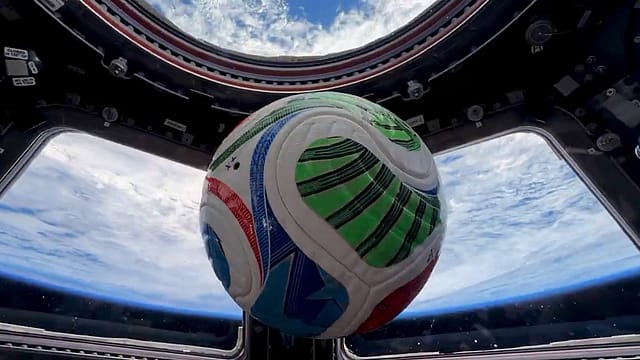
The official match ball for the 2026 FIFA World Cup, Trionda, has reached space, with astronauts aboard the International Space Station (ISS) conducting experiments to study football dynamics and ball performance in microgravity.
Sharing images and details of the experiment, in a post on Instagram, the National Aeronautics and Space Administration (NASA) said the ISS crew recreated a 2019 study using the Adidas-made Trionda football to examine how balance and centre of mass affect a ball's movement.
"The official FIFA World Cup ball went to space," NASA said, adding that sports engineers carefully measure and optimise a football's centre of mass and balance to ensure predictable movement during play.
The Modi Years
02 Oct 2026 - Vol 05 | Issue 40
A Nation Rebuilt
According to the space agency, the crew repeated the experiment to demonstrate the effects of good and poor balance in football.
The findings have helped researchers better understand how embedded technologies, including match-ball sensors, can influence performance on the field.
Why Is The Trionda World Cup Ball Named After ‘Three Waves’?
"Helping to improve the beautiful game is just one of the ways NASA science done on the International Space Station makes life better for people on Earth," NASA said in the post.
The Trionda is the official match ball of the 2026 FIFA World Cup and was developed by Adidas.
According to FIFA, the ball's name is derived from the Spanish phrase meaning "three waves", symbolising the first-ever FIFA World Cup to be jointly hosted by three nations - Canada, Mexico and the United States.
Its design features red, green and blue colours representing the three host countries, while a four-panel construction with fluid geometry forms a triangle at the centre of the ball, reflecting the unity of the host nations.
The ball also incorporates symbols associated with each country, including a maple leaf for Canada, an eagle for Mexico and a star for the United States.
FIFA said Trionda includes several technological innovations aimed at improving performance, including deep seams for enhanced flight stability and embossed surface details that improve grip in wet conditions.
The ball is also equipped with advanced connected-ball technology, featuring a 500Hz motion sensor chip that transmits real-time movement data to the Video Assistant Referee (VAR) system.
The technology is designed to assist match officials with decision-making, including offside calls and other key incidents during matches.
The experiment marks a unique intersection of sports science and space research, with the World Cup's official ball becoming the latest sporting equipment to be tested aboard the ISS.
(With inputs from ANI)