The Man Who Revealed Nixon’s ‘Smoking Gun’
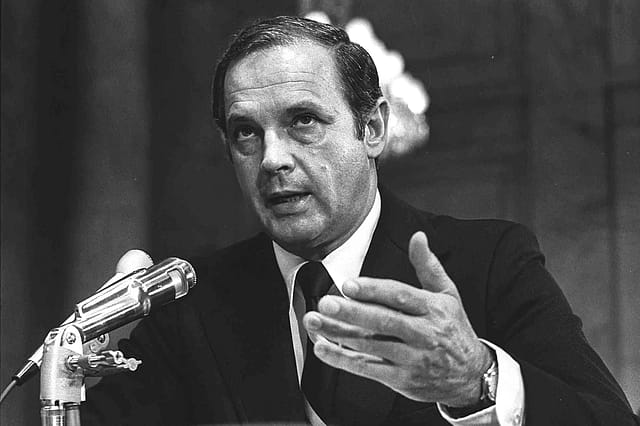
When former White House aide and then FAA chief Alexander Butterfield replied to the Watergate Committee’s question “Mr. Butterfield, are you aware of the installation of any listening devices in the Oval Office of the president?” with the legendary line: “I was aware of listening devices, yes, sir,” the US had watched it on TV, stunned into silence by the extent of presidential corruption. What America didn’t know barring a few Committee members and other DC officials was that Butterfield had already disclosed almost everything he knew a few days earlier in a closed session. This was for the national audience.
The rest is history as the Watergate investigation from that moment on became one about the “tapes”—the tapes that had recorded practically every word of meetings and phone conversations in the Oval Office, the Cabinet and Lincoln Rooms, as well as the presidential lodge at Camp David. President Richard Nixon had that secret and sound-activated recording system installed as his verbal alibi. It turned out to be his nemesis.
Butterfield, who died at 99 on March 9, was not guilty of any of the wrongdoings of the Nixon White House but Nixon had no idea of his disclosures till the televised Senate hearing. The president would never have found himself in that predicament had his decision to dispute his former counsel John W Dean III accusations against him not been too detailed to be the product of anything other than a recording. Suspicions had arisen immediately and later proved when Butterfield testified.

Youth Issue 2026
24 Apr 2026 - Vol 04 | Issue 68
50 Portraits of Icons and Achievers
The chain of irony at work from the beginning led to a sequence of unintended consequences, ultimately establishing that Nixon had not only known about the burglary at the Democratic National Committee offices on June 17, 1972 but was actively involved in the cover-up when he instructed the CIA to obstruct the FBI investigation into the break-in as well as ordering buying the silence of the burglars with cash. He had gone to the extent of promising presidential pardons if they went to jail. All of this was recorded on tape on June 23, 1972 which became the smoking gun that felled Nixon.
Things fell into place quickly for the investigators once the tapes were handed over by the White House on the Supreme Court’s orders. (Nixon had tried to get Special Prosecutor Archibald Cox fired for demanding the tapes but it had led to a constitutional crisis as the Attorney General and Deputy Attorney General both resigned in protest.) Nixon’s aides went to prison and the president himself resigned on August 9, 1974 to pre-empt impeachment, only to be pardoned by his successor Gerald Ford.
Almost 20 years later, Butterfield would tell Oliver Stone, who was making his <Nixon> film, that he had no doubt that the president was guilty. On the periphery of the investigation till his closed-door hearing, it was Butterfield’s disclosure of something unique to the Nixon White House that nobody had bothered to ask about till then that had served the cause of justice. Of course, one of Ford’s first actions as president was to have the recording system removed.