The Funeral Trap: How Iran is Weaponising 40 Days of Mourning
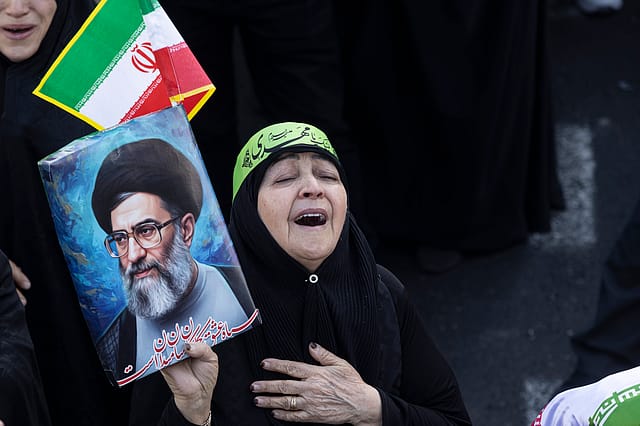
The 40-day mourning period (Arbaeen/Chehlum) is one of the most sacred observances in Shia Islam. It signifies the end of a 40-day mourning period for the Prophet Muhammad’s grandson, Hussein ibn Ali, killed in the Battle of Karbala in 680 CE. The tradition traces back to Jabir ibn Abd Allah, a companion of the Prophet, who was the first to make a pilgrimage to Hussein’s grave exactly 40 days after the battle.
Critically, according to most Islamic schools of law, a person who dies is mourned for 40 days by loved ones. But here’s the nuance: in the Sunnah of Islam, mourning of a deceased is for three days only. The exclusive exemption is Imam Husain, and the important event of Arbaeen. The 7th day, 40th day, and one-year ceremonies are customary traditions, not religious obligations.

Losing Memory
16 Oct 2026 - Vol 05 | Issue 42
The making of a medical and social emergency
So when Iran declares 40 days of mourning for Khamenei, it is deliberately equating his death with the martyrdom of Imam Hussein at Karbala - the foundational narrative of Shia identity. This is not routine grief. This is mythologisation in real time. By framing Khamenei’s assassination as a Karbala-like event, the regime is tapping into 1,400 years of Shia theology that teaches: the martyred leader’s cause becomes more powerful after death, not less.
The Arbaeen pilgrimage, described as the world’s largest peaceful gathering, drawing up to 25 million people, demonstrates the mobilising power of this tradition. Iran’s leadership understands that mourning, in the Shia context, is not passive. It is activation.
The activation is already visible. On Sunday, tens of thousands of black-clad mourners packed Tehran’s Revolution Square, beating their chests and clutching portraits of Khamenei, chanting “God is great!” In the southwestern city of Yasuj, large crowds chanted “the lion of God has been killed.” Hezbollah organised thousands of supporters in Beirut to mourn Khamenei, chanting “Death to America, death to Israel.” In Sanaa, Houthi supporters filled Sebeen Square carrying Iranian flags and Khamenei portraits. The mourning is generating its own momentum — across borders, across the Shia world, in real time.
This has happened before though under vastly different circumstances.
The day after Khomeini’s death on June 3, 1989, Khamenei was appointed as Iran’s new supreme leader following an extraordinary meeting of the Assembly of Experts. The transition was messy: Khamenei held only an intermediate clerical rank, and the constitution was controversially amended to lower the religious threshold to allow his elevation.
The mourning period for Khomeini served a critical dual function: it gave the public an emotional outlet while the elite consolidated power behind closed doors. When Khomeini died in 1989, his state funeral was attended by millions -- mourners literally pulled him out of his coffin and scrambled for sacred mementos. That enormous public grief bought time for Rafsanjani and Khamenei to outmanoeuvre rivals and lock in the succession.
The current leadership is running the same playbook, but under fire, literally. Iran has confirmed a three-person temporary leadership council to govern the country under Islamic law: President Masoud Pezeshkian, Chief Justice Gholam-Hossein Mohseni-Eje’i, and a senior Guardian Council cleric, pending the Assembly of Experts’ selection of a new supreme leader.
But the 2026 succession faces a crisis the 1989 transition never did: the decapitation strike may have eliminated the very people meant to fill the vacuum. Trump told ABC News on Sunday that “the attack was so successful it knocked out most of the candidates.” Over 40 Iranian officials were killed in the strikes, according to Israeli sources. The key contenders - Mojtaba Khamenei (the late leader’s son), Hassan Khomeini (the founder’s grandson), Sadiq Larijani, and hardliner Mohammad-Mahdi Mirbagheri - have not all been publicly accounted for. And yet, in a remarkable signal, Trump told NPR through a senior White House official that Iran’s new leadership has “indicated they want to talk.” The contradictions are dizzying: bomb the candidates, then negotiate with the survivors.
The sharpest strategic analysis comes from Al Jazeera’s report. Political sociologist Saleh al-Mutairi identifies something extraordinary: The government’s declaration of 40 days of mourning creates a “funeral trap” for the opposition. The streets will likely be filled with millions of mourners, creating a human shield for the government and making it logistically and morally difficult for anti-government protests to gain momentum in the short term.
Think about what this means operationally. Trump and Netanyahu’s explicit goal is regime change through popular uprising. They’ve called on Iranians to “take over your government.” And yes, some residents were rejoicing, cheering from rooftops, blowing whistles and letting out ululations when Khamenei’s death was reported. In a city outside Tehran, young people danced in the streets. Even in the capital, some shouted “long live the shah” from rooftops.
But the 40-day mourning period floods the streets with regime loyalists. Millions of grieving Shia faithful will pour into public spaces, shrines, and squares, not to protest the government, but to mourn the “martyred” leader. Any opposition movement now has to compete for street space with a grief-charged, religiously motivated mass. You can’t stage a revolution when the streets are already occupied by a funeral.
This is the regime weaponising Shia mourning culture against the very uprising the strikes were meant to catalyse.
The funeral trap is working, but the picture is more fractured than the regime hoped. The contrast on Sunday was stark: Revolution Square in Tehran packed with mourners, while simultaneously, diaspora Iranians in Glasgow, Los Angeles, and across North America rallied in celebration. Inside Iran, the divide runs street by street. As Chatham House assessed: “It is no surprise that people are cheering and celebrating the death of the longest-serving regional autocrat… but it is difficult to see how genuine political transformation develops under conditions of sustained war, chaos and potential fragmentation.” The funeral trap holds the streets. Whether it holds the country is another question.
Here’s what makes this mourning period different from 1989: the doctrine that governed Iran for decades died with Khamenei.
Hassan Ahmadian, a professor at the University of Tehran, says the era of “strategic patience” died with the supreme leader. “Iran learned a hard lesson from the June 2025 war: Restraint is interpreted as weakness.”
For decades, Khamenei championed calculated restraint, absorbing blows, fighting through proxies, never crossing the threshold into direct confrontation that could bring the full weight of American power down on Iran. That doctrine is now dead. The IRGC’s response -- six waves of retaliatory strikes within 24 hours, targeting 27 US bases and Israeli facilities -- is the operational manifestation of a new doctrine: direct, immediate, escalatory response.
Al Jazeera’s analysis captures the paradigm shift: if Iran survives the initial shock, the nation that emerges will likely be fundamentally different: less calculated and probably more violent.
Seventy-two hours in, the doctrinal shift is no longer theoretical. It is being demonstrated in real time across the entire region: The IRGC targeted the USS Abraham Lincoln aircraft carrier with four ballistic missiles, an act that previous Iranian doctrine would have considered unthinkably provocative. The US confirmed no damage, but the signal was unmistakable: Iran is now willing to strike at the most potent symbols of American naval power.
Hezbollah broke its ceasefire with Israel. In the early hours of Monday March 2, Hezbollah launched precision missiles and a drone swarm at a missile defence site south of Haifa, the first attack on Israel since the November 2024 ceasefire. Hezbollah called it “revenge for the blood of the Supreme Leader of the Muslims.” Israel responded with immediate airstrikes across Beirut’s southern suburbs, southern Lebanon, and the Bekaa Valley. Israeli strikes have killed at least 31 Lebanese and injured 149. The IDF issued evacuation orders for over 50 villages. The Lebanon front has reopened.
The Houthis have resumed Red Sea attacks. Leader Abdul-Malik al-Houthi announced his forces are “in a state of high readiness” and have resumed strikes on US and Israeli-flagged ships.
A suspected Iranian drone struck RAF Akrotiri, Britain’s military base in Cyprus, overnight. No casualties, but the geographic expansion of the conflict is alarming.
Ali Larijani, secretary of Iran’s Supreme National Security Council, framed it in language that shows the old restraint is gone: Trump “has transformed his self-made slogan of ‘America First’ into ‘Israel First’ and sacrificed American soldiers for Israel’s quest for power.” President Pezeshkian declared that “bloodshed and revenge” are Iran’s “legitimate right and duty,” and threatened to “forcefully crush the enemy’s bases.” Foreign Minister Araghchi: “We will resist as long as it takes.”
Strategic patience is dead. What has replaced it is strategic fury.
Based on the full scan, the 40-day mourning period is serving five simultaneous strategic functions:
Function 1: Domestic Crowd Control (The Funeral Trap). Fill the streets with mourners, not revolutionaries. Make it morally impossible for anti-regime Iranians to protest during a national funeral. The seven-day public holiday further keeps people home and off the streets in the critical first week.
Function 2: Succession Time. The Assembly of Experts needs time to convene — its 88 members may currently be dispersed outside Tehran, and assembling them under active bombardment is logistically dangerous. The mourning period creates a constitutional window for the Provisional Leadership Council (Pezeshkian + judiciary chief + Guardian Council cleric) to govern while the real succession battle plays out.
This function has become more critical than anticipated. Trump’s claim that “most of the candidates” were killed means the Assembly of Experts may face an even shallower bench than the 1989 transition. The IRGC will be the ultimate kingmaker but the question is whether the IRGC itself can maintain cohesion after losing over 40 senior officials. The Council on Foreign Relations was blunt: “Taking out Khamenei is not the same as regime change. The IRGC is the regime.”
Function 3: Proxy Activation Shield. While Iran is “in mourning,” its proxies can escalate. The mourning period provides theological cover for proxy escalation: these are acts of grief-driven revenge for the martyred Imam, not calculated state policy.
This function has activated far beyond initial expectations. Hezbollah has entered the war with its first strikes on Israel since 2024. The Houthis have resumed Red Sea operations. Kataib Hezbollah in Iraq has threatened to “soon begin attacking US bases.” The Kurdish CPFIK has announced forces “deep inside Iran” and along the Iraq border, “ready to respond as the situation develops.” In Karachi, Pakistan, clashes between protesters storming the US Consulate have escalated to 9 killed and over 50 wounded. The “proxy shield” has become a proxy offensive and it is not limited to Iran’s traditional allies. The grief is metastasising.
Function 4: International Sympathy and Legitimacy. A nation in mourning is harder to bomb than a nation at war. Every image of weeping Iranians at shrines, every funeral procession, every crying child, all of this shapes global opinion.
The sympathy function gained enormous fuel from the Minab school airstrike, where casualties have now risen to 148 dead, mostly schoolgirls. Iran says 201 people have been killed and over 700 injured across the country. The EU has called for “maximum restraint” and civilian protection. Brazil condemned the strikes. The UN Secretary-General condemned the escalation. But here’s the counter-current: the EU’s Ursula von der Leyen simultaneously signalled support for a “credible transition” of power in Iran. The sympathy is real but conditional -- the world mourns Iran’s dead children while quietly hoping the regime falls.
Function 5: IRGC Reorganization. The IRGC’s command structure took massive hits. It needs time to reorganize, redistribute command authority, and assess which capabilities survived. The mourning period provides operational breathing room to reconstitute -- while the retaliatory strikes maintain deterrence and demonstrate that capability still exists.
The IRGC’s response speed has defied Western expectations. CENTCOM confirmed it struck over 1,000 Iranian targets in the first 48 hours, including IRGC headquarters, Iranian Navy submarines, missile sites, communications links, and command-and-control centres. And yet the IRGC has continued launching waves of strikes. The retaliatory attacks demonstrate institutional depth: even with the top layer of command decapitated, the middle tiers are executing. But the cost is mounting. Three US service members have been killed, reportedly in a drone strike in Kuwait, and five seriously wounded. Iran has struck airports, ports, and military bases across six countries. The Strait of Hormuz has been disrupted. Global aviation is in chaos: over 7,700 flights delayed, 2,280 cancelled, 20,000 travellers stranded in the UAE alone. Iran’s own airspace is closed until at least March 3.
Iran launched six waves of strikes within 24 hours of the initial bombardment. The IRGC has hit targets across Israel, the UAE, Qatar, Kuwait, Bahrain, Saudi Arabia, and Jordan. The question was always about scale, not intent.
The answer, 72 hours in, is that the scale has exceeded almost every pre-war estimate.
Iranian missiles struck residential buildings in Beit Shemesh, Israel, destroying a synagogue and smashing a bomb shelter. Nine people were killed, including a 16-year-old and an emergency services volunteer alongside her mother. Twenty-three were hospitalized. A woman was killed and 27 injured in a strike on residential Tel Aviv. Jebel Ali, Dubai’s massive port and logistics hub, was hit, causing fires. Kuwait International Airport was struck. Saudi Arabia confirmed attacks on Riyadh and its Eastern Province. Bahrain’s US Fifth Fleet headquarters was targeted. The US Embassy in Jerusalem, the US Embassy in Bahrain, and Ben Gurion Airport are all closed.
Meanwhile, a critical intelligence revelation has emerged. Pentagon briefers acknowledged to congressional staff that Iran was not planning to strike US forces unless Israel attacked first, undercutting the White House’s claimed justification of an “imminent threat.” Senator Mark Warner, top Democrat on the Intelligence Committee, confirmed he has seen “no intelligence” to support the pre-emptive strike claim.
The real question now tracks against three scenarios:
Scenario A: Controlled Escalation → Negotiated Off-Ramp. Iran sustains retaliatory strikes at a level that demonstrates capability without triggering total annihilation. Araghchi’s messaging — “we don’t want war” and “we will resist as long as it takes” — keeps a diplomatic channel alive. The White House signal that Iran’s new leadership “wants to talk” suggests this scenario is not dead. After the mourning period, with a new leader installed, Iran negotiates from a position of demonstrated resilience. Trump himself told reporters the strikes could last “four weeks or so” — suggesting even Washington sees a finite timeline.
Scenario B: Uncontrolled Escalation → Regional War. This scenario is no longer theoretical. It is happening. Hezbollah has opened a second front against Israel. Israel is bombing Beirut, southern Lebanon, and the Bekaa Valley, issuing evacuation orders for over 50 villages. The Houthis are resuming Red Sea attacks. A British military base in Cyprus has been struck. The Strait of Hormuz is disrupted. Gulf aviation hubs are shut. Three American service members are dead, and Trump has acknowledged “there will likely be more.” Retired General Frank McKenzie, former CENTCOM commander, warned Americans to brace for “several more days of exchanges of long-range rockets.” The mourning period was supposed to provide a controlled pause. Instead, the conflict has spread to seven countries in 72 hours.
Scenario C: Internal Fracture. The mourning period fails to suppress internal divisions. The Kurdish Coalition of Political Forces of Iranian Kurdistan has announced forces “deep inside Iran.” Baloch fighters are engaging government forces in the southeast. The regime’s ethnic and sectarian fault lines — Kurdish, Baloch, Arab, Azeri — are under unprecedented stress. If the IRGC cannot demonstrate it can both fight externally and hold internally, the cohesion of the elite could break. The funeral trap fails. Opposition movements exploit the chaos. Netanyahu has stated the campaign will continue “until the Iranian people are free.”
The most unsettling reality: all three scenarios are now unfolding simultaneously. Iran is negotiating (Scenario A), the region is at war (Scenario B), and the internal fault lines are cracking (Scenario C). The 40 days were supposed to impose sequential order on these dynamics. Instead, they are converging.
The 40-day mourning is not one thing. It is a multi-layered strategic instrument simultaneously performing religious, political, military, and diplomatic functions. It draws on the deepest well of Shia theological tradition — the Karbala paradigm — to transform assassination into martyrdom, defeat into defiance, and grief into mobilisation.
Iran’s strategists are doing what the Rasanah Institute described in its pre-war assessment: behaving like the “spider-tailed viper” found in Iran’s mountains, camouflaging itself with its surroundings while luring prey with its deceptive tail.
But 72 hours into Operation Epic Fury, the viper is wounded. Over 1,000 of its military targets have been struck. Over 40 senior officials are dead. Its supreme leader is gone. Its proxies are lashing out with theological fury, but Hezbollah is diminished, Hamas is degraded, and the viper’s own internal organs — the Kurdish, Baloch, and Arab peripheries — are stirring.
And yet the regime has not collapsed. It is retaliating with a speed and breadth that has startled Western analysts. It has already drawn American blood. It has forced the closure of airports and embassies across the Middle East. It has disrupted global shipping. It has opened fronts in seven countries. The Chatham House assessment is apt: “This is existential and clearly about regime survival. It is also unlikely to end quickly.”
The mourning is real. The strategy is real. The revenge is real - and it is already being executed across the region.
The only question is whether the 40 days will deliver a successor strong enough to channel it, a negotiated off-ramp rational enough to end it, or whether the contradictions -- a regime mourning and fighting and fracturing all at once -- blow the system apart from within.
The clock is ticking. Thirty-seven days remain.