‘That Administration Is Temporary’: Aruna Miller on Taking On Trump
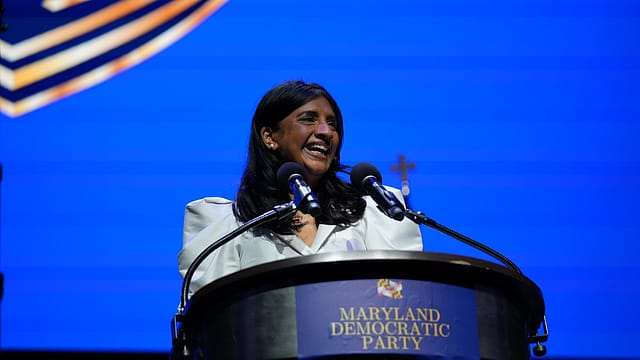
Aruna Miller arrived in America from India at seven. Now Maryland’s Lieutenant Governor, she is fighting federal policies she says are hurting families who came in pursuit of the same opportunities hers did.
“This is hurting families, and we are going to push back against it,” she tells OPEN Digital.
Ahead of the November 3 elections, Miller accuses the Trump administration of trying to tilt the congressional contest through mid-cycle redistricting. She also defends Maryland’s efforts to limit local police cooperation with federal immigration enforcement. Her message to immigrants anxious about their future is blunt: “But that administration is temporary.”

Look Who's Talking Regime Change
23 Oct 2026 - Vol 05 | Issue 43
Miller and Governor Wes Moore are seeking re-election with their own record under scrutiny. She points to falling homicides and fewer teacher vacancies, while identifying affordability as a priority for another term.
In a free-wheeling interview with Sumit Singh, she discusses the confrontation with Washington, the pressures facing Maryland and whether America still offers immigrant families the promise that brought her own there. Excerpts:

Answer: Well, I think every election is a test of the federal administration. So yes, we have midterm elections coming up, and I know that the Trump administration has taken some aggressive steps to control the number of representatives on the GOP side elected to Congress. What they are doing is going to Republican-led states and asking them to undertake mid-cycle redistricting.
And that is usually not the case. We do redistricting every 10 years, and this is mid-cycle. So the rest of us, including the state of Maryland, are fighting back. We actually have a ballot question, Question 3, in which we are asking Marylanders to support the measure so we can push back against the egregious assaults we are facing from the Trump administration. Again, it is trying to control Congress by changing the rules in the middle of the game and adding more GOP members to Congress.
Question: You and Governor Wes Moore are seeking re-election this year. What would you say are the biggest achievements of your administration over the past few years? And what is the most significant unfinished task you would want to take up if voters give you another term?
Answer: Well, I always say the road to progress is always under construction. We have accomplished quite a few things, but we know there is so much more to be done.
During the first term of our administration, we have been able to tackle several challenges. Maryland has lost over 31,000 federal jobs due to Trump-Vance administration cuts. As a result, we are diversifying our economy and focusing on our lighthouse sectors, which include AI, quantum computing, cybersecurity, aerospace, defense, and life sciences.
We have also made significant strides in bringing down the number of homicides across our state. So, essentially, we have made public safety that much stronger. This is the first time we have been able to reduce homicides by over 44% across the state.
In Baltimore City, they have seen the lowest levels of homicides and violent crimes since records began in the 1970s. So we are very proud of the improvements we have made in public safety.
We have also made a lot of progress in education. When we first started, there were many teacher vacancies. We haven't been able to fill all of the positions, but vacancies have dropped by 73.3 percent over the last four years. Teacher vacancies dropped from a high point of 2,145 during the 2022-23 school year to 572 this school year, attributed to a broad range of initiatives, including salary enhancements, Grow-Your-Own Educators programs, and recruitment and retention efforts with state government, school system, and labor partners.
One of the things we are going to concentrate on, should voters give us four more years, is affordability for Marylanders. That is at the top of the list. We understand how important it is, and we are going to work towards it.
Question: Maryland has often found itself at odds with the Trump administration over immigration and other policies. How have these federal decisions affected your state? When federal policies conflict with Maryland’s priorities, how do you respond?
Answer: Immigration plays a valuable role in our country, and specifically in the state of Maryland. In fact, one in every six residents in Maryland is foreign-born. The state of Maryland is the most diverse state in the Mid-Atlantic region, and we are very proud of this.
That means people from anywhere in the world can come to Maryland and find a community here. They can practice their faith, culture, and language. All of that is here. They come here because Maryland is such an inclusive state, and we also have many jobs.
The Trump-Vance administration’s immigration policies have been deeply hurtful to the people of Maryland because we have a large percentage of residents who are immigrants to this great country. We have pushed back through the legislature. We have made sure that our local law enforcement does not act as ICE agents for the federal administration. Their job is to focus on Maryland issues only. So we have put a firewall in place to prevent this kind of cooperation, unless, of course, the individual being apprehended is involved in a violent crime. In that case, absolutely, we will participate in law enforcement.
We are also making sure that immigrants have opportunities and access to government services. For the first time, we have been able to create the Office of Immigration Affairs, where individuals reach out to immigrant communities and help them navigate government services. They also help them obtain citizenship if they already have a green card, because we know that many individuals come to America right now because of the H-1B visa issues the Trump administration has imposed, including a $100,000 visa fee.
That is just too staggering and too high. We are going to push back on all of this to ensure that our international students feel comfortable coming to our state and learning from the best universities we have to offer, while also receiving the support, guidance, and help they need when they arrive.
Question: You came to the US from India at the age of seven. When you look at America today, do you feel the country is still offering immigrants the same promise of opportunity that it offered your family?
Answer: Look, I think every generation faces its own challenges when they come here. I am sure my mom and dad could tell you about the challenges they faced when they came in the 1960s and 1970s.
But here is the thing: we are here today, and the current administration’s views on immigration have been incredibly painful for immigrants. I know that. But that administration is temporary. We will get a new administration, and its policies and its ability to embrace the greatness of immigration to our country will be different from those of the administration in office right now.
So, while the Trump-Vance administration is here, we are going to push back as much as we can and protect our immigrant communities in every way we can.
Moving forward, immigrants add so much to the economy of our country and our state and to our culture. We are that much better because we have such strong immigration policies, and we will continue to protect immigrants. We will also make sure that any enforcement action follows the rule of law so that you cannot simply apprehend an individual anywhere and kick them out of the country. This is hurting families, and we are going to push back against it.
Question: You made history as Maryland’s first woman of color and the first immigrant elected to statewide office. Has representation translated into meaningful change?
Answer: Look, I certainly hope that my ability to serve the people of Maryland in this capacity has changed things for other young people who perhaps look like me or have had a similar journey. It lets them know that when you come to America, you can be anything you want to be, and you can run for any position you choose.
Anytime diverse candidates run for public office and take on these roles, you cast the electoral net that much wider. That means a bigger community gets engaged because people see someone who looks like them or, as I said, may have had a similar life journey or similar experiences.
And diversity comes in all different forms. It is not just about the way you look. It is about your profession, your lived experiences, your culture, and your faith. All of that makes our democracy stronger.
Question: Young people across the world are increasingly expressing frustration over jobs, inequality, the cost of living, and their sense of political exclusion. Many are taking to the streets to demand change. How should leaders respond to this growing youth unrest, and how can governments better understand and address the aspirations of the next generation?
Answer: Yes, we are going to be handing our countries, and what we have inherited, to the younger generation. I think we need to sit down and seriously listen to their concerns. Their concerns may not be exactly the same as the ones we have, but it is vital that we listen to them because they are living in a totally different world from the one I grew up in.
When I grew up, there was no internet. There was no social media. There was no AI. All these things are moving at such a significant pace, and young people are facing challenges that we may not fully understand. Affordability is a big part of it, too.
So I think it is really important for every government official and every elected official to sit down and hear the concerns of the younger generation and work with them on how we can move forward together in ways that benefit them. Because, at the end of the day, that is what we are doing. We are building this world for them, so they can play their role in it and hand it over to the next generation.
It is important for us to make sure that we fight for healthcare, protect our planet, ensure that good jobs are available for young people, and promote equity—not just racial equity, but also gender equity and socioeconomic equity. We have to fight for those things.