Shot Down, Hunted, Rescued: Inside the Secret Mission That Saved a US Airman in Iran
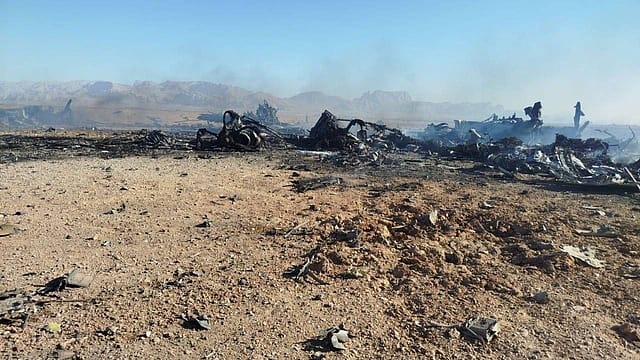
US special operations forces carried out a high-risk mission deep inside Iran on Saturday night to rescue an injured American airman whose F-15 fighter jet had been shot down, President Donald Trump said.
The operation, involving dozens of commandos, US warplanes and helicopters, as well as intelligence support from the Central Intelligence Agency, unfolded over two days in hostile territory.
The exact circumstances remain unclear, but officials described the extraction as hugely complex.
In a post on Truth Social on Sunday, Trump said, "We have rescued the seriously wounded, and really brave, F-15 Crew Member/Officer, from deep inside the mountains of Iran."

The Modi Years
02 Oct 2026 - Vol 05 | Issue 40
A Nation Rebuilt
He added that the US had been monitoring the airman’s location "24 hours a day, and diligently planning for his rescue."
How was the US airman shot down in Iran and what happened after the F-15 crash?
The incident began on Friday when an F-15E Strike Eagle carrying a pilot and a weapons systems officer was shot down over southern Iran.
Both crew members ejected. The pilot was rescued the same day, but the second crew member remained missing.
The downed officer evaded Iranian forces for more than 24 hours, at one point hiking up a 7,000-foot ridgeline, according to a senior US military official.
US Military pilots told The Guardian that the airman would have attempted to hide, transmit his location relative to a known secret point and wait for extraction.
He reportedly concealed himself in a mountain crevice and restricted the use of his beacon signal out of concern it could be detected.
Iran signalled its intent to capture the officer alive and offered a bounty of £50,000 ($66,100). As US forces moved in, a firefight erupted, a former senior military official briefed on the operation said.
How did SEAL Team 6 execute the high-risk US airman rescue mission in Iran?
The extraction was carried out by SEAL Team 6, a secretive unit created in October 1980 for “no-fail” missions, often devoted exclusively to counter-terrorism.
The team is known for carrying out the operation that killed Osama bin Laden. The New York Times has described it as “a global manhunting machine” and “one of the nation’s most mythologized, most secretive and least scrutinized military organizations.”
Once on the ground, the officer had only a handgun to defend himself. US officials said he had received survival training that included activating a beacon, seeking high ground, concealing his position and establishing communications.
The rescue operation involved low-flying Pave Hawk helicopters and C-130 Hercules transport aircraft.
According to US media reports, two transport planes intended to extract rescue crews were unable to take off from a remote base inside Iran and were destroyed to prevent capture.
Special forces later evacuated personnel using three additional aircraft.
How did the IRGC respond to the US airman rescue operation in Iran?
Iranian authorities said several "flying objects" were destroyed during the operation.
According to Tasnim news agency, the Islamic Revolutionary Guard Corps stated, "During a joint operation (Aerospace, Ground Force, Popular Units, Basij and Police command), enemy flying objects were destroyed."
Iran’s police command also claimed an American C-130 aircraft had been downed in southern Isfahan.
Iran’s military further said two US C-130 transport planes and two Black Hawk helicopters were destroyed, adding that "a deception and escape mission at an abandoned airport in southern Isfahan…was completely foiled".
State media also reported that IRGC troops shot down a US drone over Isfahan during the search operation.
A senior US administration official said the CIA tracked the airman’s exact location and relayed it to the Pentagon.
How did the CIA use deception tactics during the US airman rescue mission in Iran?
The agency also launched a deception campaign to mislead Iranian forces into believing the airman had already been rescued and was being moved out of the country by ground convoy.
The CIA can also facilitate contact with civilians in what is known as unconventional assisted recovery.
An Israeli security official said Israel provided intelligence assistance and halted its attacks in the area to facilitate the mission.
US officials said the operation involved hundreds of special operations personnel and incorporated cyber, space and intelligence capabilities alongside air and ground combat.
Bombs and weapons fire were used to keep Iranian forces away as rescuers approached the airman.
The F-15E was downed in a region with significant opposition to the Iranian government, raising the possibility that local civilians may have helped the officer remain concealed.
Officials described the mission as one of the most challenging in US special operations history, citing the mountainous terrain, the airman’s injuries and the rapid movement of Iranian forces toward his location.
Before midnight US time, the rescue was completed and the airman was flown to Kuwait for medical treatment. Trump said the officer was "seriously wounded", but "he will be just fine".