Scholars, including Jeffrey Sachs, slam US indictment of Raul Castro
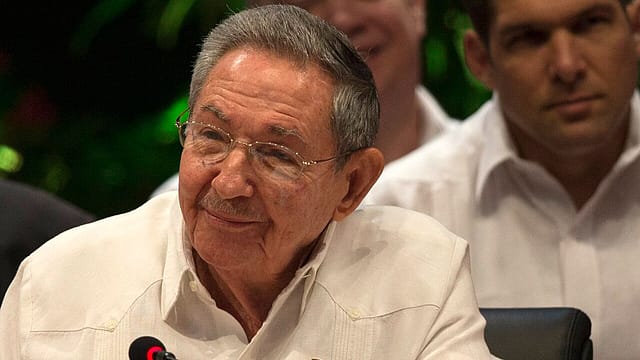
Several scholars have sharply criticised the US indictment of former Cuban President Raul Castro, 94, arguing that it is a ruse to advance President Donald Trump’s imperial ambitions in the region and turn the Caribbean island into a US playground once again -- as it was before the 1959 Cuban Revolution ended decades of American dominance through proxies. Since the case has to be fought in a US court, it is also seen as a move to extradite or kidnap Castro from Cuba to the US, much like former Venezuelan President Nicolas Maduro was brought to the US earlier this year. Strikingly, it was when Raul Castro was at the helm that Barack Obama achieved what is widely called the Cuban Thaw (2015–2017), normalisation of relations between Havana and Washington after 54 years of hostilities.
Within days of Director John Ratcliffe visiting Havana on May 14 to reportedly threaten Cuba with dire consequences unless it made sweeping political changes suited to American business interests, the US Department of Justice accused Raul Castro, brother of the late Fidel Castro and the last surviving major leader of the Revolution, of murdering American citizens 30 years ago. Cuba has hit back at the US, saying this move was merely political manoeuvring without any legal standing and that the four people killed on February 24, 1996, died after two planes operated by a Cuban exile group repeatedly violated Cuban airspace for years before being shot down. Three of them were US citizens and one was Cuban.

The Health and Wellness Issue
25 Sep 2026 - Vol 05 | Issue 39
Speaking to Open, noted American economist, author and public intellectual Jeffrey D. Sachs accused the US of gross misuse of its power. “Of course this is pure imperialism, start to finish. Naked power. The failure of world leaders to condemn it is as sad as the US criminality itself.”
Doubts have been cast over the rationale behind indicting Raul Castro over an incident that many Americans themselves claim involved years-long violations of Cuban airspace by the exile group called Brothers to the Rescue (BTTR). The group’s leader, Bay of Pigs mercenary José Basulto, is treated as a terrorist in Cuba over his alleged involvement in a plot to bomb a missile base in Havana and for firing on the Hornedo de Rosita hotel, where he believed Fidel Castro would be dining, according to reports in the US media. Basulto himself had confessed in interviews that he had been trained as a terrorist by the United States.
In their book Back Channel to Cuba: The Hidden History of Negotiations between Washington and Havana, William M LeoGrande and Peter Kornbluh write that between August 1995 and February 1996, the Cuban government filed four diplomatic notes protesting violations of its airspace, only for the FAA (Federal Aviation Administration) to request additional evidence for its plodding investigation.
Emboldened by his seeming impunity, on January 13, 1996, Basulto again flew planes over Havana, this time dropping half a million leaflets exhorting the Cuban people to “Change Things Now”. As Basulto himself bragged to Radio Martí back in Miami, his ability to penetrate Cuban airspace demonstrated that “Castro isn’t impenetrable, that many things are within our reach to be done”.
The FAA, the US government agency within the Department of Transportation, did little to stop the violations, the book suggests. Highlighting BTTR’s actions against Cuba, the authors write: “On November 10, 1994, Basulto dropped Brothers to the Rescue bumper stickers over the Cuban countryside. Repeatedly over the next eight months, BTTR planes violated Cuban airspace. Their most provocative act in 1995 came on July 13, when Basulto’s Cessna Skymaster buzzed Havana, raining down thousands of religious medallions and leaflets reading ‘Brothers, Not Comrades’ along the Malecón, Havana’s broad seaside avenue. ‘We are proud of what we did,’ Basulto exalted after landing back in Miami, where footage of the mission taken by an NBC cameraman on the plane aired on local TV stations.”

Helen Yaffe, Professor of Latin American Political Economy at the University of Glasgow and co-host of the Cuba Analysis podcast, told Open that by accusing Raul Castro of ordering the shooting down of two planes used by a criminal organisation funded by the CIA for violating Cuban airspace, the US is “creating an opportunity to do in Cuba something similar to what they have done in Venezuela”. She noted that BTTR was responsible for 25 serious violations of Cuban airspace between 1994 and 1996.
Yaffe, author of several books on Cuba, added that the Americans have launched a psychological war on the people of Cuba, who are currently reeling from hardships caused by the American blockade. Referring to US Secretary of State Marco Rubio’s recent speech on Cuba, in which he claimed that American sanctions are not responsible for food shortages and the power crisis in the island nation, she said: “His speech betrays his frustration at the Cuban people not revolting against the government.”
Yaffe stated that Rubio’s strategy mirrors one conceived in 1960 by US official Lester Mallory, who proposed economic warfare to create “hunger, desperation and overthrow of government” in Cuba, even while acknowledging the government’s popularity due to advances in universal healthcare, education and a higher quality of life for many in what had once been an unequal society dominated by a handful of pro-American companies and their lackeys.
Speaking about recent reports that Cuba has purchased drones, Yaffe, author of We Are Cuba! How a Revolutionary People Survived in the Post-Soviet World, said the country has the right to acquire drones to defend itself. She also disapproved of the tone of news reports suggesting Cuba was arming itself with drones as though it had no right to do so.
Trump, meanwhile, has posted on social media threatening Cuba, stating that the “removal” of Maduro was a clear message to his allies. “The accusation and removal of Maduro sent a clear message to his socialist allies in Havana: this is our hemisphere, and those who destabilise it and threaten the United States will face consequences.”
The report in the Axios news outlet that Yaffe referred to claimed, quoting an unnamed US military official, that Cuba planned to use military drones to attack the US naval base at Guantanamo Bay, military vessels and possibly Key West, Florida. For his part, Cuban Foreign Minister Bruno Rodriguez accused the US of fabricating a fraudulent case to justify economic sanctions and possible military intervention.
Cuba has been under American sanctions since the early 1960s. After the fall of the Soviet Union, the country’s major trading partner for decades, the Caribbean nation faced increasing international isolation thanks to new US legislation aimed at regime change.
The US continues to use extraterritorial sanctions by threatening countries that do business with Cuba and seek to address its shortages. Huge restrictions were imposed in the 1990s under the Helms-Burton Act, the Torricelli Act and numerous other punitive measures aimed at financially crippling Cuba. Trump followed this up in his first term by imposing 243 restrictions on travel and business with Cuba. On January 29 this year, Trump signed Executive Order 14380 to restrict the island’s fuel access. On May 1, he issued Executive Order 14404, “Imposing Sanctions on Those Responsible for Repression in Cuba and for Threats to United States National Security and Foreign Policy”, authorising sanctions against non-US companies engaged in a wide range of business with Cuba.
For more than 30 years, the United Nations General Assembly has routinely and overwhelmingly passed annual resolutions asking Washington to lift sanctions on Cuba. Of the organisation’s 193 member states, close to 190 have often backed Cuba, with the US and Israel typically voting against such resolutions.
Now, after Rubio claimed that American sanctions have nothing to do with the agony Cubans are facing, scholars have mocked him, saying that if that is true, then it is time for the US to lift those sanctions.