Robot Olympics, Human Problems: The Humanoid That Ran Too Fast and Snapped in Half
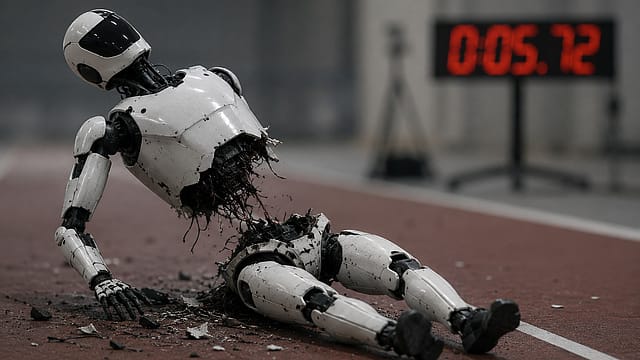
The robot had already mastered the hard part.
It could run.
Fast.
What it hadn't quite mastered was something humans learn as toddlers.
Stopping.
During a training session ahead of the 2026 World Humanoid Robot Games in Beijing, a humanoid robot sprinted down a track, overshot its stopping zone and crashed into a protective barrier at full speed. The impact appeared to buckle the machine at the waist, while sparks were reportedly seen moments later. Within hours, videos of the incident had spread across Chinese social media and beyond.
For a machine designed to showcase the future of robotics, it was an awkward moment.
For the internet, it was comedy gold.
What Happened at China's 'Robot Olympics' Training Session?
The incident took place during preparations for the World Humanoid Robot Games, a competition often described as the closest thing the world currently has to a Robot Olympics.

Losing Memory
16 Oct 2026 - Vol 05 | Issue 42
The making of a medical and social emergency
According to reports and widely shared footage, the humanoid robot was participating in a sprint test when it failed to slow down before reaching the end of the track. Instead of stopping gracefully, it collided with a safety cushion and crumpled dramatically.
The video quickly attracted millions of views, with social media users joking that the robot had "retired injured" before the competition had even begun.
Others compared it to an athlete pulling a hamstring during Olympic warm-ups.
The robot, fortunately, did not appear to suffer anything resembling embarrassment.
Why Is Everyone Calling It the Robot Olympics?
The nickname sounds like something straight out of science fiction.
But it is surprisingly accurate.
The World Humanoid Robot Games feature robots competing in sports-inspired events including sprinting, football, obstacle courses and other physical challenges. The event is designed to test how well humanoid machines can perform tasks that humans take for granted.
Walking.
Running.
Balancing.
Changing direction.
Stopping before hitting a wall.
That last one, apparently, remains a work in progress.
The competition has become a showcase for China's rapidly growing robotics sector, which is investing heavily in humanoid machines capable of working in factories, warehouses, healthcare facilities and even homes.
Why Are Robot Failures Often More Popular Than Robot Successes?
Here's the irony.
The purpose of these events is to demonstrate how advanced robots have become.
Yet the clips that go viral are usually the ones where something goes spectacularly wrong.
A robot falls over.
A robot loses its balance.
A robot crashes into another robot.
Or, in this case, a robot discovers the limits of momentum.
Part of the fascination comes from how human these failures feel.
When a robot stumbles, people instinctively react as though they are watching an athlete make a mistake. The machine suddenly seems less like a piece of technology and more like an overenthusiastic competitor having a very bad day.
The Funny Video Also Reveals a Serious Engineering Problem
It is easy to laugh at a robot running into a wall.
Engineers, however, see something else.
Data.
Running is one of the most complex things a humanoid robot can do. Every stride requires thousands of calculations involving balance, speed, weight distribution and environmental awareness.
Stopping can be even harder.
Humans adjust instinctively. A robot must rely on sensors, software and mechanical systems working perfectly together. If one calculation is slightly off, the result can be a full-speed collision.
That is precisely why robotics companies conduct these tests.
Failures often teach engineers more than flawless demonstrations ever could.
The Future Is Getting Faster
The crash comes at a time when humanoid robots are improving at remarkable speed.
Reuters recently reported growing optimism within the robotics industry that advances in artificial intelligence could dramatically accelerate the capabilities of humanoid machines over the next few years. Companies across China, the United States and Europe are racing to build robots that can move, learn and interact more naturally than ever before.
Which means there is an amusing lesson buried inside this viral moment.
The robots are getting smarter.
They are getting faster.
They are getting stronger.
But every now and then, they still remind us that even the future occasionally runs straight into a wall.