Rajnath Singh Cites Op Sindoor, Proposes ‘India-ASEAN Youth Bridge’ in ADMM-Plus
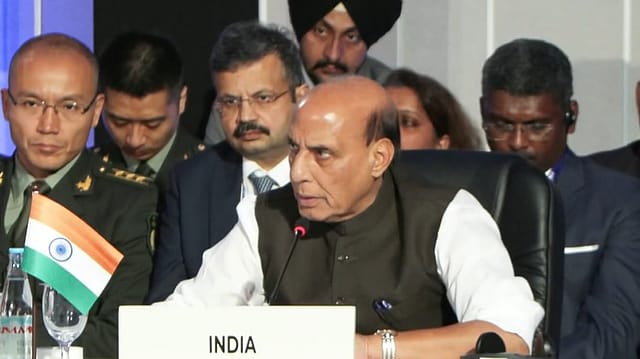
Defence Minister Rajnath Singh used the 13th ASEAN Defence Ministers’ Meeting-Plus (ADMM-Plus) in Cebu, Philippines, to press India’s case on terrorism, to offer a new youth partnership with ASEAN and to hold a string of bilateral meetings with some of the region’s most important defence leaders. He was given a ceremonial Guard of Honour at the Mactan Expo before the meeting began on Thursday.
‘EXPERIENCE NOT LIMITED TO CLASSROOM LEARNING’
Singh took a firm line on state-sponsored terrorism. “India reiterates its commitment to enhancing security in the region and eradicating terrorism at its roots,” he said. India’s counter-terrorism experience, he said, “is not limited to classroom learning or theoretical knowledge. Rather, it has been gained through decades of confronting cross-border security challenges on the ground. Every strategy we employ against terrorism has been tested and proven effective in real-world operations.”

Look Who's Talking Regime Change
23 Oct 2026 - Vol 05 | Issue 43
He cited Operation Sindoor last year as a major example, when India “destroyed a large number of terrorist infrastructure sites.” It was also, he said, “a clear declaration of India’s stance against state-sponsored terrorism.” He urged partners to share battle-tested experience through joint exercises, capacity-building and strong intelligence sharing, and said India supports an Indo-Pacific “that is secure and resilient, where peace and stability are not merely aspirations but the outcome of our collective efforts.”
He began his address with condolences over the October 23 crash that killed four Philippine Air Force pilots. “In this hour of sorrow, India stands in complete solidarity with the Armed Forces of the Philippines and the bereaved families,” he said.
THE ‘INDIA-ASEAN YOUTH BRIDGE’
Singh proposed a new initiative aimed at young people. “India believes that our greatest strength lies in our young population, in their energy, dynamism, and aspirations,” he said. Both India and the ASEAN nations have relatively young populations, he said, and that “interlinks our futures.” To turn the potential into reality, India proposed a robust “India-ASEAN Youth Bridge” that would foster people-to-people links, digital innovation and capacity building.
Many ASEAN members, including Vietnam, Indonesia, Timor-Leste and the Philippines, have young populations, and the Philippines, the host, has one of the youngest in Southeast Asia. The vision of empowering the next generation, Singh said, is also reflected in the meeting’s joint statement. “By empowering our youth, we are laying the foundation for a bright future for this region,” he said.
ASEAN CENTRALITY AND THE ACT EAST POLICY
Singh reaffirmed India’s “unwavering commitment to ASEAN centrality, which is a cornerstone of our Act East Policy and Indo-Pacific vision.” He said he hoped the meeting would strengthen mutual trust, tackle emerging disruptions and advance defence cooperation, and he thanked the Philippines for its hospitality as host.
India’s vision for an open, inclusive and rules-based Indo-Pacific, he said, rests on “shared interests, mutual respect, and practical cooperation.” For the wider region, India’s approach is built on MAHASAGAR, short for Mutual and Holistic Advancement for Security and Growth Across Regions, and on the Indo-Pacific Oceans Initiative that Prime Minister Narendra Modi launched in 2019. The Act East Policy itself aims to boost economic cooperation, cultural ties and strategic relationships, and to improve connectivity for India’s northeastern states, including Arunachal Pradesh.
FIVE BILATERAL MEETINGS
On Wednesday, on the sidelines of the forum, Singh held talks with defence leaders from five countries.
With the Philippines’ Secretary of National Defence, Gilberto Teodoro Jr., he reviewed defence cooperation and discussed expanding the strategic partnership, with an emphasis on maritime security and joint defence production. “India remains committed to fostering a free, open, and inclusive Indo-Pacific region,” he said.
With South Korea’s Defence Minister Kang Shin-chul, he discussed the growing defence partnership, including ways to co-develop military technologies and improve Indo-Pacific security.
With Japan’s Defence Minister Shinjiro Koizumi, he reviewed progress since their previous meeting in August and the priorities agreed then. “Our shared commitment remains vital for a free, open, and peaceful Indo-Pacific region,” Singh said. Koizumi thanked him for the welcome and assured him of Japan’s commitment to deeper cooperation, including in defence.
With US Secretary of War Pete Hegseth, he reviewed progress on the India-US Major Defence Partnership and under the two countries’ foundational security agreements. They discussed improving operational readiness, technology sharing and integration between the two defence industries.
The Ministry of Defence said regional security and counter-terrorism featured prominently. Singh said the global community must take an “uncompromising, zero-tolerance approach” towards nations that support, train or fund terrorist groups, and Hegseth reaffirmed the US’s “unwavering solidarity” with India in its fight against cross-border terrorism.
With Australia’s Deputy Prime Minister and Defence Minister Richard Marles, he reviewed cooperation, military interoperability and regional security challenges. “India places great value on its Comprehensive Strategic Partnership with Australia for a free, open, and secure Indo-Pacific,” he said. The two exchanged gifts, and Singh invited Marles to Aero India-2027, to be held in Bengaluru in February 2027.
‘JAI: JAPAN, AUSTRALIA, INDIA’
On Thursday, Singh posted a picture of himself standing between Koizumi and Marles, holding both men’s hands. “JAI: Japan, Australia, India,” he wrote on X.
WHAT IS ADMM-PLUS FORUM
The ADMM is the highest defence consultative and cooperative mechanism within ASEAN. The ADMM-Plus brings together the 11 ASEAN states, Brunei, Cambodia, Indonesia, Laos, Malaysia, Myanmar, the Philippines, Singapore, Thailand, Timor-Leste and Vietnam, with eight Dialogue Partners: India, the US, China, Russia, Japan, South Korea, Australia and New Zealand. The inaugural meeting was held in Hanoi in 2010, and since 2017 the ministers have met every year. The Philippines chairs the forum in 2026, and India co-chairs the Experts Working Group on Counter-Terrorism with Malaysia for the 2024-2027 cycle.
With inputs from ANI