One volcano, 2,300 cancelled flights: Anak Krakatau throws Indonesia into chaos
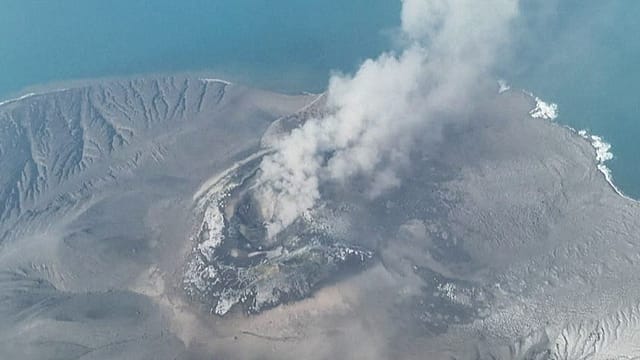
There are few things that can bring an airport to a standstill quite as efficiently as volcanic ash.
Not a strike. Not a storm. Not even a broken baggage system.
Just a cloud of tiny, abrasive particles drifting through the sky.
That is what Indonesia is dealing with now.
Mount Anak Krakatau — the volcano that rose from the remains of the legendary Krakatoa — has erupted in the Sunda Strait, sending ash across parts of Java and Sumatra and turning a routine travel day into a very large waiting game.
By Monday, more than 2,300 flights had been disrupted and over 270,000 passengers affected, according to Reuters. Seven airports remained closed, including two in Jakarta, while Soekarno-Hatta International Airport was kept shut until at least 6 pm local time.
And the volcano isn't quite finished talking yet.

Losing Memory
16 Oct 2026 - Vol 05 | Issue 42
The making of a medical and social emergency
What happened at Anak Krakatau?
The current episode began late on September 4, when Anak Krakatau entered a prolonged eruption.
Indonesia's Geological Agency says the continuous eruptive episode lasted roughly 25 hours, from 11:07 pm on September 4 until 12:04 am on September 6. It was followed by several smaller Strombolian eruptions.
The eruption was not merely a spectacular plume in the distance.
It produced lava fountains, ash and powerful sounds that were reportedly heard hundreds of kilometres away.
And then the ash got into the airways.
Why did one volcano disrupt so many flights?
Because volcanic ash and aircraft engines are a particularly bad combination.
Unlike an ordinary cloud, volcanic ash contains tiny particles of rock and minerals. When sucked into a jet engine, they can melt inside the engine's hotter sections and potentially damage critical components.
The ash can also reduce visibility and interfere with aviation operations.
That is why Indonesian authorities took the cautious option: close airports rather than gamble with aircraft.
Reuters reported that the disruption initially affected eight airports and more than 1,500 flights. By Monday, the number of affected flights had risen above 2,300 as closures and cancellations continued.
Which Indonesian airports were affected?
The disruption spread well beyond the volcano itself.
Airports affected included Soekarno-Hatta and Halim Perdanakusuma in Jakarta, Radin Inten II in Lampung and Husein Sastranegara in Bandung, among others. Indonesia's meteorological agency said ash was affecting airspace across parts of Java and Sumatra.
And this is what makes the episode particularly striking.
Anak Krakatau is in the Sunda Strait, but the airport shutdowns were happening more than 150 km away at Jakarta's main international airport.
The volcano did not need to reach the airport.
Its ash cloud did the travelling for it.
How high did Anak Krakatau's volcanic ash reach?
Pretty high.
Indonesia's BMKG said volcanic ash was detected at around 20,000 feet on one side of the volcano and as high as 50,000 feet — about 15 km — in areas farther west, including parts of Banten and over the Indian Ocean.
The direction of the ash has been changing with altitude and winds, which is one reason authorities have struggled to give travellers a simple reopening schedule.
As Reuters reported, windy and dry conditions were continuing to spread ash, making aviation conditions unpredictable.
Why is Anak Krakatau such a famous — and frightening — volcano?
Because its family history is extraordinary.
Anak Krakatau literally means “Child of Krakatoa.”
It emerged in the 1920s from the volcanic caldera left behind by the catastrophic 1883 Krakatoa eruption, one of the deadliest volcanic disasters in recorded history. That eruption triggered enormous tsunamis and killed more than 36,000 people.
But Anak Krakatau has its own deadly chapter.
In December 2018, a portion of the volcano collapsed into the sea during an eruption, triggering a tsunami that struck coastal areas of Java and Sumatra and killed more than 400 people.
So when Anak Krakatau starts behaving dramatically, Indonesians have very good reason to pay attention.
Is there a tsunami threat this time?
Not at present.
Indonesia's disaster authorities said there was no immediate tsunami risk from the current eruption. Indonesia's BMKG also reported that its monitoring systems had detected no sea-level anomaly indicating a tsunami associated with the latest activity.
That distinction matters because the memory of 2018 is still very fresh.
This eruption is causing serious disruption, but authorities are not currently reporting a repeat of the 2018 tsunami scenario.
Could Anak Krakatau erupt again?
Yes — and this is where the story gets interesting.
The Geological Agency has kept Anak Krakatau at Level III, or Siaga, Indonesia's third-highest volcanic alert level.
Its latest assessment says the probability of further eruptions in the coming period remains high. The potential hazards include heavy ashfall, incandescent rock fragments and lava flows if another prolonged eruption develops.
Authorities have also maintained a 3-km exclusion zone around the volcano.
So while the long eruption has ended, the volcano has not exactly clocked out.
What is happening to people on the ground?
The disruption isn't limited to travellers staring at departure boards.
Authorities have advised people in ash-affected areas to reduce outdoor activity and wear masks to avoid respiratory irritation. Schools in Jakarta and Lampung have shifted to remote learning as a precaution, while fishing activity has also been affected.
At airports, meanwhile, stranded passengers have been dealing with cancellations, delays and uncertainty over when flights can resume.
The Indonesian government has even turned to weather modification efforts to encourage rain, hoping that rainfall will help clear volcanic ash from affected areas.
When will the airports reopen?
That is the frustrating part: there is no neat answer yet.
Soekarno-Hatta was extended to remain closed until at least 6 pm Monday, while other airports have had their operating status adjusted according to the movement of the ash cloud and aviation-safety assessments.
The Transport Ministry has stressed that conditions can change quickly because wind and weather determine where the ash travels.
In other words, the airport timetable is currently being written by a volcano — and the volcano isn't particularly good at keeping schedules.
What does the eruption tell us about Indonesia?
Indonesia has more than 120 active volcanoes and sits on the Pacific Ring of Fire, where several tectonic plates meet.
Volcanic eruptions are therefore part of life in the archipelago.
But Anak Krakatau is a particularly vivid reminder of how a volcano can affect far more than the people living near its slopes.
A mountain in the sea can disrupt international aviation, schools, fishing, public health and thousands of travel plans hundreds of kilometres away.
And that may be the strangest thing about volcanic ash.
You don't need to see the volcano to know it's there.
Sometimes, all it takes is a cancelled flight.
(With inputs from yMedia and agencies)