Oman Shipping Attack: How 21 Indian Crew Members Were Rescued
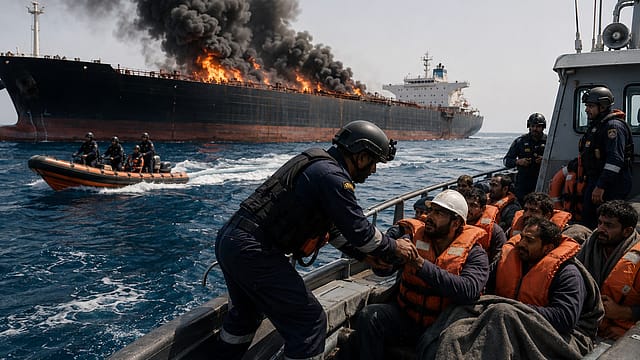
India has strongly condemned an attack on the commercial vessel Settebello off the coast of Oman after 24 Indian crew members were caught in the incident. While 21 Indians have been rescued, three remain missing, prompting an ongoing search-and-rescue operation involving Omani authorities and Indian diplomatic officials.
The incident comes amid rising tensions in the Gulf region, where commercial shipping has increasingly become entangled in the broader conflict involving the United States, Iran and regional actors. The attack has also renewed concerns about the safety of one of the world's most critical maritime trade corridors.
What Happened to the Vessel Settebello?
According to the Ministry of External Affairs (MEA), the commercial vessel Settebello came under attack off the coast of Oman on Wednesday.
In an official statement, the MEA said: "We condemn the attack on the commercial vessel Settebello off the coast of Oman, earlier today. Of the 24 Indian crew onboard, 21 Indians have been rescued thus far and 03 Indians are reportedly missing. Our Embassy in Oman is closely monitoring the situation and proactively coordinating with the Omani authorities in the ongoing Search and Rescue operation."

Zeroing In on ECI
09 Oct 2026 - Vol 05 | Issue 41
Constitutional legitimacy versus political opportunism
The Indian Embassy in Oman is working closely with local authorities as efforts continue to locate the missing crew members.
What Do We Know About the Rescue Operation?
Of the 24 Indian nationals aboard the vessel, 21 have been rescued safely. However, the fate of three crew members remains uncertain.
Indian officials say the country's embassy in Oman is maintaining constant contact with Omani authorities overseeing the search operation.
The incident has once again highlighted the vulnerability of Indian seafarers working aboard international commercial vessels in conflict-prone waters.
What Did Maritime Authorities Report?
Earlier, the United Kingdom Maritime Trade Operations (UKMTO) reported a fire aboard a tanker approximately 37 kilometres (20 nautical miles) northeast of Sohar in Oman.
According to UKMTO, the blaze originated in the vessel's engine room and resulted in one casualty. No additional details regarding the victim or the circumstances surrounding the fire were immediately available.
The exact connection between the reported fire and the attack remains under investigation.
Why Is India Linking the Incident to Regional Tensions?
India's statement went beyond condemning the attack and pointed to the wider security environment in the Gulf.
The MEA said: "The continuing incidents of attacks on shipping in the region are deeply worrisome and a direct result of the ongoing conflict in the region."
The ministry warned that repeated attacks on merchant shipping threaten global trade, regional stability and the safety of civilian crews operating in international waters.
What Is India's Position on the Escalating Crisis?
India reiterated its call for diplomatic engagement and a reduction in tensions.
The MEA stated: "We reiterate our call for immediate de-escalation of tensions, and the conclusion of ongoing negotiations for a diplomatic solution so that peace and stability can return to the region."
The statement reflects India's long-standing position that dialogue and diplomacy remain the best path toward resolving regional disputes.
India also stressed the importance of protecting global shipping routes and maintaining freedom of navigation.
According to the ministry: "The targeting of commercial shipping and civilian infrastructure in the region must end, and free and unimpeded navigation and commerce through the international waterways in the region in keeping with international law must be restored at the earliest."
How Does This Incident Relate to the Earlier MT Marivex Case?
The latest attack follows another major maritime incident earlier this week involving the Palau-flagged oil tanker MT Marivex.
Twenty-four Indian crew members aboard that vessel were rescued after the tanker caught fire off the coast of Oman.
On Tuesday, India thanked Oman for assisting in the rescue effort.
MEA spokesperson Randhir Jaiswal said: "Our embassy, for the rescue purpose, contacted the Omani authorities, who swung into action. We are grateful to the Omani government for its excellent support in rescuing the crew and ensuring their safety. Our mission continues to be in touch with the seafarers."
The rescue operation underscored the close coordination between Indian diplomatic officials and Omani authorities during maritime emergencies.
What Did India Reveal About the MT Marivex Incident?
Addressing a media briefing, MEA spokesperson Randhir Jaiswal confirmed that communication had taken place between the vessel and the US Navy before the tanker was disabled.
He said: "The ship MT Marivex was disabled off the coast of Oman. We have learned that it is a Palau-flagged vessel. We also understand there was some exchange of communication between the ship and the US Navy before the incident. There were 24 crew members on board the ship, all of them being Indian nationals. They all have been rescued and are safe."
His remarks provided India's first official account of the events leading up to the incident.
Why Did the US Navy Intercept MT Marivex?
According to the US Central Command (CENTCOM), US forces disabled MT Marivex in the Gulf of Oman on June 8.
CENTCOM stated that the tanker was allegedly attempting to sail toward an Iranian port in violation of the US-led blockade against Iran.
The American military said the vessel was struck after the "crew failed to comply with directions from US forces."
The incident has drawn attention to the increasingly volatile security environment in and around the Strait of Hormuz, one of the world's most strategically important shipping routes.
Why Does This Matter Beyond India?
The waters around Oman and the Strait of Hormuz are vital for global energy supplies and international commerce. Any disruption can affect shipping costs, oil markets and trade flows worldwide.
Reports indicate that both US and Iranian forces have targeted commercial vessels in the region since a ceasefire took effect in April, underscoring the fragile security situation.
For India, which has thousands of seafarers employed aboard international vessels and depends heavily on maritime trade and energy imports, the safety of commercial shipping in the Gulf is a matter of both economic and national interest.
The attack on Settebello and the earlier MT Marivex incident highlight how rapidly escalating regional tensions can place civilian crews and global trade routes at risk, reinforcing calls for de-escalation and a diplomatic resolution to the conflict.
(With inputs from ANI)