Nepal Flash Floods: 258 Dead, 910 Missing as Glacier Collapse Buries Himalayan Borderlands
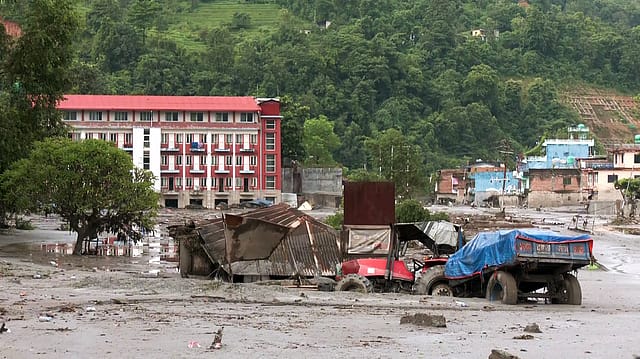
A section of glacier broke loose high in the Himalayas. Ice, rock and sediment plunged roughly 1,200 metres into the valley below. What followed was less a conventional flood than a moving wall of debris.
It crashed into a mountain river, raced towards the Nepal-Tibet frontier and thundered through settlements along the Bhote Koshi and Trishuli rivers. Roads vanished. Bridges buckled. Buildings, vehicles and hydropower installations were swept downstream. Entire communities were cut off before many residents could understand what was coming.
By Thursday afternoon, Nepal’s National Disaster Risk Reduction and Management Authority had reported 258 bodies recovered. Another 910 people were listed as missing or out of contact, including 517 foreign citizens and 127 Nepalis living abroad who were visiting the country.
Among those Nepal had been unable to reach were 288 Indians.

Zeroing In on ECI
09 Oct 2026 - Vol 05 | Issue 41
Constitutional legitimacy versus political opportunism
The figures remain fluid. Communications have collapsed across some of the worst-hit valleys, rescue teams are still reaching isolated settlements and authorities are trying to separate those trapped or displaced from those who may have been swept away.
Reuters reported that the combined death toll in Nepal and Chinese-controlled Tibet had crossed 270, with more than 1,000 people unaccounted for across both sides of the border. The news agency said over 650 foreigners from more than two dozen countries, many travelling to or returning from Mount Kailash, remained unreachable.
When a Glacier Fell into a River
The disaster struck on Wednesday morning close to Rasuwagadhi, Nepal’s principal land crossing with Tibet.
Early reports raised the possibility of an earthquake or a glacial lake bursting upstream. Satellite imagery examined by experts, however, points towards the collapse of the lower portion of a glacier. According to Reuters, ice, snow, rock and sediment broke away and plunged down the mountainside. The impact drove a violent surge into the river system below.
A seismic signal detected around the time of the disaster was initially interpreted as a possible earthquake. The United States Geological Survey later said the disturbance was produced by the collapse itself. The resulting flood travelled down the Bhote Koshi and into the Trishuli river system. Reuters reported that water levels rose by as much as nine metres within 30 minutes in some places.
The speed mattered as much as the volume. Water mixed with boulders, ice, trees and pulverised earth can acquire the force and density of wet concrete. It does not merely inundate a building. It can wrench it from its foundations and carry the wreckage downstream. Nepal Foreign Minister Shisir Khanal described the event as one of the country’s largest natural disasters in recent memory. Town after town, he said, had been wiped out within hours, while thousands of families still did not know whether relatives had survived.
288 Indians Remain Unreachable
India’s Ministry of External Affairs said communication lines in the affected region had been “totally disrupted”, preventing officials from contacting 288 Indian nationals believed to have been in or near the disaster zone.
The largest identifiable group includes 73 Indians working at the Trishuli-1 hydropower project. The Indian Embassy in Kathmandu is in contact with the project management as it attempts to establish their whereabouts. The others include two groups of 37 and 49 pilgrims from Tamil Nadu who travelled for the Kailash Mansarovar Yatra; 32 people from West Bengal believed to have been in Timure in Rasuwa district; 61 travellers from different states; and 33 people from Kerala.
Being “uncontactable” does not necessarily mean that a person is physically missing. Mobile towers, power supplies, roads and local communication networks have been knocked out. Officials believe some of those listed may be safe in isolated settlements or moving towards evacuation points. Twenty-one Indian pilgrims from Tamil Nadu have already been rescued. Indian officials said they were being brought towards Kathmandu, from where arrangements would be made for their return.
A large group associated with Sadhguru’s Isha Foundation was also among those authorities were attempting to trace.
Mansarovar Pilgrims Stranded in Tibet
The crisis straddles one of the most difficult borders in the world.
Nearly 200 Indians stranded on the Tibetan side have asked the Indian government for evacuation assistance. The Indian Embassy in Beijing is coordinating with Chinese authorities as groups of pilgrims attempt to move towards safer towns and possible border crossings.
The MEA said 95 Indians were travelling from Darchen towards Baisha, four were in Gyirong and 13 were moving from Zutulpuk towards Saga. The flood hit a corridor used by travellers undertaking the Kailash Mansarovar Yatra. That has complicated the search because groups were scattered across mountain roads, pilgrimage stops, immigration facilities and remote settlements on both sides of the frontier.
Reuters reported that 558 people were unaccounted for in Tibet’s Gyirong county alone, including 260 foreign nationals. Chinese authorities have also been monitoring a lake formed behind debris upstream. If that natural barrier fails, it could release another sudden surge into valleys where rescue teams are already operating.
Chitwan Records the Heaviest Toll
Although the flood began near Nepal’s northern frontier, bodies and debris were carried far downstream.
According to Nepal’s disaster-management authority, 108 bodies had been recovered in Chitwan, the highest toll recorded by any district. Nawalparasi East reported 62 deaths, Dhading 27, Gorkha 20, Nawalparasi West 15, Nuwakot 12, Tanahun 12 and Rasuwa two. The apparently low number in Rasuwa, where the first surge struck, does not reflect the scale of destruction there. At least 161 people in the district were listed as missing or out of contact, while many communities remained inaccessible.
Those unaccounted for included 28 Nepal Police personnel, 44 soldiers, 13 members of the Armed Police Force, 15 customs officials and four immigration officials. Helicopters operated by Nepal’s military and private companies have been deployed alongside the Nepal Army, Nepal Police and Armed Police Force. Teams worked through the night to reach Timure, Syaphrubesi and other settlements cut off by washed-out roads.
More than 5,000 personnel have been mobilised across Nepal, according to Reuters. Helicopters are ferrying survivors and injured residents while carrying food, medicine and emergency supplies into areas that can no longer be reached by road. India has sent two aircraft carrying relief material. The United Nations, China, the United States, Canada, the World Health Organization and the Red Cross are among those offering or mobilising assistance.
A Warning From a Warming Himalaya
The precise chain of events is still being investigated. Scientists have therefore cautioned against attributing this single collapse solely to climate change before detailed field studies are completed.
The broader danger, however, is well documented.
Reuters reported that Nepal has lost about a third of its glacier ice over the past three decades, with the pace of melting accelerating sharply during the past ten years. Retreating glaciers can expose unstable slopes, create or enlarge lakes and weaken natural dams holding back enormous volumes of water. The same border corridor suffered a deadly flood in July 2025 after a supraglacial lake drained in Tibet and sent water crashing down the Bhote Koshi. That disaster destroyed the Friendship Bridge linking Nepal and China and killed or left missing Nepali and Chinese workers.
A year later, the mountains have delivered a catastrophe on a far larger scale. For rescue workers, the immediate contest is against broken roads, unstable slopes, bad weather and a second possible flood. For hundreds of families in Nepal, India and far beyond the Himalayas, it is against silence: a switched-off phone, a severed communication line and the agonising difference between missing and merely unreachable.
(With inputs from ANI)