Missiles, Money and Hormuz: Why the UAE Suspended Trade With Iran — And What Happens Next
For a moment, it was the kind of alert that makes people look up from their phones. A warning went out to residents in the UAE: there was a “potential missile threat” and people were told to seek shelter. The alert was lifted soon afterwards.
Then came a far more consequential announcement.
The UAE said its air defences had detected two ballistic missiles launched from Iran, with the missiles assessed as targeting maritime traffic. One fell outside UAE territorial waters and the other inside them, according to the UAE Defence Ministry. No direct impact on the UAE was reported from the missiles.

Losing Memory
16 Oct 2026 - Vol 05 | Issue 42
The making of a medical and social emergency
Tehran rejected the accusation.
Iranian Foreign Ministry spokesperson Esmaeil Baghaei called the UAE's claims “baseless”, according to reports from Xinhua and Al Jazeera.
But Abu Dhabi did not stop at issuing a warning. It went after the economic relationship.
The UAE has drawn an economic line
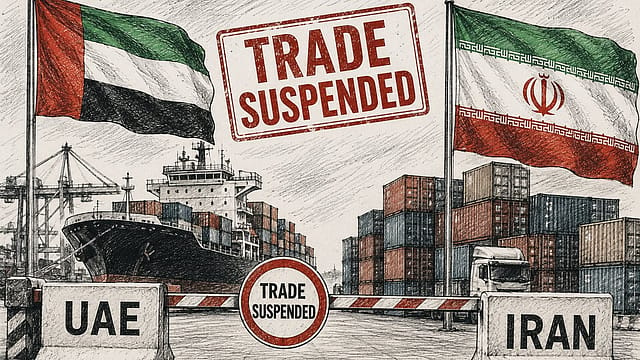
The UAE announced that all trade activities, commercial exchanges and financial transactions with Iran have been halted until further notice.
Afra Al Hameli, director of strategic communications at the UAE Foreign Ministry, said: "In light of regional escalations... all trade, commercial exchanges, and financial transactions with Iran have been halted until further notice."
The ministry said the decision was prompted by regional escalation that it believes threatens regional and international peace and security.
There is an important detail here: the UAE has not yet publicly provided a detailed list of exemptions or explained exactly how every aspect of the sweeping suspension will be implemented. That means it is too early to say precisely which businesses, payments or shipments will be affected and for how long.
But the wording is unmistakably broad. This is not just a suspension of one category of imports. Trade. Commercial exchanges. Financial transactions. All halted — for now.
Why does this matter?
Because Iran and the UAE have long been commercially connected despite political and security tensions.
Dubai, in particular, has historically been an important trading gateway for Iranian businesses. The relationship has survived sanctions, diplomatic tensions and repeated regional crises.
In June, the UAE had even agreed to unlock billions of dollars in Iranian funds as part of a broader effort to de-escalate tensions, according to a report shared by Reuters.
That makes the latest decision particularly striking. A relationship that had been showing signs of economic thaw is suddenly facing another freeze.
And then there is the Strait of Hormuz
Look beyond the UAE-Iran border and the stakes become much bigger.
The Strait of Hormuz is one of the world's most important shipping and energy routes. It is the narrow maritime passage linking the Persian Gulf with the Gulf of Oman and the wider Arabian Sea.
And right now, it is at the centre of the wider US-Iran confrontation.
On August 18 it was reported that shipping through Hormuz remained severely disrupted, with Iran insisting that the waterway would remain closed amid the collapse of a June interim arrangement with Washington. US President Donald Trump, meanwhile, has insisted that the Strait is open. That contradiction matters.
Because when ships hesitate to enter a waterway, insurers reassess risk, traders worry about supplies and energy markets begin looking nervously at the map.
The latest UAE decision adds another layer: trade between two major Gulf economies is now caught in the same geopolitical squeeze.
This is not the first time the UAE has faced Iranian attacks
The current crisis also comes after months of military confrontation. The UAE reportedly experienced repeated Iranian attacks during the wider conflict, with Emirati authorities saying the country had faced thousands of missiles and drones. The UAE had reported a period without attacks after the June memorandum came into effect, before tensions escalated again.
The latest missile allegation is therefore arriving against a much longer backdrop.
But there is still a crucial distinction between what Abu Dhabi says happened and what Tehran accepts. The UAE says its air defences detected two missiles launched from Iran. Iran says the accusation is baseless.
That dispute has not been independently resolved in the public reporting available so far.
What happens to trade now?
That may be the next big question. A suspension of financial transactions can affect far more than cargo moving between two ports. Businesses depend on banks to settle payments, insurers to cover shipments and logistics companies to move goods. If the suspension lasts, companies dealing directly with Iran may have to find alternative arrangements or markets.
But exactly how extensive that disruption becomes will depend on how the UAE implements the order — and whether the measure is temporary or turns into a longer-term economic rupture.
For now, the UAE has left the clock running. “Until further notice.”
From a missile alert to an economic freeze
That is what makes this episode bigger than a single missile scare. A warning appeared on phones. The UAE accused Iran of launching two ballistic missiles towards maritime traffic. Iran denied it.
And within hours, Abu Dhabi had taken a decision that reaches into trade, commerce and finance.
The missile flight lasted minutes. The economic consequences could last much longer.
For years, the UAE and Iran managed to keep commercial channels alive even when politics between them became difficult. Now those channels have been shut again.
And with the Strait of Hormuz already at the centre of a much wider confrontation, the question is no longer simply who fired the missiles? It is how much more of the Gulf's economic machinery gets pulled into the conflict.
(With inputs from ANI)