Meet Keisha Lance Bottoms, America’s First Black Woman Governor-Elect
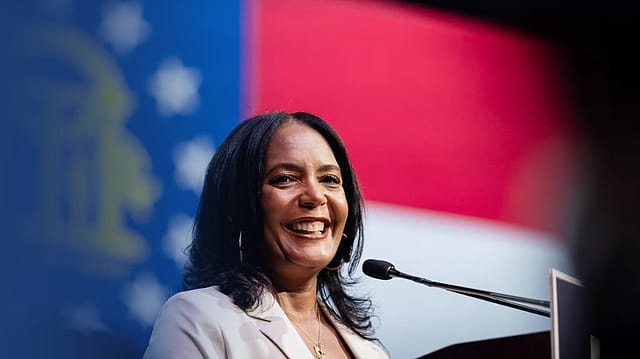
Georgia has elected Black senators. Atlanta has elected Black mayors. The governor’s office remained beyond the reach of a Black candidate.
Keisha Lance Bottoms has changed that. The former Atlanta mayor defeated Republican businessman Rick Jackson in the November 3 election. She will become Georgia’s first woman governor and its first Black governor, as well as the first Black woman elected governor of any US state.
Her victory brings a national milestone to a state whose recent elections have repeatedly demonstrated how competitive American politics can become.
Why is Bottoms’ win bigger than a change of party?
Because it breaks two state barriers and a national one.
Before this election, no woman had served as Georgia’s governor, and no Black woman had served as governor of a US state. Rutgers University’s Center for American Women and Politics identified both possibilities when Bottoms won her party’s nomination earlier this year.

The Era of Forever Wars
30 Oct 2026 - Vol 05 | Issue 44
Coping with an explosive Middle East
A governor leads a state’s executive branch: the administration responsible for putting state laws and programmes into operation. Winning that office gives Bottoms responsibility for decisions affecting schools, healthcare and public spending.
Her election changes who holds that authority. The practical consequences will emerge through the decisions her administration makes.
Who is the woman behind the milestone?
Bottoms built her career through law, local government and the White House.
She served as a judge and an Atlanta city councillor before being sworn in as the city’s 60th mayor on January 2, 2018. Her mayoralty included a major cyberattack, the Covid-19 pandemic and the racial-justice protests of 2020.
That experience gave her an executive record for voters to assess. It also gave opponents material to challenge.
Jackson attacked her handling of Atlanta’s crime and disorder. Bottoms defended her leadership through a period when cities across America faced pandemic-era disruption. The campaign contested what her record showed about her readiness to run the state.
What happened to Georgia’s long Republican grip?
Democrats finally won an office they had last captured in the 1998 election.
Roy Barnes, the party’s last governor, served from January 1999 until January 2003. His departure began the long period of Republican control that Bottoms’ victory now ends.
But Georgia’s political movement has been uneven. Biden carried the state in 2020; Trump won it in 2024. Democrats won its US Senate seats while Republicans retained the governorship. Different offices have produced different coalitions and results.
Bottoms’ win demonstrates that Democrats can now win the state’s top executive office. It does not settle how Georgia will vote in future elections.
What role did Stacey Abrams and Atlanta play?
They form part of the political groundwork behind this result.
Stacey Abrams unsuccessfully contested the governorship in 2018 and 2022. Her campaigns and organising efforts helped strengthen Democratic participation in a state where Black voters are central to the party’s coalition.
Growth in metropolitan Atlanta has also reshaped statewide competition. Bottoms brought experience governing its largest city, although a statewide election required support beyond the city itself.
The result should not be reduced to a single demographic explanation. Her campaign offered an economic and policy programme, while Jackson defended a sharply different approach to government.
Was she campaigning mainly to make history?
Her campaign foregrounded what she wanted government to do.
Healthcare is a central example. Bottoms proposes expanding Medicaid, the public health-insurance programme jointly funded by Washington and state governments for eligible people, including many on low incomes.
Her platform also promises support for rural hospitals, help with housing costs, changes to education funding and a route towards free technical and community college.
Those proposals connect the election to everyday questions: whether a family can afford treatment, whether a hospital remains accessible and whether education leads to a better-paid job.
Her campaign’s historical significance accompanied a contest over those choices.
How much can a Georgia governor actually change?
The office has substantial power, shared with other institutions.
Georgia’s governor oversees the executive branch and can veto legislation. A veto blocks a bill unless lawmakers overturn it with the required two-thirds majority in each chamber.
The budget illustrates the limits. The governor develops spending recommendations, but the state legislature must pass the appropriations that authorise spending. The governor then reviews the legislation and can reject individual spending items.
Consequently, election promises involving new programmes or major spending changes need a workable route through the legislature. A statewide victory supplies political authority; implementing an agenda also requires legal powers, money and votes.
How is this different from a governor’s appointment in India?
Georgia’s voters have chosen the person who will lead their state executive.
In India, the President appoints state governors. That constitutional arrangement differs from the directly elected American office.
For Indian readers, the key is to understand the responsibility attached to Bottoms’ victory. She will be accountable for running a state administration and pursuing a programme through its political institutions. Her achievement concerns access to executive power, alongside representation.
What happens next?
Bottoms moves towards taking office and building an administration. The transition will show who she chooses to lead departments and which commitments she prioritises.
Her early budget proposals will provide a concrete test: how much she seeks for healthcare, housing and education, and what lawmakers agree to fund.
The national barrier has been broken. Governing Georgia is the work that follows.