Iran War Casualties Cross 770 as Israel’s E1 Plan Deepens Cracks in US-Led West Asia Order
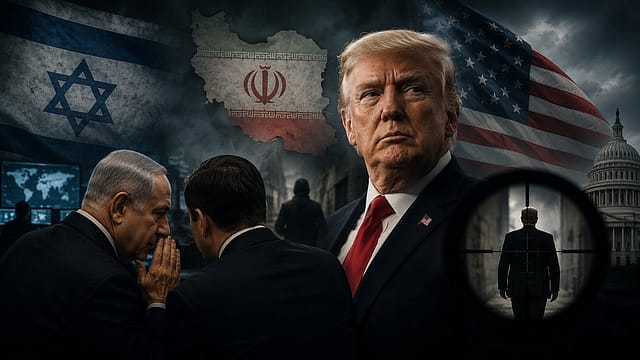
Look at what unfolded across West Asia within a few hours. The Pentagon’s Iran war casualty count rose to 774. Arab governments and several of Washington’s closest Western allies condemned Israel’s E1 settlement plan. Iran then claimed that neighbouring countries were approaching Tehran to discuss new security arrangements that would rely less on the United States.
Three developments. One uncomfortable question. Is the American-led order in West Asia beginning to crack?
Tehran would certainly like the world to believe so. Iranian Parliament Speaker Mohammad Bagher Ghalibaf claimed that Washington had endangered its regional allies through its support for Israel and disregard for their interests. “The United States put the security of every single one of its allies at such risk through bullying and pure disregard for their interests for the sake of Israel that they briefly saw their entire existence on the line,” Ghalibaf wrote on X.

Zeroing In on ECI
09 Oct 2026 - Vol 05 | Issue 41
Constitutional legitimacy versus political opportunism
He said Iran had received “numerous messages” from neighbouring countries about creating new regional security arrangements and expanding economic cooperation. “A homegrown, independent order is what will actually deliver peace and security,” he added. That is Iran’s version of events, and it should be treated as such. Ghalibaf did not identify the countries involved or disclose the contents of the reported messages. An account published by Iran’s state-run ISNA also offered no independent confirmation.
But Tehran’s claim has arrived at a useful moment. The war is approaching the six-month mark. American military casualties are rising even during a period of relative calm. Washington’s handling of the Strait of Hormuz has created friction with Oman. Israel’s settlement policy has brought together an unusually broad coalition of Arab, Islamic and Western governments. Iran may be exaggerating the birth of a new regional order. The strain on the existing one is harder to dismiss.
THE HUMAN COST KEEPS CLIMBING
The Iran war has now killed or wounded 774 American service members, according to figures drawn from the Pentagon’s casualty reporting system and reported by The Washington Post.
The total includes 18 personnel killed and 756 wounded. The number jumped after scores of names were added to the wounded list, although some of the increase may reflect a delay between injuries being recorded by military medical services and appearing in the Pentagon database.
That delay has become part of the story. The Pentagon has faced questions over the transparency of its casualty reporting after deaths and injuries previously disappeared from the public totals before being restored. The department attributed the fluctuations to “temporary data disruptions”.
CNN reported that the Pentagon had also created an “Overseas Operations” category covering casualties from July 7, the date on which the Trump administration informed Congress that a new conflict with Iran had begun under the War Powers Act. The department did not initially explain which conflict the category represented.
The fighting has eased in recent weeks, but there has been no final settlement. A 60-day memorandum of understanding signed in June has expired, negotiations remain stalled and the Strait of Hormuz continues to sit at the centre of the confrontation. The war may have slowed. Its cost is still arriving.
WASHINGTON, OMAN AND THE STRAIT
Now consider Oman.
For decades, Muscat has played a valuable role as an intermediary in regional conflicts. It has maintained working relationships with Washington and Tehran, allowing it to carry messages and host conversations that more openly aligned governments could not.
That balancing act has become considerably more dangerous. Oman and Iran have been discussing safe commercial navigation through the Strait of Hormuz, one of the world’s most important energy corridors. US President Donald Trump responded by warning Oman against obstructing Washington’s position on the waterway and threatened military action if it did.
Days later, US Secretary of State Marco Rubio met Oman’s Ambassador to Washington, Talal Al Rahbi. According to the Omani embassy, the two men praised the countries’ enduring partnership and stressed the need for coordination over shared regional challenges. That is diplomacy doing what diplomacy often does: cleaning the room after politics has thrown the furniture around. Oman remains an American partner. There is no evidence that Muscat has abandoned Washington or joined an Iranian security bloc. Yet the episode captures the pressure now confronting US allies. They rely on American military protection while also living within range of the missiles, drones and commercial disruption produced by an expanding conflict.
Washington can view Iran primarily as an adversary. Its Gulf partners must also live next door to it.
THE E1 PLAN WIDENS THE RIFT
The second pressure point lies in the occupied West Bank.
Israel has opened tenders for 1,234 settler homes in the E1 area, a strategically important stretch of land between occupied East Jerusalem and the large Israeli settlement of Ma’ale Adumim.
The proposal is part of a wider plan for 3,401 housing units. Why does E1 matter so much? Because geography can settle a political argument long before diplomats do. Development across E1 could create an Israeli settlement corridor linking East Jerusalem with Ma’ale Adumim. Critics warn that it would split the northern and southern West Bank, further isolate Palestinian communities and severely weaken the territorial basis for a future Palestinian state.
The plan has produced opposition well beyond the Arab world. The leaders of France, Germany, Italy, the United Kingdom, the Netherlands and Norway, along with several other governments and the European Commission, called the publication of the tenders “unacceptable”. In an official joint statement, they warned that E1 could drive a wedge through the West Bank, damage Palestinian territorial contiguity and undermine a two-state solution. They urged Israel to withdraw the plan and warned businesses against bidding for related contracts because of possible legal and reputational consequences.
The Gulf Cooperation Council issued a parallel condemnation. Its secretary general, Jasem Mohamed Albudaiwi, called the settlement push a challenge to international legitimacy and said it threatened efforts to establish an independent Palestinian state along the 1967 borders, with East Jerusalem as its capital. The foreign ministers of Qatar, Jordan, the United Arab Emirates, Indonesia, Pakistan, Türkiye, Saudi Arabia and Egypt also rejected the E1 project, describing it as a dangerous escalation that could advance de facto annexation.
This is where Washington’s regional problem becomes visible. Many of the governments opposing E1 are US partners. Several of the Western signatories are among Israel’s longstanding allies. Their objection is not merely to another construction project. They believe the development could make the two-state solution physically impossible.
Iran, naturally, sees an opening.
A NEW ORDER OR AN OLD WARNING?
Ghalibaf wants to turn these tensions into a much larger claim: that American allies no longer trust Washington to protect their interests and are ready to build a regional order without it.
The evidence does not yet carry him that far. US military bases, arms agreements and diplomatic relationships remain deeply embedded across West Asia. Gulf states may seek greater strategic autonomy without choosing Tehran over Washington. They can oppose Israel’s actions, negotiate with Iran and retain close security ties with the United States at the same time. West Asian diplomacy rarely offers the comfort of exclusive relationships.
Yet something is shifting.
A war intended to weaken Iran has wounded or killed more than 770 American troops. The fight over the Strait of Hormuz has placed Washington at odds with Oman’s attempt to mediate. Israel’s E1 plan has opened a fresh divide between the Israeli government and a coalition stretching from the Gulf to Europe. Iran has not proved that a new regional order is taking shape. It may not need to. For the moment, Tehran can simply point towards the old order and ask whether Washington’s own decisions are pulling it apart.
(With inputs from ANI)