‘Iran Cannot…’: What Donald Trump Revealed After Meeting Xi Jinping in China
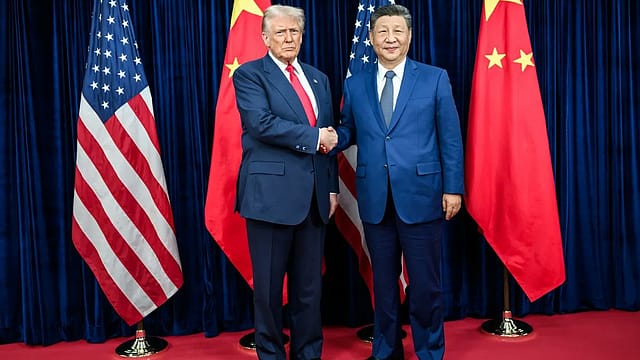
Following his meeting with President Xi Jinping during a state visit to China, Donald Trump on Saturday said both Washington and Beijing have shared a clear position on Iran’s nuclear ambitions.
Speaking to reporters aboard Air Force One, Trump said: "I have a lot of respect for him. On Iran, he feels strongly that they can't have a nuclear weapon--said that very strongly, they can't have a nuclear weapon--and he wants them to open up the strait. But as he said, they close it and you close them. And it's true, we (US) control the strait, and they (Iran) have done no business in the last two and a half weeks, which is approximately 500 million dollars a day.”
Trump’s remarks suggest a rare convergence between the United States and China on preventing Iran from acquiring nuclear weapons, while also linking the issue to maritime access.
Why is the Strait of Hormuz so important?
The Strait of Hormuz is one of the world’s most critical oil transit chokepoints, through which a large share of global crude supply passes.
Trump emphasised that keeping the strait open is essential, while also asserting US control over the passage and highlighting economic pressure on Iran due to restricted trade flows.
What did Trump claim about US actions against Iran?
Trump said Iran has suffered major financial losses due to US actions in the region. He claimed the country has lost around $500 million per day over the past two and a half weeks, attributing this to a US naval blockade affecting its ability to conduct business.

Open Minds 2026
26 Jun 2026 - Vol 05 | Issue 26
The power of ideas and arguments in 50 portraits
His remarks underline Washington’s strategy of applying economic and military pressure amid ongoing tensions in West Asia.
What was discussed about Taiwan?
Taiwan emerged as another major topic during Trump’s talks with Xi.
Trump said: "We had a great stay; it was an amazing period of time. President Xi is an incredible guy. President Xi and I talked a lot about Taiwan. He thinks they cannot have anything to do with what they're doing. He's very much against what they're doing. We talked about Taiwan and we talked about Iran a lot, and I think we have a very good understanding on both. On Taiwan, he does not want to see a fight for independence because that would be a very strong confrontation. I heard him out. I didn't make a comment on it, but I heard him out. I have a lot of respect for him."
The comments indicate China’s firm opposition to any move toward Taiwanese independence and highlight the sensitivity of the issue in US-China relations.
Did Trump discuss US arms sales to Taiwan with China?
Trump confirmed that the topic of arms sales to Taiwan was raised, including historical commitments.
He said: "I think 1982 is a long way away. It was a big, far distance. I didn't say anything about it, but he brought that up. He talked about that being an issue, obviously. So, what am I going to do--say I don't want to talk to you about it because I have an agreement that was signed in 1982? No, we discussed arms sales too. We discussed Taiwan in great detail, actually. And I'll be making a decision. The last thing we need right now is a war that's 9,500 miles away. We're doing very well."
This refers to the 1982 assurances under former US President Ronald Reagan, which governed aspects of US-China-Taiwan relations.
What does this mean for global geopolitics?
Trump’s statements suggest that while the US and China remain strategic rivals, there are areas of overlapping interest, particularly in preventing nuclear proliferation and maintaining stability in key global trade routes.
At the same time, the discussions on Taiwan highlight ongoing tensions that could shape future geopolitical dynamics, especially if disagreements escalate.
Overall, the talks reflect a mix of cooperation and competition between two of the world’s most powerful nations, with implications for energy security, regional stability, and global conflict risks.
(With inputs from ANI)