Iran Anthem Booed, Pre-Revolutionary Flags Wave Despite FIFA Ban at World Cup
Iran’s FIFA World Cup 2026 campaign began with far more than football dominating the headlines.
The team’s opening match against New Zealand at SoFi Stadium in Los Angeles became the focal point of a wider political debate involving exiled Iranians, anti-government demonstrators, FIFA regulations and competing visions of Iranian identity.
The match ended in a 2-2 draw, but much of the attention remained fixed on events inside and outside the stadium.
What Happened Outside SoFi Stadium?
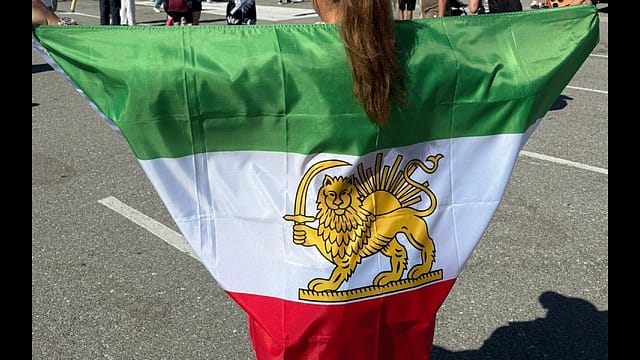
Hours before kickoff, several hundred Iranian Americans gathered outside SoFi Stadium to protest against the government in Tehran. Demonstrators waved the pre-revolutionary Iranian lion-and-sun flag and called for political change in Iran.
Greening the Future
23 Jul 2026 - Vol 05 | Issue 30
Securing a sustainable India
The protests highlighted deep divisions within the Iranian diaspora, particularly in Southern California, which is home to the largest Iranian community outside Iran. Many members of the community left the country following the 1979 Islamic Revolution and remain critical of the current political system.
Tensions occasionally flared. According to reports, some protesters seized an official Iranian flag from a supporter, stomped on it and tore it apart.
For many demonstrators, the national football team itself has become a symbol of the Iranian state.
“They are not my team. They are a government team,” said Rameileh Jaffrey, a 46-year-old Los Angeles resident who left Iran more than a decade ago.
Others arriving at the stadium argued that football should be separated from politics and attended primarily to support the players.
Why Is the Pre-Revolutionary Flag So Controversial?
At the centre of the controversy was the widespread display of Iran’s pre-revolutionary lion-and-sun flag.
The flag was used before the 1979 Islamic Revolution, which overthrew the monarchy and established the Islamic Republic. For many government opponents and members of the Iranian diaspora, the flag represents an alternative national identity and serves as a symbol of resistance to the current regime.
However, FIFA ruled before the tournament that displaying the flag could violate tournament regulations. Under rules announced in May, FIFA prohibits “banners, flags, flyers, apparel and other paraphernalia that are political, offensive and/or discriminatory in nature” inside World Cup venues.
Just hours before the match, a court upheld FIFA’s decision to ban the flag.
How Did Fans Defy FIFA’s Ban?
Despite the ruling, enforcement proved difficult.
Inside SoFi Stadium, the lion-and-sun flag remained visible throughout the match. Supporters displayed it on banners, flags and clothing across various sections of the crowd.
Security at the venue was notably strict. Fans passed through metal detectors and bag inspections before entering the stadium. In one instance, security personnel asked supporters wearing T-shirts featuring the pre-revolutionary flag to remove them. When those fans explained they had no other clothing available, they were instructed to turn their shirts inside out.
Yet once spectators entered the stadium, the ban appeared difficult to enforce comprehensively. The pre-revolutionary flag remained prominently visible throughout the stands.
Why Was the National Anthem Booed?
Another notable moment came before kickoff during the playing of Iran’s national anthem.
Fans inside the stadium reacted with a mix of cheers and boos, reflecting the political divisions within the crowd. Some supporters also turned their backs to the field while the anthem was being played.
The reactions underscored how Iran’s participation in the tournament has been shaped by political tensions that intensified following the recent conflict involving Iran and the United States.
For some spectators, supporting the national team remained separate from politics. For others, the team’s presence on the world stage was inseparable from broader debates about Iran’s government and future.
A Match That Reflected a Larger Divide
Iran’s opening World Cup fixture ultimately became a reflection of the broader divisions within the global Iranian community.
Outside the stadium, demonstrators demanded political change. Inside, supporters challenged FIFA’s ban by displaying the lion-and-sun flag. The national anthem itself became a point of contention, drawing both applause and boos.
While the match against New Zealand ended with a share of the points, the scenes in Los Angeles demonstrated that for many Iranians and Iranian Americans, the World Cup is about far more than football. It has become another arena in which questions of identity, representation and political allegiance are being publicly contested.
(With inputs from ANI)