India should not bet its future on Israel and the US: Jeffrey Sachs
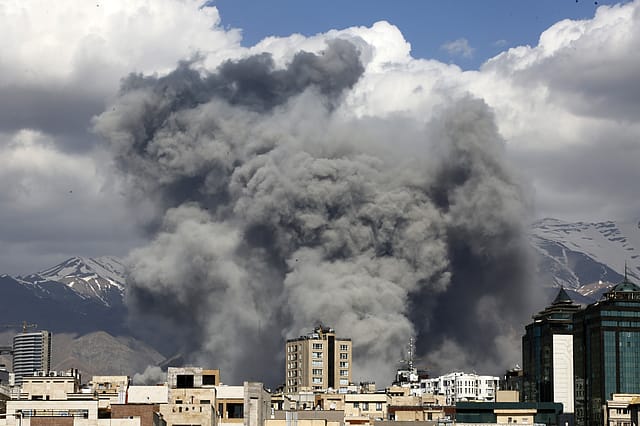
As staunch allies of President Donald Trump in Washington press and prod Gulf Arab states to join the ongoing Israeli-US military campaign against Iran, dissenting voices have begun to surface both in the United States and the Middle East. Many warn against dragging other countries into what is, in essence, a war waged by Washington and Tel Aviv.
Emirati billionaire Khalaf Ahmad Al Habtoor was among the first to lash out publicly at Trump and the Republican senator Lindsey Graham. In a widely circulated post on X, Al Habtoor asked: “Who gave you the authority to drag our region into a war with Iran?” He also rebuked Graham for his remarks urging Gulf participation.
Look Who's Talking Regime Change
23 Oct 2026 - Vol 05 | Issue 43
Writing on X after reports of the evacuation of the American embassy in Riyadh, Graham had said: “Why should America do a defence agreement with a country like the Kingdom of Saudi Arabia that is unwilling to join a fight of mutual interest?”
In an interview with Fox News, Graham went further. “To all the antisemites, to all the isolationists… I’m not with you, I’m with Israel. I will be with Israel to our dying day,” he said. Addressing Washington’s Gulf allies, he added: “What I want you to do in the Middle East — to our friends in Saudi Arabia and other places — is step forward and say, ‘This is my fight too. I join America. I’m publicly involved in bringing this regime down.’”
Noted American economist and public intellectual Jeffrey D. Sachs told Open that the United States will do everything it can to draw the Gulf into the conflict. “Saudi leaders until now lack the confidence to break with the US, even though the US offers only Israeli dominance of the region,” he said. “The entire Gulf region has behaved this way, betting its future on Israel and the United States. It’s a bad bet, as history has shown.”
Sachs was responding to a question on whether the 2023 Saudi-Iran rapprochement brokered by China is now at risk, with Trump appearing to favour confrontation over stability in the region.
The economist also offered a warning to New Delhi. “I hope India does not bet on an alliance with the US. That too would end very badly for India,” he said.
Sachs, a former director of Earth Institute at Columbia University and adviser to three UN secretaries-general, has long argued that American foreign policy has been shaped by militarism and special interests aligned with Israel. Though himself of Jewish origin, Sachs has been sharply critical of what he describes as the disproportionate influence of the Israel lobby on Washington’s strategic choices, arguing that US foreign policy should be guided by constitutional principles rather than external agendas.
In an earlier interview with Open, Sachs said the United States had carried out, overtly or covertly, scores of regime-change operations since the end of World War II. Citing the book Covert Regime Change, 1947–1989 by Lindsey O’Rourke, he noted that 70 such operations are documented during the Cold War alone. “Since then, there have been dozens more — coups, wars, colour revolutions — both overt and covert,” he said, pointing to countries ranging from Serbia and Afghanistan to Libya, Syria, Ukraine and Venezuela. A full accounting, he suggested, could approach 100 attempts, though much of the record remains classified or contested.
Meanwhile, Iran has widened its retaliation for the war launched by the US and Israel on February 28, which killed its then Supreme Leader Ali Khamenei along with several senior officials. Tehran has extended its response beyond Israel, targeting American military installations across Gulf Cooperation Council countries, a marked departure from its stance in June 2025 when it refrained from striking the Gulf in line with informal understandings with those states.
Graham’s comments have also drawn criticism from unexpected quarters. Steve Bannon, once chief strategist in Trump’s White House, attacked the senator and said he ought to be registered as a foreign agent of the Israeli government.
Iran has also warned that technology companies and data centres in the Gulf could become legitimate targets because of their links to the war effort. Technology firms play a pivotal role in modern warfare by providing infrastructure for data processing, surveillance and automated decision-making used by both the United States and Israel.
Investment giant BlackRock is a major shareholder in several technology, defence and infrastructure firms tied to US military operations. Companies such as Microsoft, Amazon, Google, Palantir Technologies and IBM have been cited for providing systems used in surveillance, military targeting and wartime infrastructure management.