Hormuz, Again: Ships Attacked, Oil Spilled, Drones Readied as the Crisis Refuses to End
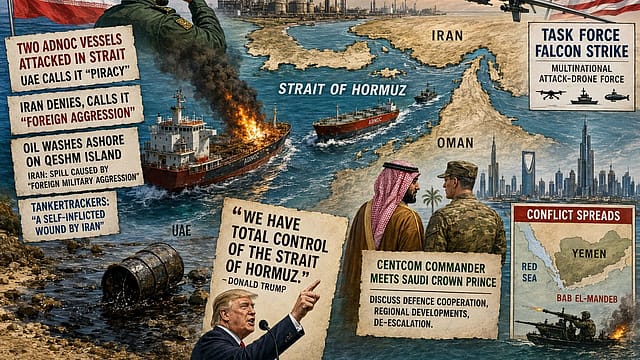
Two ships were attacked. Oil washed ashore. Iran called it foreign aggression. The UAE called it piracy. And Donald Trump says America has “total control” of the Strait of Hormuz. The ships appear to have missed that memo.
Months into a crisis that has repeatedly closed, reopened and destabilised one of the world's most important waterways, Hormuz is once again producing several crises at the same time.
On Thursday evening, two vessels belonging to Abu Dhabi's state-owned oil giant ADNOC were attacked while passing through the Strait. No injuries were reported and ADNOC said the situation was brought under control. The UAE blamed Iran and reached for some of its strongest language yet, accusing the Islamic Revolutionary Guard Corps of committing “acts of piracy” and using Hormuz for “economic coercion or blackmail”.

Zeroing In on ECI
09 Oct 2026 - Vol 05 | Issue 41
Constitutional legitimacy versus political opportunism
Reuters reported that this was the second alleged Iranian attack involving ADNOC vessels in less than a week. The company has been operating in an extraordinarily difficult environment: Reuters reported separately that ADNOC said last week that 15 of its vessels had been attacked while transiting Hormuz, leaving one crew member dead and 20 injured.
Egypt joined the UAE in condemning Thursday's attack, calling it a threat to maritime navigation through one of the world's most critical international waterways.
Yet the latest attacks tell only part of the story. Because the bigger question hanging over Hormuz remains the same one that has haunted it for months: Who actually controls it?
Trump says America. Iran says Iran. The ships tell another story Trump has claimed that the United States has “total control” over Hormuz.
Tehran's answer has been unequivocal. Iran says the Strait remains blocked and will not fully reopen until its conditions are accepted. Mohsen Rezaei, the newly appointed head of Iran's Supreme National Security Council, has warned that Tehran will not completely reopen the waterway until Washington meets “all the conditions”.
The reality on the water is considerably messier than either declaration of control. Reuters, citing Kpler data, reported on Friday that only nine commodity vessels crossed Hormuz on Thursday, up from five a day earlier but still below August's daily average of 12. Most used the Iranian shipping route.
Before the conflict, roughly a fifth of the world's oil and liquefied natural gas passed through this narrow stretch of water separating Iran from Oman. That explains why every missile, drone, threat and ship movement here travels far beyond the Gulf. Hormuz is geography with a price ticker attached.
Then the oil started washing back towards Iran
As if attacks on ships and competing claims of control weren't enough, the crisis has acquired an environmental front. Oil pollution has appeared along the shores of Iran's Qeshm Island. Tehran blamed the contamination on the repercussions of “foreign military aggression” in the region.
Iranian Deputy Foreign Minister Kazem Gharibabadi argued that the environmental damage strengthened Tehran's case for establishing a management mechanism for Hormuz. Foreign Ministry spokesperson Esmaeil Baqaei said contamination had been documented at three coastal locations and on parts of the sea surface, with preliminary evidence pointing towards a foreign bulk carrier.
There is, however, a rather extraordinary twist.
TankerTrackers offered a completely different account. The shipping-monitoring platform said the spill appeared to have originated from the Minoan Pioneer, a bulk carrier attacked off Oman on August 3, and that the oil subsequently drifted across the Strait towards Iran. Its conclusion was devastatingly simple: “A self-inflicted wound by Iran.”
The cause has not been independently established. AP reported that it was not immediately clear what caused the Qeshm spill, while noting TankerTrackers' competing assessment.
Which leaves Hormuz with another dispute layered on top of the others: even the oil washing ashore has become part of the geopolitical argument over who is responsible for what.
America is preparing for the next kind of fight
While diplomats argue over control and ships navigate the risks, the US military is preparing something new. CENTCOM has announced plans for Task Force Falcon Strike, its first multinational, multi-domain attack-drone task force. The unit is intended to combine American and regional unmanned capabilities above, on and below the sea, with CENTCOM inviting regional partners to participate.
The significance lies partly in what came before it. Nine months ago, CENTCOM established Task Force Scorpion Strike, its first dedicated one-way attack-drone squadron in the region. According to CENTCOM, that force subsequently launched an aerial attack drone from a US Navy warship and deployed unmanned systems during military operations against Iranian facilities.
Falcon Strike takes the concept one step further. It internationalises it. Instead of America operating its own drone capability, the plan is to integrate US and allied unmanned systems into what CENTCOM describes as a multinational deterrent. And the timing is difficult to ignore.
Ships are being attacked. Hormuz traffic remains constrained. Iran and America are publicly disputing control of the waterway. Now Washington wants its regional partners plugged into a common attack-drone architecture.
Enter Saudi Arabia
Hours around the announcement, CENTCOM commander Admiral Brad Cooper was in Jeddah meeting Saudi Crown Prince Mohammed bin Salman. According to the Saudi Embassy in Washington, the two discussed defence cooperation, regional developments and efforts to “de-escalate and enhance security and stability”. That juxtaposition captures the strange grammar of West Asia right now.
De-escalation is being discussed while deterrence is being armed. Washington wants to prevent the conflict from spreading while simultaneously strengthening the military network that would respond if it does. And it is already spreading.
Hormuz isn't the only waterway under pressure. Travel west from Hormuz and another shipping artery is flashing red. The Red Sea and Yemen are again becoming entangled in the wider confrontation. Russia told the UN Security Council that the stalled Yemeni peace process had helped drag the Houthis into what Moscow described as the broader regional confrontation involving the US, Israel and Iran. Moscow called for the complete lifting of the land, air and maritime blockade of Yemen while also condemning attacks that endanger commercial shipping.
AP reported renewed fighting involving the Houthis and Yemeni government forces, alongside Houthi claims of attacks on Saudi energy infrastructure and threats against shipping.
So, the map of risk is getting larger. Hormuz in the east. The Red Sea and Bab el-Mandeb in the west. Between them sit some of the world's most important energy producers and maritime routes. And that is why Hormuz matters all over again It is tempting to look at Thursday's attack as another entry in a conflict already overflowing with them. Two more ships. Another accusation. Another threat. Another military task force. But put the developments together and something more consequential emerges.
The UAE is accusing Iran of piracy. Iran is insisting Hormuz remains under its control. America is talking about control of its own. Shipping traffic remains depressed. Environmental damage is becoming another battlefield of accusation. Washington is assembling regional partners around a new generation of attack drones. Saudi Arabia is talking security with the commander overseeing that effort. Yemen is heating up again.
And all of it is happening around waterways through which the global economy cannot simply choose to stop sailing. That may be the most important thing about Hormuz after months of drama. The world has had plenty of time to get used to the crisis. The crisis hasn't become any less dangerous.
(With inputs from ANI)