Honey Bees Follow Personal Flight Routes With Incredible Precision, Study Finds
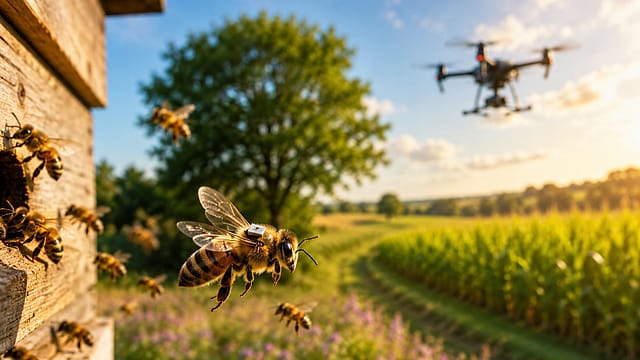
Honey bees may be far more sophisticated navigators than previously believed.
A new study by researchers at the University of Freiburg has found that individual honey bees follow their own highly consistent flight paths and can repeat them with remarkable precision, often flying just centimetres from routes they had taken before.
The research was led by neurobiologist and behavioural biologist Prof. Dr. Andrew Straw, whose team tracked honey bees travelling between their hive and a food source roughly 120 metres away in an agricultural landscape.
To monitor the insects, researchers employed a drone-based tracking system known as 'Fast Lock-On (FLO) Tracking', developed by Straw's research group. Tiny reflective markers were attached to the bees, allowing a computer mounted on a drone to identify and follow individual insects within milliseconds during flight.

Greening the Future
23 Jul 2026 - Vol 05 | Issue 30
Securing a sustainable India
"Our tracking system makes it possible for the first time to record high-resolution 3D flight paths of honey bees in natural landscapes," explains Straw. "Our recordings show that each bee has its own preferred route and flies it very precisely. You could almost say that each bee has its own personality."
Landmarks Help Bees Stay on Course
The team analysed 255 flight paths recorded near Kaiserstuhl, Germany. The landscape included hedges, a cornfield and a tree positioned between the hive and the food source, forcing bees to navigate around obstacles rather than fly in a straight line.
The findings showed that bees consistently returned to their preferred routes with extraordinary accuracy.
"We found a high degree of precision in the flight paths. Individual bees repeated their individual flight paths nearly exactly on several flights. They often fly just a few centimeters away from their previous paths," Straw emphasizes.
Researchers observed the greatest route consistency near prominent visual features, especially the tree. In contrast, bees displayed more variation when flying over the cornfield, where the environment offered fewer distinctive landmarks.
"Our results suggest that visual landmarks aid the bees' navigation and increase the precision of their flight paths," explains Straw.
The study indicates that bees experience greater uncertainty when traversing visually uniform environments, underscoring the importance of landmarks in their navigation system.
New Insights Into the Waggle Dance
The research also offers fresh perspective on the waggle dance, the well-known communication method honey bees use to direct hive mates toward food sources.
Scientists have long known that the directional information conveyed through the waggle dance is not perfectly precise. For food sources located about 100 metres away, the communicated direction can vary by roughly 30 degrees.
"It was previously known that the directional information in the waggle dance is not entirely accurate," explains Straw.
However, the new findings suggest that this imprecision is not caused by poor navigational abilities. Instead, bees appear to navigate with far greater accuracy when travelling to destinations they already know.
"Our research has shown that individual bees navigate much more accurately to destinations they are familiar with. Even where their flight paths vary most, they deviate from their individual route by only a few degrees. Our results allow us to conclude that the inaccuracy of the waggle dance is not due to the bees' limited navigational abilities. Rather, individual animals are spatially much more accurately oriented than their dance communication would suggest," says Straw.
The findings provide some of the strongest evidence yet that honey bees possess highly refined spatial awareness and rely heavily on visual cues to navigate the world around them.
(With inputs from ANI)