Fujairah Oil Hub Attack: India Condemns Strikes, Warns Over Global Trade Disruption
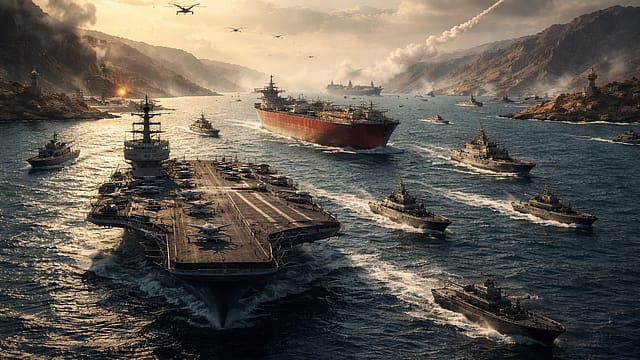
New Delhi didn’t equivocate. It called the strikes on the UAE’s Fujairah oil hub “unacceptable”—and demanded an immediate halt.
The attack, involving drones and missiles, targeted one of the region’s most strategically critical energy corridors. Inside the Fujairah Petroleum Industries Zone (FOIZ), a fire broke out in the aftermath. Three Indian nationals were caught in it, sustaining moderate injuries. The Indian Embassy in the UAE confirmed the casualties and said officials are working closely with local authorities to ensure the injured receive adequate medical care and support.
Fujairah’s importance runs deeper than geography. It is the only emirate on the Gulf of Oman, positioned outside the Strait of Hormuz—the narrow, high-risk chokepoint through which a significant share of the world’s oil supply moves. That location makes Fujairah a crucial bypass, a release valve for global energy flows. Disruptions here don’t stay local; they ripple outward.
India’s response reflected that reality.
MEA spokesperson Randhir Jaiswal, in an official statement, underscored the urgency of de-escalation as tensions rise across West Asia. The targeting of civilians and civilian infrastructure, he said, must stop. India, he reiterated, continues to back “dialogue and diplomacy” as the only viable path to restoring peace and stability in the region.
But the message went beyond condemnation.
New Delhi flagged the larger stakes—global trade and maritime security. It called for “free and unimpeded navigation and commerce” through the Strait of Hormuz, stressing that these must remain aligned with international law. The subtext was clear: any threat to this corridor carries consequences far beyond the immediate conflict zone.

Open Minds 2026
26 Jun 2026 - Vol 05 | Issue 26
The power of ideas and arguments in 50 portraits
India also signalled readiness to support efforts aimed at a peaceful resolution, even as the situation on the ground remained volatile.
In the UAE, authorities moved quickly.
The Ministry of Defence reported detecting and intercepting multiple incoming threats, including four cruise missiles launched from Iran toward various locations. Loud explosions reported across parts of the country were attributed to these successful interceptions, not direct impacts.
Even so, caution dominated the response.
The National Emergency Crisis and Disaster Management Authority (NCEMA) issued public advisories urging residents to remain indoors, stay in safe locations, and rely only on official channels for updates. Citizens and residents were explicitly warned against approaching, touching, or photographing debris from intercepted missiles—allowing authorities to assess and secure affected areas without risk.
The UAE’s diplomatic response was equally forceful—and unambiguous.
Its Ministry of Foreign Affairs condemned what it described as “renewed unprovoked Iranian aggression,” stating that drones and missiles had targeted civilian sites and facilities. The ministry confirmed that the three Indian nationals injured were caught in the crossfire of these strikes.
The language hardened quickly.
The attack, the UAE said, constituted an “unacceptable act of aggression”—a direct threat to its security, stability, and territorial integrity, and a violation of international law and the Charter of the United Nations. It made clear that the country would not tolerate any infringement on its sovereignty under any circumstances.
Then came the escalation clause.
The UAE asserted that it “reserves its full and legitimate right to respond” to the attacks in a manner that protects its national security and territorial integrity, in accordance with international law. At the same time, it demanded an immediate halt to hostilities and full compliance with cessation calls, holding Tehran “fully responsible” for both the attacks and their consequences.
Which leaves the region in a familiar, uneasy place.
A strategic oil hub hit. A critical maritime artery under scrutiny. Two nations trading accusations. And the ever-present risk that the next move won’t just be a response—but a trigger.
In West Asia, that’s how quickly the equation shifts—from isolated strike to something far harder to contain.
(With inputs from ANI)