From old wounds to AI and defence: Why Ishiba wants Japan and South Korea closer than ever
What if two countries with one of Asia’s most complicated histories decided that the future was simply too important to leave to the past?
That is essentially the argument former Japanese Prime Minister Shigeru Ishiba is making in Seoul.
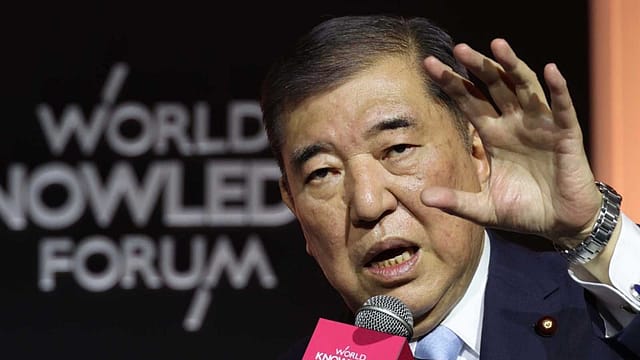
Speaking at the 27th World Knowledge Forum this week, Ishiba called for a much deeper Japan-South Korea partnership, arguing that the two countries could become a formidable combined economic and defence power while contributing more to regional security. The forum is being held in Seoul from September 8 to 10 under the theme “The Promethean Moment: Architecting the Co-Intelligence Order.”
But Ishiba's pitch is about much more than military cooperation. He is imagining something broader: two technologically advanced neighbours pooling their strengths in defence, artificial intelligence, semiconductors and supply chains — while finding a way to deal honestly with the history that has repeatedly strained their relationship.
Ishiba says Japan and South Korea could become a global power pair
Ishiba's argument is striking in its simplicity: separately, Japan and South Korea are major powers. Together, he says, they could become even harder to ignore.

Losing Memory
16 Oct 2026 - Vol 05 | Issue 42
The making of a medical and social emergency
He pointed to their combined economic and defence capabilities, saying the two countries would rank around third globally on both measures, while their combined population would rank ninth. His broader message was that Seoul and Tokyo, which share democratic values and commitments to freedom and human rights, should build what he described as a “true partnership of equals.”
That idea comes at a time when the security environment in East Asia is becoming more complicated. Ishiba told Japan's Nippon.com and Jiji Press that declining US power compared with 2002 makes stronger Japan-South Korea ties increasingly important for regional stability.
And this is no longer just talk about the future.
Japan and South Korea are already moving closer on AI and semiconductors
Just days before Ishiba's Seoul appearance, South Korea and Japan held their fifth economic-security dialogue in Tokyo.
According to Yonhap, the two sides discussed cooperation on artificial intelligence, semiconductors and other advanced technologies, along with stabilising supply chains for energy and critical minerals. The talks followed an earlier agreement between the two governments to strengthen strategic communication on economic and economic-security issues.
That technological overlap is becoming increasingly important. South Korea is home to semiconductor giants such as Samsung Electronics and SK Hynix, while Japan remains a major supplier of semiconductor materials and manufacturing equipment. At the same time, AI is driving fresh demand for advanced chips and data-centre infrastructure across both economies. Reuters reported this week that strong semiconductor and data-centre demand has helped push Japanese manufacturers' sentiment to its highest level in nearly five years.
In other words, the future Ishiba is talking about is already being built — chip by chip.
Ishiba wants defence cooperation to move beyond symbolism
Security is where his proposal becomes more ambitious.
Ishiba has argued for a network of Indo-Pacific security partnerships sometimes described as an “Asian NATO”. But rather than suggesting that NATO could simply be copied into Asia, his more recent formulation has focused on building a lattice-like network connecting existing US alliances and partnerships.
At an earlier Asan Plenum appearance in Seoul, Ishiba argued that deeper cooperation among countries including Japan, South Korea, Australia and the Philippines could eventually form the foundation for a broader regional security framework. He also identified a Japan-South Korea Acquisition and Cross-Servicing Agreement, or ACSA, as a practical step toward closer defence cooperation.
The idea is becoming more relevant as defence ties between Seoul and Tokyo continue to develop. On September 8, senior Japanese and South Korean defence officials reaffirmed the importance of both bilateral and Japan-US-South Korea trilateral cooperation, according to the Japanese Defence Ministry and Yonhap.
Why Ishiba keeps bringing up South Korea's nuclear submarine plans
Another issue on Ishiba's radar is South Korea's pursuit of nuclear-powered submarines.
He has argued that South Korea has the technological and industrial capacity to strengthen its own defence capabilities and, in doing so, potentially reduce some of the security burden carried by the United States.
But the bigger concern is what happens if two crises erupt simultaneously.
Ishiba has warned that a Taiwan Strait contingency occurring at the same time as a crisis on the Korean Peninsula would be among the most dangerous scenarios for the region. He has therefore called for substantive consultations among Seoul, Tokyo and Washington to prepare for such a possibility.
But there is one thing Japan and South Korea cannot simply build around
Technology can be shared.
Supply chains can be strengthened.
Military exercises can be expanded.
History is harder.
Relations between Japan and South Korea remain deeply shaped by Japan's 1910-1945 colonial rule over the Korean Peninsula and disputes over how that history is remembered and addressed.
Ishiba has repeatedly taken a comparatively conciliatory position on the issue. In Seoul, he stressed that Japan needs to confront the historical pain caused by its annexation of Joseon and pointed to his decision not to visit the controversial Yasukuni Shrine for 25 years as part of his approach to historical reconciliation.
That matters because trust between the two countries can be fragile. Ishiba's own earlier proposals for an “Asian NATO” drew a cautious response from Seoul, with concerns over what a more formal military alignment with Japan might mean.
The real test is whether the partnership can survive the past
There is a fascinating contradiction at the heart of Ishiba's vision.
Japan and South Korea may have every reason to cooperate more closely: they face overlapping security concerns, depend on sophisticated technology and supply chains, and share an important alliance with the United States.
Yet they also carry a history that neither country can simply file away.
Ishiba's pitch is therefore not really about forgetting the past. It is about deciding whether the two countries can acknowledge it honestly while building something much bigger for the future.
The semiconductor factories, AI systems and defence networks may be the easy part.
Building trust between Tokyo and Seoul could be the real strategic project.
(With inputs from ANI)