Donald Trump Urges Voting Reforms, Warns of Communism in US 250th Anniversary Speech
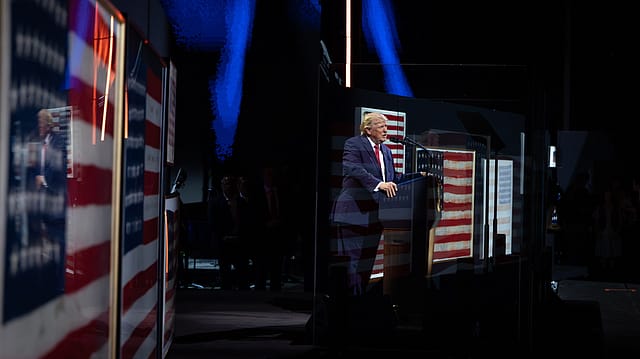
US President Donald Trump marked the 250th anniversary of the United States with a speech on the National Mall that blended patriotic messaging with political themes, according to Reuters.
The address, delivered on Saturday after a delay of nearly two hours caused by approaching storms, featured both celebration of American history and warnings about ideological threats.
Trump praised milestones such as military victories, the lunar landing and the Wright brothers' first flight, while also highlighting what he described as his administration's achievements.

The Health and Wellness Issue
25 Sep 2026 - Vol 05 | Issue 39
During the speech, Trump urged lawmakers to advance stalled legislation aimed at restricting mail-in voting and requiring proof of citizenship for voter registration.
He also claimed he had "wiped out" Iran's military and warned about what he characterised as the potential rise of communism in the United States.
Although Trump has previously labelled some left-wing Democratic candidates as "communists", he did not directly name them during this address.
The event reflected a departure from past presidential traditions, as most US leaders have avoided making in-person appearances at Independence Day celebrations.
Aside from Trump's 2019 speech, no president has addressed a July 4 gathering on the National Mall since 1951.
Attendees faced challenging conditions, with temperatures reaching 103 degrees Fahrenheit, or 39 degrees Celsius, amid a record-breaking heat wave that led to the cancellation of several parades and events.
Authorities briefly ordered an evacuation when thunderstorms approached, directing visitors to nearby museums and government buildings before allowing them to return.
Trump had earlier indicated he would "make a really long speech" for Saturday's rally "just to show that I can do anything." However, his remarks lasted under 40 minutes, shorter than many of his previous addresses.
Security was heightened for the event, which also drew the presence of the white nationalist group Patriot Front. The organisation marched through Washington earlier in the day and travelled on Metro services, though police reported no incidents of violence.
The celebrations were organised in part by the Trump administration's Freedom 250 group, which has taken a leading role over a bipartisan body established in 2016 to oversee the anniversary.
Large sections of the 1.5-mile National Mall were closed off for a "Great American State Fair", featuring attractions such as a Ferris wheel alongside exhibits from conservative organisations and defence contractors.
Freedom 250 said the event was intended to highlight the people and innovations that make the United States "the greatest nation on Earth."
Participation was uneven, with several Democratic-led states opting not to send delegations and a number of performers withdrawing over concerns about political overtones.
Trump had earlier launched the celebrations with a rally on June 24.
While crowds were initially limited, attendance increased in the following days, leading to long queues stretching several blocks.
Businesses within nearby Smithsonian Institution museums reported near-record sales, according to Smithsonian executive Frank DiGiovine, as cited by Reuters.
(With inputs from ANI)