China’s Tianwen-2 Reveals Mysterious ‘Second Moon’ Near Earth
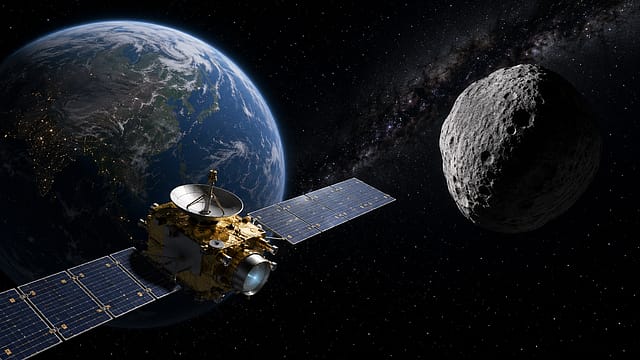
For decades, Earth was assumed to have just one moon. A small asteroid called Kamo'oalewa has been circling nearby in a stable enough pattern to earn the title of quasi-moon.
A fresh image captured in July 2026 by China's Tianwen-2 spacecraft has brought it into sharper focus, reigniting one of astronomy's most compelling open questions.
What Is Kamo'oalewa?
Kamo'oalewa, formally known as asteroid 2016HO3, is a small, asymmetrical rock measuring roughly 50 to 65 feet in diameter.

What Rahul Gandhi Wants
28 Aug 2026 - Vol 05 | Issue 35
He is desperately courting the angry youth. That won't be enough to credibly challenge Modi
It qualifies as a quasi-moon, a body orbiting the sun on a path that keeps it consistently close to Earth. There are at least seven known quasi-satellites of Earth, though their orbits are generally less stable than those of true moons.
Is Kamo'oalewa Earth's Second Moon?
Not technically. Quasi-moons orbit the sun rather than Earth directly, but their paths keep them in our planet's gravitational neighbourhood.
Earth occasionally captures others temporarily before releasing them back into solar orbit. Kamo'oalewa has remained unusually stable by comparison.
Could Kamo'oalewa Be a Fragment of Our Own Moon?
Some scientists believe Kamo'oalewa was created when a massive impact knocked a chunk of the Moon into space between 1 million and 10 million years ago, as per Space.com.
A 2024 study published in Nature Astronomy proposes it could be material ejected by the impact that formed the Giordano Bruno crater on the lunar surface.
What Has China's Tianwen-2 Discovered So Far?
Tianwen-2 launched on May 29, 2025, traveling approximately 620 million miles to reach roughly 12 miles from Kamo'oalewa. According to China's Xinhua news, an image captured on July 2 revealed a small, irregular rock with no surface details yet confirmed.
How Long Will the Mission Study the Asteroid?
The spacecraft carries 11 scientific instruments and will spend nearly a year studying Kamo'oalewa before attempting to collect a surface sample that could confirm or challenge the lunar origin theory.
How Does Tianwen-2 Compare to Earlier Asteroid Missions?
Japan's Hayabusa completed the world's first asteroid sample return in 2010. The United States followed in 2023, when OSIRIS-REx returned samples from asteroid Bennu (collected in 2020) that reportedly contained amino acids considered vital for life on Earth.
Tianwen-2 marks China's first such attempt.
What Comes Next for China's Deep Space Programme?
China plans to launch Tianwen-3, a Mars sample-return mission, in 2028, followed by Tianwen-4 targeting Jupiter and Uranus two years later.
The possibility that Earth shares its neighbourhood with a fragment of its own Moon reshapes how scientists understand our cosmic surroundings.
Kamo'oalewa is no longer just a footnote in an asteroid catalogue.
(With inputs from yMedia)