NASA Named Artemis III Crew Members Who Will Rehearse Humanity's Return to the Moon
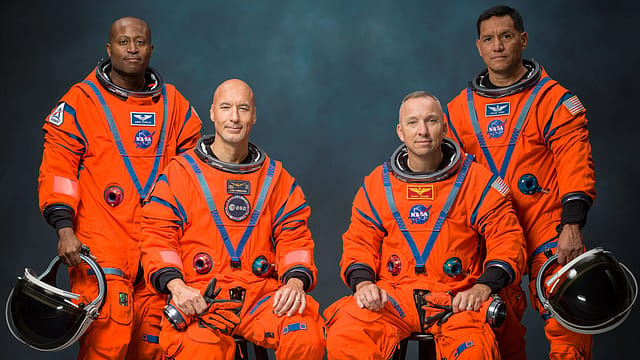
NASA has formally announced the four-member crew for Artemis III, one of the most technically demanding spaceflight missions in recent history.
Scheduled to launch before the end of 2027, the mission will serve as the essential rehearsal for Artemis IV, the first planned crewed landing at the lunar South Pole in 2028.
The announcement also marks the first time a European astronaut has been assigned to an Artemis mission.
Who Are the Astronauts Named for Artemis III?
The Artemis crew consists of commander Randy Bresnik (NASA), pilot Luca Parmitano (ESA) , and mission specialists Andre Douglas and Frank Rubio (NASA).

What Rahul Gandhi Wants
28 Aug 2026 - Vol 05 | Issue 35
He is desperately courting the angry youth. That won't be enough to credibly challenge Modi
NASA astronaut Bob Hines will serve as the official backup crew member. All four will begin training immediately on Orion spacecraft systems alongside test versions of commercial landers from Blue Origin and SpaceX.
What Will the Artemis III Mission Do in Orbit?
The mission will launch aboard NASA's Space Launch System (SLS) rocket from Kennedy Space Center into low Earth orbit.
Once there, Orion will demonstrate rendezvous and docking with test versions of both commercial landers for the first time.
The crew is expected to spend approximately two weeks in space, with the exact duration confirmed in real time.
Why Does This Mission Require Multiple Rocket Launches?
The mission demands a multi-launch campaign using the world's most powerful rockets. Blue Origin's lander pathfinder launches first and awaits the crew.
After roughly two days of docked operations, SpaceX's Starship pathfinder launches separately and docks for approximately one day of hardware checkouts.
Because this Starship test article will not feature an active life-support system, the crew will remain safely inside Orion during this phase before returning home.
Who Is Luca Parmitano and Why Does His Inclusion Matter?
ESA astronaut Parmitano is the first European assigned to an Artemis mission.
According to ESA Director General Josef Aschbacher, his assignment as pilot reflects the depth of European expertise in human spaceflight, as per NASA.
Parmitano previously commanded the International Space Station during Expedition 61, becoming the first Italian to do so.
How Far Along Is NASA in Preparing for Artemis III?
The SLS core stage integration is progressing steadily, solid rocket booster segments have arrived at Kennedy Space Center, and rocket stacking is scheduled to begin this summer.
Heat shield testing is ongoing and Orion's crew and service modules are set to be connected in the coming months.
What Does Artemis III Mean for the Longer Road to Mars?
NASA describes the Artemis III mission as foundational not only for the lunar South Pole landing but for the first crewed missions to Mars.
It is designed to stress-test the hardware, software, and communications architecture that all future deep-space missions will depend on.
(With inputs from yMedia)