China at the Red Fort: Beijing Leads Global Wishes as India Marks 80th Independence Day
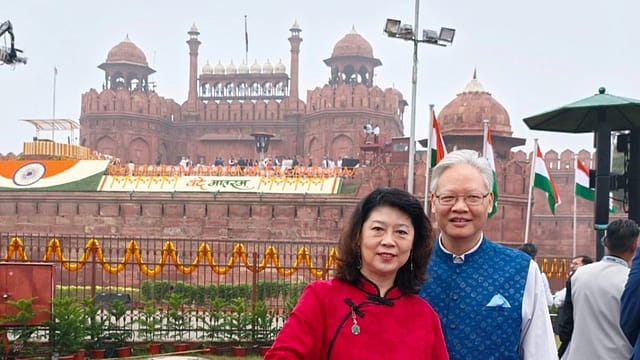
There was a Chinese diplomat watching as the Tricolour went up over the Red Fort on Saturday morning. As Prime Minister Narendra Modi addressed the nation on India's 80th Independence Day, Chinese Ambassador Xu Feihong was among those attending the celebrations in New Delhi. His message was short. “Warm congratulations to India on the 80th anniversary of independence!” Xu wrote on X.
But on a day filled with diplomatic greetings, the optics carried their own significance. China was at the Red Fort. India was celebrating in Beijing. And thousands of kilometres away, another Tricolour was going up. In Beijing, the rain didn't stop the celebrations At the Indian Embassy in Beijing, Ambassador Vikram Doraiswami hoisted the national flag as members of the Indian community and friends of India gathered despite the rain. Doraiswami read excerpts from President Droupadi Murmu's address to the nation, while children from the Indian diaspora performed patriotic songs.
Rise of the Pivotal Power
18 Sep 2026 - Vol 05 | Issue 38
The BRICS declaration is a strategic victory for Modi
The celebrations also carried an unusual cultural bridge. The embassy felicitated Mi Xuanye, winner of the Indian Council for Cultural Relations' Pratibha Sangam Competition in Hindustani instrumental music. Indian Independence Day. In Beijing. And a Chinese musician being honoured for Hindustani music.
Diplomacy sometimes produces its nicest pictures away from negotiating tables. Shanghai had a typhoon. Then came the sun The celebrations in Shanghai had to contend with even more difficult weather. After a typhoon hit the city, the sun emerged in time for Independence Day celebrations attended by more than 400 members of the Indian diaspora, friends of India and representatives of the local consular community, according to the Indian mission.
Consul General Pratik Mathur led the celebrations. The Indian Consulate captured the mood succinctly: “the sun finally shone in typhoon-hit Shanghai”. And then the messages came from across the world.
China was only one part of the diplomatic chorus.
From India's immediate neighbourhood to Europe, West Asia and the Asia-Pacific, leaders and diplomats sent messages marking the country's 80th Independence Day. Nepal Prime Minister Balendra “Balen” Shah invoked the two countries' deep historical ties and close people-to-people relationship, expressing hope that cooperation between New Delhi and Kathmandu would grow stronger. Former Maldives President Ibrahim Mohamed Solih described India's journey since 1947 as an inspiration for developing democracies and called for an even stronger India-Maldives friendship. Singapore President Tharman Shanmugaratnam used his message to look ahead, highlighting cooperation with India in digitalisation, skills, sustainability and advanced manufacturing and stressing the two countries' shared interest in a peaceful and connected region.
Israel celebrates an old friendship
Israeli President Isaac Herzog's message focused on the increasingly close relationship between New Delhi and Jerusalem. He congratulated President Droupadi Murmu, Modi and the “wonderful people of India”, adding: “May we continue to strengthen the beautiful friendship between Israel and India.”
Australia joined the celebrations visually. High Commissioner Philip Green shared images of the Australian High Commission illuminated in saffron, white and green, with members of his team also dressing in the colours of India's flag.
Latvia wished India “continued progress, unity, and prosperity”, while Ireland used the occasion to reflect on how far its relationship with India had travelled.
Eighty years later, a very different India There is another story underneath all those diplomatic messages. When India became independent in 1947, it emerged from nearly two centuries of colonial rule confronting poverty, Partition and enormous questions about whether its democratic experiment would survive. Eighty Independence Days later, foreign governments aren't simply congratulating India on surviving. Their messages increasingly speak the language of technology, manufacturing, economic cooperation, strategic partnerships and regional security. That reflects the distance India has travelled, as well as the interests countries now have in its future.
And perhaps the day's most interesting symmetry came from China. In Delhi, China's ambassador watched India's Independence Day ceremony from the Red Fort. In Beijing, India's ambassador raised the Tricolour. In Shanghai, hundreds gathered after a typhoon to celebrate. Two countries with one of Asia's most complicated relationships. For one morning, though, the message from Beijing was remarkably uncomplicated: “Warm congratulations to India.”
(With inputs from ANI)