Big-Ticket Announcements Ahead? Nuclear Push in India–US Relations Explained
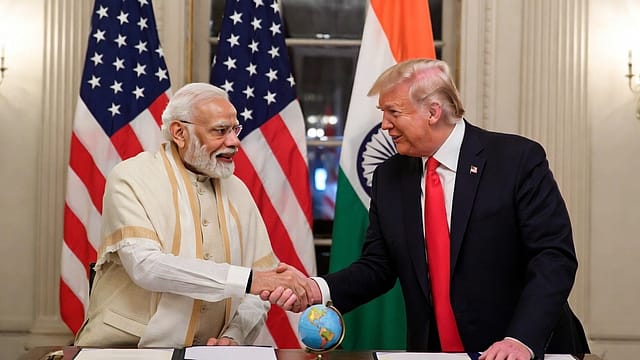
A recent high-stakes conversation between Prime Minister Narendra Modi and US President Donald Trump signals a deepening phase in bilateral ties, particularly at a time of global instability.
Foreign affairs expert Robinder Sachdev described the engagement as part of a sustained diplomatic process.
“The conversation between President Trump and Prime Minister Modi is definitely a continuing process, and it's good to see two big nations talking regularly, exchanging views, especially right now when the world is in such a high degree of turmoil. It also indicates that India and America both want their relationships to continue to prosper, having deeper depth and wider width, as also noted by Sergio Gor,” he said.
The dialogue reflects not just continuity, but an expansion of cooperation across strategic, economic, and security domains.
Why is nuclear energy at the centre of discussions?
A key outcome expected from the evolving partnership is cooperation in nuclear energy, particularly after India’s recent policy shift.
“In terms of what could be some big-ticket announcements in the coming months, if he mentions energy, I would guess it would be something related to nuclear power, especially small modular reactors. India has recently reframed our nuclear liability bill as the Shanti Bill, which was holding up progress and the implementation of nuclear projects. Now that it has been amended, the nuclear sector would definitely be one,” Sachdev said.
The Vanguard
21 Aug 2026 - Vol 05 | Issue 34
BJP Rearmed for 2029
The amendment to nuclear liability laws has removed a longstanding hurdle, potentially unlocking US investment and collaboration in India’s nuclear sector.
What role will Small Modular Reactors (SMRs) play?
Small Modular Reactors are expected to be a major focus in upcoming India–US energy cooperation.
“Nuclear energy would be one area, I think. The other could be strategic rather than energy-related,” added Sachdev.
SMRs are seen as more flexible, scalable, and cost-effective compared to traditional nuclear plants, making them attractive for India’s growing energy needs.
How does the global security situation shape these talks?
The discussions also come against the backdrop of heightened tensions in West Asia, with both nations prioritising regional stability and secure energy routes.
Ensuring the safety of critical maritime corridors remains essential for global trade and India’s energy security, making defence and strategic coordination equally important.
Why is thorium being projected as India’s long-term answer?
India’s unique advantage in thorium reserves could redefine its nuclear future.
“If we look at the crisis of the world today, nuclear is one big answer for India. In fact, more than nuclear, I have been advocating that thorium is the answer for India. We have 30% of the world's thorium. We have the most advanced fast-breeder technology, and we should be looking to industrialise it. We attained criticality in the fast-breeder program a few weeks ago, which Prime Minister Modi inaugurated,” he noted.
This positions India to potentially lead in next-generation nuclear energy, especially through fast-breeder and thorium-based reactors.
What is the significance of Marco Rubio’s upcoming visit?
The next major development is expected during the visit of US Secretary of State Marco Rubio to India.
“There should be some announcement or indication of the Quad summit because that is something that has been pending. Perhaps that will be discussed deeper when Secretary Rubio visits India next month,” Sachdev said.
The visit could accelerate progress on the long-pending Quad Summit and broaden cooperation beyond energy into defence and maritime strategy.
Is this relationship becoming more strategic than transactional?
The evolving India–US partnership appears to be moving beyond transactional deals toward a more comprehensive strategic alignment.
From nuclear collaboration to maritime security and multilateral frameworks like the Quad, the relationship is expanding in both scope and depth, reinforcing its role in global stability.
(With inputs from ANI)