Balancing The BRICS
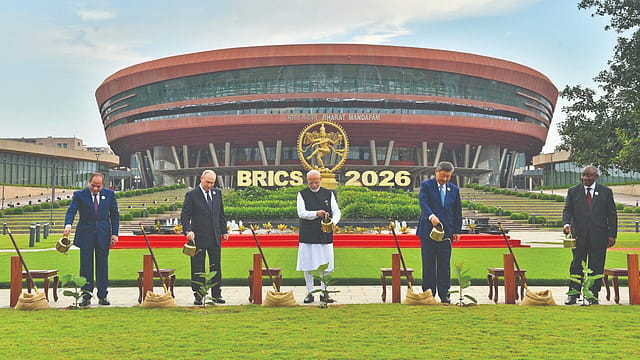
The 2026 BRICS Summit in New Delhi marked an important stage in the evolution of a grouping that has changed considerably from its origins as a compact association of large emerging economies. What began as an economic acronym has gradually acquired a broader political and diplomatic purpose. Yet the expansion of BRICS has also exposed the central paradox of its rise: its growing weight is accompanied by increasing internal diversity, making consensus both more valuable and more difficult to achieve.
India’s role in this process has been distinctive. New Delhi has consistently sought to make BRICS a platform for the Global South without allowing it to become an explicitly anti-Western coalition. Its preference has been for a pragmatic, development-oriented multilateralism that expands the room for manoeuvre of emerging powers while preserving their strategic autonomy.

Zeroing In on ECI
09 Oct 2026 - Vol 05 | Issue 41
Constitutional legitimacy versus political opportunism
Acronym to Platform
BRICS was born out of an economic thesis. Jim O’Neill’s 2001 formulation of “BRIC” identified Brazil, Russia, India, and China as economies whose growing weight would reshape the global economy. Political cooperation followed in 2006, and the first leaders’ summit was held in Yekaterinburg in 2009, against the backdrop of the global financial crisis. South Africa’s entry in 2010-11 transformed BRIC into BRICS. The early agenda was relatively straightforward: greater representation for emerging economies in global economic governance, reform of the Bretton Woods institutions and a stronger architecture for South-South cooperation. The creation of the New Development Bank and the Contingent Reserve Arrangement gave this ambition institutional form. But BRICS was never simply an economic project. It represented an attempt by states that had acquired greater economic weight to challenge the distribution of influence within an international system whose institutions had not kept pace with that transformation.
The decisive change came after the 2023 Johannesburg summit. The admission of Egypt, Ethiopia, Iran, and the UAE in 2024, Indonesia in 2025, and the expanding role accorded to Saudi Arabia transformed BRICS into a much more geographically dispersed and politically heterogeneous grouping. The emergence of a partner-country category further extended its reach.
The result is a BRICS that is considerably larger in demographic, economic and energy terms than the original grouping. By 2026, it represented roughly half of the world’s population and around two-fifths of global GDP in purchasing-power-parity (PPP) terms, even as estimates vary. Intra-BRICS trade has also expanded substantially.
This evolution can broadly be understood in three phases. The first, from 2006 to the mid-2010s, was about identity formation and institution building. The second, from the late 2010s into the early 2020s, involved incremental cooperation amid diverging economic trajectories and mounting geopolitical tensions. The third, beginning in 2023, has been characterised by rapid expansion, greater representation of the energy-rich and developing world, and a sharper focus on multipolarity, local-currency settlements, digital infrastructure and the priorities of the Global South.
The irony is that the more BRICS expands, the less it resembles a conventional geopolitical bloc.
Delhi and Diversity
The 2026 New Delhi summit demonstrated both the possibilities and the limitations of this enlarged BRICS. Under the theme of ‘Building for Resilience, Innovation, Cooperation and Sustainability’, the summit produced a lengthy declaration after difficult negotiations. That the declaration was adopted by consensus is itself significant. In a grouping containing states with sharply divergent interests, consensus is not a procedural detail; it is the principal political achievement.
The declaration covered a wide range of issues, from reform of global governance and stronger representation for India and Brazil in the UN Security Council to trade, development finance, digital public infrastructure (DPI), artificial intelligence (AI), health and energy. It also addressed conflicts in West Asia and condemned terrorism, including explicit reference to the April 2025 Pahalgam attack.
Yet perhaps more revealing than what BRICS said was what it chose not to become. Despite mounting criticism of aspects of the Western-led international order, the grouping stopped short of defining itself as an anti-Western alliance. This distinction matters. BRICS is increasingly an instrument for diversification of global power, but it is not yet an alternative security architecture. India has played a significant role in maintaining this distinction.
As a founding participant and a four-time chair, including in 2012, 2016, 2021 and 2026, New Delhi has consistently pushed BRICS towards practical cooperation. The 2012 chairship helped advance the idea that ultimately became the New Development Bank. The 2021 presidency placed greater emphasis on technology, health and counter-terrorism. The 2026 presidency carried this approach further by focusing on DPI, payment systems, local-currency financing and development-oriented cooperation.
India’s presentation of its DPI, including systems such as UPI and Aadhaar, is particularly noteworthy. It reflects a broader Indian ambition: to move the Global South from being a recipient of imported technological models to becoming a source of scalable institutional innovation.
This is also where India’s conception of BRICS differs from a more narrowly geopolitical interpretation. New Delhi wants developing countries to become “rule-shapers” rather than merely “rule-takers”. But it does not believe this requires the destruction of the existing multilateral system. Reform, rather than wholesale replacement, remains the preferred strategy.
The Indian Bridge
The central challenge for India is China’s structural weight within BRICS. Any assessment of the grouping’s future has to recognise that its expansion has not reduced China’s economic predominance. Indeed, in some respects, enlargement has increased the importance of managing that asymmetry. India’s response has been neither confrontation nor accommodation. It has been to insist on consensus, development and strategic autonomy.
This approach reflects India’s wider foreign-policy positioning.
New Delhi is simultaneously engaged with the Quad, G20, and other Western and Asian-led institutional arrangements while seeking greater influence among developing countries. BRICS therefore functions less as an alliance commitment than as an instrument of strategic diversification.
The 2026 summit illustrated the value of this positioning. The Modi-Xi engagement, Xi Jinping’s return to India after seven years, and India’s efforts to facilitate dialogue between Iran and the UAE all reinforced New Delhi’s image as a diplomatic convenor. India’s ability to maintain relationships across otherwise competing camps gives it a role that few other BRICS members can easily replicate. This is perhaps the most important contribution India can make to BRICS: not to dominate it, but to prevent its internal contradictions from paralysing it.
Limits of Expansion
The future of BRICS will ultimately depend less on the number of members than on its capacity to convert political rhetoric into institutional delivery. Expansion has undeniably increased the grouping’s weight. BRICS now brings together major markets, energy producers, critical-mineral holders and large populations. But every new member also introduces new interests and, potentially, new veto points.
The contradictions are evident. Members occupy different positions on major geopolitical conflicts. Their economic models vary sharply. Some are deeply integrated into Western financial systems even as they advocate greater use of local currencies. Others have strategic relationships with China that India and several other members do not share. This makes BRICS a difficult vehicle for collective geopolitical action. It is much better suited to selective cooperation in areas where interests overlap.
The New Development Bank therefore becomes particularly important. Greater capitalisation, more local-currency lending and a stronger pipeline of development projects would give BRICS an institutional foundation beyond political declarations. Similarly, interoperable payment systems, digital standards, technology cooperation and resilient supply chains could give the grouping tangible relevance to businesses and citizens. The alternative is familiar: a larger number of declarations accompanied by limited implementation.
Not an Alternative Order
BRICS is likely to remain an important expression of the transition towards a more multipolar international system. But multipolarity should not be confused with the emergence of a coherent alternative order. China’s economic dominance, the divergent interests of member states, Western sanctions and tariffs, regional conflicts and the continued importance of the dollar-based financial system all impose limits on what BRICS can achieve. Its members themselves remain committed to hedging rather than choosing exclusive camps.
The emerging partner-country architecture points towards a flexible and concentric model. Rather than rushing towards unlimited full membership, BRICS may increasingly develop layers of participation, allowing it to widen its influence without making consensus impossible. This may ultimately prove more sustainable than rapid enlargement.
The Indian Wager
For India, the wager is clear. BRICS can help expand the strategic space available to the Global South, but only if it remains sufficiently open, pragmatic and development-focused to avoid becoming another instrument of great-power rivalry.
New Delhi’s repeated emphasis on people-centric outcomes, technological cooperation and practical delivery reflects this understanding. India does not need BRICS to become an alternative to the West. It needs BRICS to become more useful to the countries that have historically had limited influence over the rules of global governance.
The 2026 New Delhi summit therefore represents less a culmination than a test. BRICS has acquired scale, visibility and ambition over two decades. What it has yet to establish is whether this enlarged coalition can translate its growing material weight into durable institutional influence. For India, the answer will depend on its ability to continue playing the role it has increasingly made its own: bridging competing camps, resisting bloc politics, and turning the language of the Global South into an agenda of practical cooperation. The credibility of a more multipolar world will ultimately be judged not by the number of declarations it produces but by whether those declarations generate institutions, resources and outcomes. That is the real challenge before BRICS as it enters its next phase.