Artificial No More, Donald Trump Renames AI ‘Super Intelligence’
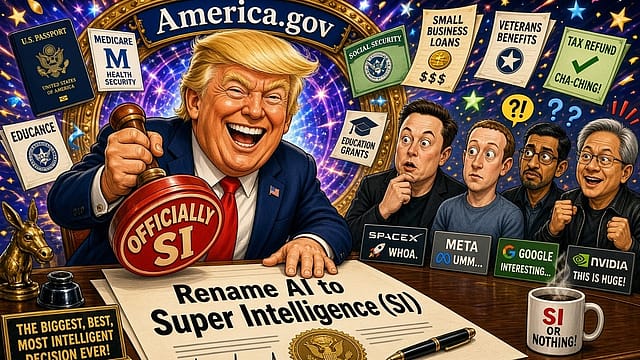
US President Donald Trump has signed an executive order directing federal agencies to replace “Artificial Intelligence” and “AI” with “Super Intelligence” and “SI” in official usage, alongside launching America.gov as a single digital gateway to government information and services.
The announcements on Tuesday followed a White House luncheon with leading technology executives, where Trump described the technology as “much bigger than the Internet” and discussed safety, national security and the demands that data centres place on local communities.
“We’re going to be renaming it Super Intelligence — officially renaming it,” Trump said ahead of the signing.
What the AI-to-SI Order Changes
Titled “Inaugurating the Era of Super Intelligence,” the order directs executive departments and agencies to adopt the new terminology in official correspondence, public communications, websites, reports and administrative policy documents, to the maximum extent permitted by law.

Losing Memory
16 Oct 2026 - Vol 05 | Issue 42
The making of a medical and social emergency
The change will not retroactively alter previously issued regulations, existing government contracts, grants or historical archival records.
Explaining the decision, the order argues that technologies developed by American companies have outgrown the original, 70-year-old framework of “artificial intelligence”.
“The capabilities of today’s frontier systems do much more than imitate or automate discrete aspects of human intelligence,” it states, pointing to their growing applications in science, medicine and creativity.
For now, the administration will apply the existing statutory definition of artificial intelligence under Title 15 of the United States Code to “Super Intelligence”. The order gives the Assistant to the President for Science and Technology 60 days to submit proposed legislative language to Congress establishing an updated definition and recommending corresponding changes to federal laws.
The immediate effect is therefore a change in executive-branch terminology, with a revised statutory definition to be proposed separately.
America.gov: A Single Door to Federal Services
Trump also unveiled America.gov alongside US Chief Design Officer Joe Gebbia, presenting the portal as a way to simplify how Americans interact with the federal government.
“For our entire lives, we’ve become used to a government so big, it makes the citizen feel very, very small — but with America.gov, the entire U.S. government will fit in the palm of your hand,” he said.
The platform is designed to let users ask questions in plain language and receive verified government information through what the administration calls Super Intelligence technology. Services such as passport renewals and Medicare enrolment are expected to become available directly through the portal in the coming months.
A separate executive order directs agencies to integrate covered public-facing services that handle more than 100,000 users annually into America.gov. National-security-sensitive services and Internal Revenue Service tax filing are excluded.
According to the White House, the initiative aims to reduce bureaucracy and the estimated 10 billion hours Americans spend each year dealing with federal paperwork.
Tech Leaders Discuss Safety and Data Centres
The White House luncheon brought together executives including Elon Musk, Mark Zuckerberg, Sundar Pichai and Jensen Huang. Discussions covered a White House Accord focused on developing the technology safely and responsibly.
“We want to give the American people and our customers confidence that the technology works in the way we intended,” said Meta CEO Zuckerberg.
Anthropic CEO Dario Amodei stressed the need for cooperation between the industry and the administration.
“We all need to work together to make sure that we can win and we can win safely,” he said.
Trump also called on technology companies to build partnerships with communities hosting data centres, including financial support and assistance for local schools and teachers.
“They’re going to work with local communities for the data centers, in particular — and they’re going to work to make the community happy,” he said.
With inputs from ANI