A new Ayatollah in the saddle as the Persian Gulf war expands its ambit
A plethora of sources in Washington D.C. point to the existence of confusion within the Trump Administration with respect to the war in Iran. The single question today plaguing the administration in the US capital is what next after the death of Ayatollah Ali Khamenei and 40 of his closest advisers on 28 February?
Is there anyone in charge in Tehran who has the authority to talk to the US about ending the war?
It is now crystal clear that Khamenei was a wily leader who planned that his death could never be used as a means to stop what came after it. Since the June 2025 war, Tehran recalibrated its military doctrine from a strategy of defensive containment to an explicitly offensive asymmetric posture. Consequently, today it has formally embraced an earlier and more extensive use of regional missiles, drones, cyber-attacks, and energy coercion. This changed doctrine was written down, institutionalized, and trained into every unit, at every level of Iran's military structure, in the nine months between the June 2025 ceasefire and the 28 February 2026 air strikes. Iran has pivoted to a quick decentralised retaliatory response to US-Israeli bombing and has demonstrated that its system has unity, resilience, command, and control, during severe wartime conditions.

Zeroing In on ECI
09 Oct 2026 - Vol 05 | Issue 41
Constitutional legitimacy versus political opportunism
Every IRGC unit that has been firing missiles and drones at Gulf energy infrastructure, at US bases, at Dubai’s Fairmont Hotel, at the US embassy compound in Riyadh, at the US 5th Fleet HQ in Bahrain, every one of those units, is executing a pre-written, pre-authorized, pre-distributed operational plan.
The Soufan Centre in New York, one of the most respected counterterrorism and geopolitical analysis organizations in the world, is telling its clients that every Iranian signal about negotiations, including the signal that Trump told the Atlantic magazine he had received from Iran's “new” troika leadership, is merely tactical positioning.
The missiles flying right now are not flying on anyone's current orders. They are flying on orders that were issued by a dead man. The current situation in the Iranian war zone describes something that military historians will study for the next century. It is a form of strategic pre-authorization that has no exact precedent in modern warfare. It explains why every ceasefire attempt, every Italian mediator, every Trump phone call, every European diplomatic channel, every Russian back channel has produced nothing but rejection or silence. It is now clear that Khamenei designed this war to run without him.
And there is a paradox. One batch of interlocutors from the besieged Iranian government are telling Trump negotiations are possible; another batch of interlocutors are telling the world that negotiations will not happen.
That is not a contradiction inside Iranian politics. That is a pre-planned unique dual track strategy which assists diplomatic signalling to manage international pressure, while military operations continue uninterrupted. This operating strategy is run by commanders who do not need political authorization to keep firing, because their authorization was issued months ago by a man who is no longer alive to revoke it.
When Trump’s envoy Zalmay Khalilzad negotiated with the Taliban in Doha in 2020, the negotiation worked because the Taliban leadership had authority over the Taliban fighters. The Doha agreement held because the men who signed it could issue orders that would be followed. The US refrained from killing at least two or three senior Taliban commanders capable of representing the organization and binding it to agreements. These were men the US could have killed, but chose not to, because it needed someone to negotiate with when it wanted the Afghan war to end.
However, this time in Iran, the US killed everyone it could identify in the leadership succession ladder.
There is a concept in nuclear deterrence strategy known as "the Dead Hand." This was introduced in the Soviet Union and known there as “Perimeter” and was an automated nuclear command-and-control system designed to guarantee a retaliatory strike even if the Soviet leadership was destroyed by a pre-emptive U.S. attack. Developed in the 1980s, this "doomsday machine" used sensors to detect nuclear explosions and, if communication with the topmost command was lost, could initiate a full-scale ICBM missile launch.
Khamenei built Iran's version of the dead hand; not nuclear but a conventional drone-based, decentralized, and pre-authorized system; operating without a central command, but structurally identical in its logic. Khamenei’s plan was to push the Persian Gulf’s pain threshold to force a ceasefire while the regime was still standing. This was to be executed postmortem by commanders he had pre-authorized.
Iran is sending diplomatic signals to manage international pressure while Khamenei's operational plan continues to be rolled out at every level below the political leadership. The signals say we might talk. The missiles say we will not stop. And the commanders firing the missiles are operating on orders that predate every conversation about negotiation. The US killed Khamenei and Khamenei had already killed the negotiation.
But Khamenei’s plan also concealed an ace of spades that has now been revealed.
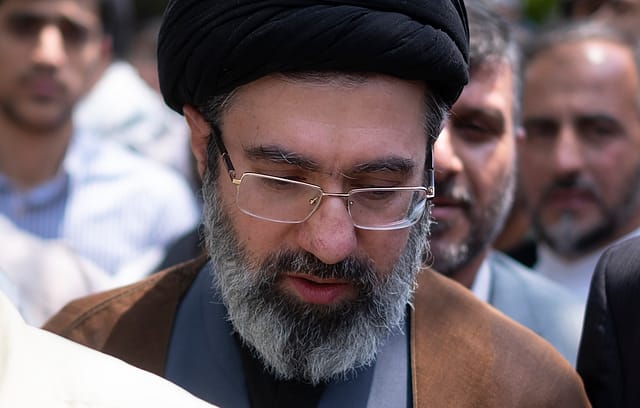
Mojtaba Khamenei the son of the slain leader was elected as the new Supreme Leader, taking over from temporary Supreme Leader Ayatollah Arafi. This is bad news for Trump. Initially considered dead, Mojtaba is a former member of the IRGC and the Basij, The Basij is formally known Sâzmân-e Basij-e Mostaz’afin ‘Organization for Mobilization of the Oppressed' and is a paramilitary volunteer militia within the IRGC and one of its five branches. It acquired combat experience in the Iran-Iraq war.
More moderate than Arafi, Mojtaba nonetheless believes in enforcing the regimes’ beliefs through toughness. Mojtaba was the key figure that leveraged IRGC forces and secret police to crush down the 2009 protests against his father’s regime. These crackdowns were ones where reports included protestors beaten to death, dragged through the streets, hung from public cranes, and where rape was used as a weapon of compliance. Mojtaba strongly believed in his father’s regional ambitions and believed Iran should leverage the Basij paramilitary group, as well as its proxies in Hezbollah and Yemeni Rebels, to expand Iranian influence.
Trump said that the 28 February attack was so successful, it knocked out all the candidates on America's list for who would come next. Mojtaba was not on America's list. He survived because he was not visible enough to be on a targeting list. The Mojtaba Khamenei succession dimension completes the picture of the strategic landscape of the first 6 days. Because if Iran's next supreme leader is the dead supreme leader's son, every calculation the US made about post Khamenei Iran becomes irrelevant.
Simultaneously, as Mojtaba was crowned, the Gulf states now face what is turning out to be a consequence comedy planned specifically for them. Their interceptors are depleting. Their LNG terminals are shut. Their oil refineries are shut. Their hotels are burning. Their property markets are collapsing. Their tourists are gone. And the man whose death was supposed to produce their liberation from Iranian pressure, left instructions before he died, that every unit in Iran's military received and is executing cast iron instructions, with a specific intent of making every Gulf government that hosted an American base understand personally, economically, and permanently, the cost of that decision.
Mojtaba Khamenei, a 55-year-old former IRGC intelligence officer and his father's closest ideological heir, is executing his father's pre-authorized operational plan against US assets across 15 countries at last count.
The Khamenei succession plan has done something that no central bank policy, no trade tariff, no technology cycle can easily reverse. It has simultaneously raised the price of energy. Brent Crude is trading at $ 82.62 at the time of writing because of the closure of the shipping lanes through which 20% of global oil trade moves, and has created the realistic prospect of a 5-week or longer conflict that keeps all of those above pressures indefinitely in place. The focus will now be on whether Iran can escalate its attacks on the production facilities of the Persian Gulf’s key marginal energy suppliers.
The key marginal energy suppliers are not the already targeted Qatari gas works at Ras Laffan that have already shut; not the Saudi refinery at Ras Tanura that has already stopped. The key marginal suppliers are the facilities that have not yet been struck. Saudi Aramco's Abqaiq plant is the world's largest oil processing and crude stabilization facility, located in Saudi Arabia's Eastern Province. It processes up to 7 million barrels daily—about 7% of global supply—converting sour crude into sweet crude. The Ghawar oilfield, located about 100km southwest of Dhahran in the Al Hasa Province of Saudi Arabia, is the world’s biggest conventional oil field both by oil reserves and production whose output underpins Saudi Arabia's entire export capacity. The offshore platforms in ADNOC’s Upper Zakum and Umm Lulu fields. The Kuwaiti export terminals at Mina Al-Ahmadi Refinery whose 1.7 million barrel per day capacity feeds refineries in Asia that have no alternative source.
If any one of those facilities is struck, not destroyed, just disrupted, the oil price trajectory that US Bank JP Morgan has modelled, does not stop at $100 per barrel. This number if crossed triggers a cascade of corporate cost increases; airlines, shipping companies, chemical manufacturers, food producers, every company whose input costs include energy or whose products travel by sea. That begins appearing in quarterly earnings reports within weeks. And those earnings reports, the first of which arrives next month in April will be the moment when global stock markets assumption that wars do not materially damage corporate profits, gets tested against the actual profit and loss statements of companies that spent March 2026 buying jet fuel at 60% premium and shipping cargo through a strait that the US Navy was escorting at gunpoint.
South Korea's KPI was the world's hottest major index till 28 February 2026. It broke 6,000 for the first time in history on 25 February 2026. It hit an all-time high above 6347 days before the war started. On Tuesday, 3 March, it lost 7.24% in a single session, wiping out $270 billion that took months to build because two Iranian drones found an energy facility in Ras Laffan and a water tank in Mesaieed and Qatari Energy shut off 20% of global LNG supply. South Korea, the country that runs a massive trade surplus and semiconductors, imports virtually all of its energy. And the Strait of Hormuz carries a critical share of that energy. And the Strait is now conditionally closed at Iran's discretion, while the US Navy announces it will escort oil tankers if necessary. The same navy whose 5th fleet headquarters in Bahrain have been struck, whose USS Abraham Lincoln came under fire, whose three F-15s are debris in Kuwait because of friendly fire.
The map of this war by Wednesday 5 March 2026 , covered Iran, Iraq, Saudi Arabia, Qatar, Kuwait, Bahrain, UAE, Oman, Jordan, Israel, Lebanon, Yemen, Cyprus, Turkey, the Red Sea, the Arabian Sea, the Gulf of Oman, the Arabian Sea, the Eastern Mediterranean, and the Indian Ocean off the coast of Sri Lanka, where a US submarine conducted the first US submarine torpedo kill since World War II.
The IRIS Dena, was a Moudge-class frigate in the Southern Fleet of the Iranian Navy and its most modern surface combatant. It now lies on the ocean floor off Sri Lanka. Its 80 dead sailors distributed across the Indian Ocean. Its 32 survivors rescued by the Sri Lankan Navy. The ship was equipped with both SAM and ASM missiles. It also had an armament of four Ghader anti-ship missiles, a 76 mm naval gun, a 40 mm Fath-40 AA cannon, a 30 mm Kamand anti-aircraft defense cannon, two 20 mm Oerlikon cannons, two 12.7 mm heavy machine guns, and two 533mm Valfajr triple torpedo launchers. Dena transmitted a distress call at 05:08 hrs (UTC+05:30), 40 nautical miles off the coast of Galle, Sri Lanka. Sources indicate that it was positioning itself to lock on to the USS Abraham Lincoln in the northern Arabian Sea.
It is believed that Ayatollah Mojtaba was so incensed when he heard of the sinking of the Dena that he ordered a retaliatory ballistic missile hit on the US base at Incirlik in Turkey. Incirlik air base contains US B-61 nuclear gravity bombs, between 50 and 60 of them, according to arms control organizations with access to NATO nuclear sharing estimates. These bombs are stored in hardened underground WS3 vaults.
A NATO destroyer in the eastern Mediterranean shot down the missile in flight as it headed toward Turkish airspace, marking the first time the alliance stepped in to defend a member state since the US and Israel began attacking Tehran last week. Turkish officials said that Turkey was not a target of the strike. They stated that it was targeted at a base in Greek Cyprus but veered off course. Aimed at a base in Greek Cyprus or aimed at Incirlik? Turkish officials gave one explanation on background. NATO published its condemnation without specifying the intended target and Iran has not commented.
But the geometry of the trajectory crossing Iraq, crossing Syria, entering the eastern Mediterranean at an angle that interceptors from a NATO destroyer in the Mediterranean engaged, is the trajectory of a missile that knew where it was going. It can be argued that the war’s geography has on 4 March crossed the threshold that every war game, every deterrence model, every alliance commitment in the post-WWII international system was designed to make uncrossable.
The days ahead will reveal more.