Tech, Intellect & ‘Superman’: How Arun Jain designed his tech nirvana
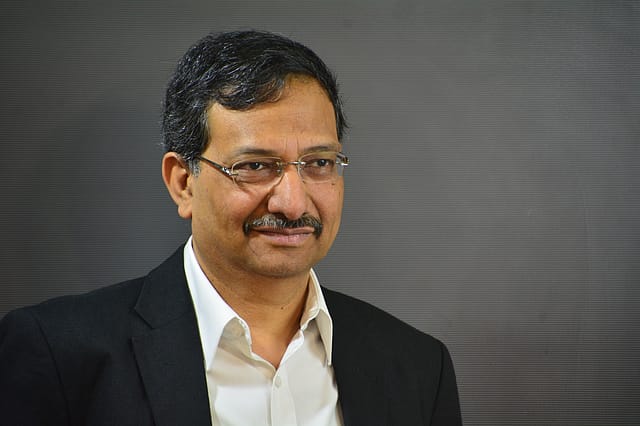
He thought he was invincible. Until the universe reminded him, he wasn’t.
Long before Arun Jain became the force behind Intellect Design Arena, he drifted into a ‘superman mode’—a dangerous altitude where passion turns into delusion and confidence slips into overreach. Twice in his entrepreneurial journey that mode betrayed him. Twice it cost him dearly. And twice he had to climb down, dust himself off, and confront a truth he now shares with disarming candour. “End of the day, even entrepreneurs are men. They are not superman,” he reckons in a freewheeling interview.
But before the ‘superman’ illusions, came the boy who was stacked against circumstances he had no business overcoming.
As a child, Jain struggled to stay in school. His father’s modest salary had to stretch across ten siblings; education felt like a borrowed luxury. But scarcity has a way of sharpening instinct. Jain reportedly earned his first profit—Rs 30 — from a food stall at a school festival. A sliver of money, but a telling spark.
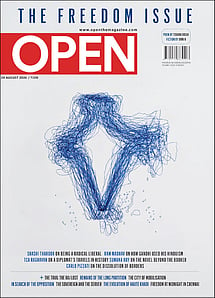
Freedom Issue 2026
14 Aug 2026 - Vol 05 | Issue 33
Shashi Tharoor on being radical liberal | Ram Madhav on how Gandhi used his Hinduism | TCA Raghavan on a diplomat's travels in history | Sumana Roy on the novel beyond the Booker | Carlo Pizzati on the dissolution of Borders
If school wired him for enterprise, college ignited the flame. After graduating in electrical engineering from Delhi College of Engineering in 1983, Jain and two seniors founded International Information Systems. The early years were scrappy: part-time projects, meagre money, and relentless hustle. But the taste of building something from nothing had seeped into his bloodstream.
A UNICORN IN 90s, GALLOPING SUCCESS
In 1986, he doubled down and started Nucleus Software Workshop. Seven years later came the turning point that would alter his trajectory: the launch of Polaris Software Lab in 1993.
Success came quickly.
By 1999, Polaris went public. “We were India’s first bootstrapped unicorn,” Jain smiles, referring to the billion-dollar valuation the company touched. “In 1999, the term ‘unicorn’ didn’t exist,” he recounts, adding that the word was missing in the startup vocabulary. Over the next few years, the company witnessed high-octane growth: a blistering CAGR of over 100% between 1993 and 2000.
It was a dream run. And then the dream changed. Why? Remember the dotcom crash?
In 2000, the dotcom bubble burst, vaporising companies overnight. “A lot went bust and a few survived,” recalls Jain. Polaris was among the survivors. Why? Because it never behaved like a generic services’ shop. “We always had a laser-sharp focus on technology,” Jain says. No wonder, by 2001, Polaris touched a revenue of Rs 296 crore with a deep focus on financial technology sourcing for the BFSI (banking, financial services, and insurance) industry.
MASTERSTROKE & SUPERMAN MODE
Success bred more success. And then it brought the second turning point.
In 2002, Polaris announced the merger of Citigroup’s technology arm, OrbiTech Solutions. Overnight, the combined entity ballooned into a 3,800-strong organisation with revenues reportedly crossing Rs 600 crore. It was hailed as a masterstroke. The coming together of two powerful BFSI technology players was a move expected to reset the rules of the game.
It did. But it also reset something inside Jain.
“I got into superman mode,” he admits. The merger fed a dangerous illusion that he could handle everything, know everything, fix everything. It wasn’t arrogance as much as momentum. Success had been unbroken for nearly a decade. The result? Invincibility quietly crept in.
The universe, though, moved quickly to correct it.
The OrbiTech integration unleashed a deluge of work. Businesses multiplied. Priorities blurred. “I had too much on my plate. There were too many businesses to take care of, and I couldn’t do justice to any,” he recalls. The man who once thrived on complexity suddenly found himself drowning in it.
Mistakes followed.
One of the costliest was hiring the brightest names in the industry for top roles. The assumption was simple: star talent would automatically translate into stellar outcomes. “I believed they would do a fabulous job. The gambit didn’t work,” says Jain.
Jain, though, doesn’t fault the hires. He faults the assumption. The result was a drop in business focus, a dip in execution, and a founder forced to confront an uncomfortable truth. “Maybe I was the impediment rather than the enabler,” he says quietly.
TURBULENCE AHEAD & MAKEOVER TIME
Success, however, can be deceptive. Whatever be the input, the output was undesirable. The streak of seamless victories had snapped.
And then came another hard fall.
In December 2002, at the end of an already turbulent year, Jain was detained by Indonesian authorities over a commercial dispute between Polaris and a local bank. It was a jolt: sudden, public, and deeply personal. It resolved in a few weeks but the scars remained. And over the next few years, the cumulative weight of everything that had happened between 2000 and 2002 began to show. “Between 2002 and 2006, the business stagnated. We survived but we didn’t ride the outsourcing wave like our peers,” says Jain. While rivals were growing 50–60% year after year, Polaris inched forward at 15–20%. “Our services business slowed down,” he recalls.
Yet in that long, grey period lay the seed of his next transformation.
For Jain, the silver lining came wrapped in clarity: he no longer wanted to live in the comfort zone of services. “I had an intellectual arrogance about the product,” he says. “Service business is a garage business.” He doesn’t dismiss the value created by Indian IT services firms, but he believes such models ultimately breed complacency. “Services become a comfort zone. And comfort is not sustainable,” he says.
So, he did something unthinkable.
In March 2014, Polaris demerged its product business—Intellect—into an independent entity. By December, Intellect Design Arena listed on the Bombay Stock Exchange at Rs 69 per share. Jain hired a battery of CEOs to scale each business line.
As he puts it, “As an entrepreneur, I thought I had all the strength to run two companies. So, hiring CEOs made sense.” It was, in hindsight, another ‘superman’ move.
Eighteen months later, the cape slipped.
“The DNA of a product company is extremely different from a service company,” he admits. The result was mounting frustration, stalled momentum, and a founder once again confronting his limits. “End of the day, even entrepreneurs are men. They are not superman.”
THINKABKLE, UNTHINKABLE & PRICELESS TEACHING
Then came the next unthinkable.
In November 2015, Jain exited Polaris by selling his 53% stake to US-based Virtusa. “I let go of the most profitable thing I had,” he says. Polaris was throwing up nearly Rs 200 crore in annual profit. Intellect, on the other hand, was bleeding. “Intellect was consuming Rs 300 crore a year,” he says. He chose loss over profit, vulnerability over comfort, and purpose over predictability.
Why? Because for Jain, the math goes deeper than numbers. “The profits from Polaris were food for the body. But they weren’t enriching the soul,” he says. His energy, he insists, comes from creating IP, building design-led businesses, and attempting what few dare to try. “My energy comes from doing the unthinkable, not mundane stuff.”
Three years later, the world threw another unthinkable his way: Covid. “It was a big crisis moment for the company,” recalls Jain. Business suffered, debt mounted, and uncertainty thickened. But Intellect endured.
Fast forward to December 2025.
Intellect Design Arena traded at Rs 1,102, up from Rs 69 at listing. In Q2 FY26, revenue rose 34% year-on-year to Rs 789 crore; cash and cash equivalents climbed to Rs 927 crore; EBITDA jumped 68% to Rs 184 crore; and PAT nearly doubled to Rs 102 crore.
The numbers glowed. But Jain’s pride comes from something else.
“Failures are your biggest teachers,” he says. “They make you get off your high horses. They make you realise humility is the biggest virtue.”
Ask him about today’s startup ecosystem and his voice carries a candid edge: “Don’t learn to ride a car from someone who has never driven a car.”
Too many people without entrepreneurial experience, he believes, have become mentors and venture capitalists. “For them, business is an Excel sheet. They can be good managers, but never good mentors.”
Then comes the line that sums up his worldview: “At times, people with capital behave like new-age zamindars. But can they empathise with the pain of the tiller of the land?” His answer is firm. “This zamindaari system will not foster entrepreneurship.”
And with that, Arun Jain signs off. He built, stumbled, rebuilt, and did unthinkable more often than the conventional. At times, for entrepreneurs, strength lies not in the cape, but in knowing when to take it off.